
The Effect of Halopriming with KNO3 and CaCl2 Solutions on Seed Germination and Vigor of Chinese Mustard
DOI:
https://doi.org/10.14456/jare-mju.2025.44Keywords:
seed enhancement, seed dormancy, low germination, speed of germination, seed vigorAbstract
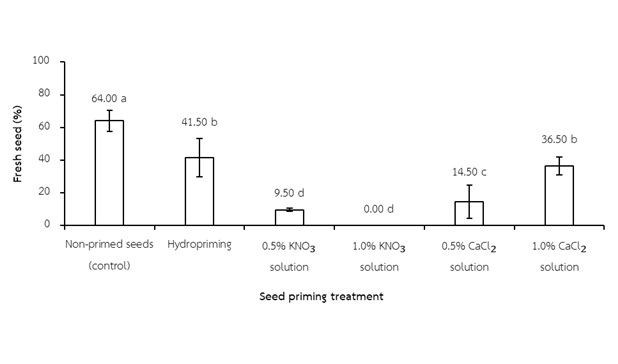
Imported Chinese mustard seeds may exhibit secondary seed dormancy due to unsuitable environmental conditions during transportation or storage, such as high temperatures, leading to high seed dormancy (64.00%) and low germination (32.50%). Therefore, this research investigated seed enhancement through seed priming using KNO3 and CaCl2 solutions. A completely randomized design was used, comprising six treatments: non-primed seeds (control), seed priming with reverse osmosis water (hydropriming), and priming with 0.5 and 1.0% KNO3 or CaCl2 solution. Seeds were soaked for 6 hours at 20±2°C, after which the moisture content of the seeds was reduced to approximately 7%, which approximated the initial moisture content. The results showed that seed priming of Chinese mustard with 1.0% KNO3 solution resulted in the highest percentages of radicle emergence and germination of 95.50 and 93.50%, respectively, when compared with non-primed seeds (32.50 and 31.00%, respectively). Moreover, the primed seeds with 1.0% KNO3 solution were highly vigorous, which had the time to reach 50% radicle emergence (0.60 days), days to emergence (1.21 days), time to reach 50% germination (2.78 days) and mean germination time (3.62 days). These times were faster than those of non-primed seeds (1.84, 2.76, 4.08 and 4.76 days, respectively). In conclusion, priming Chinese mustard seeds with 1.0% KNO3 solution for 6 hours at 20±2°C is the best method as it resulted in the highest radicle emergence, germination and speed of germination.
References
Agricultural Regulatory Office. 2024a. List of quantity and value of imported controlled seeds in 2024 (1 January to 31 December 2024). [Online]. Available https://www.doa.go.th/ard/wp-content/uploads/2025/01/import-seed-2567-Plant-list.pdf (July 7, 2025). [in Thai]
Agricultural Regulatory Office. 2024b. List of imported controlled seeds by country in 2024 (1 January to 31 December 2024). [Online]. Available https://www.doa.go.th/ard/wp-content/uploads/2025/01/import-seed-2567-Plant-list.pdf (July 7, 2025). [in Thai]
Alboresi, A., C. Gestin, M.T. Leydecker, M. Bedu, C. Meyer and H.N. Truong. 2005. Nitrate, a signal relieving seed dormancy in Arabidopsis. Plant, Cell and Environment 28(4): 500–512.
Anschutz, U., D. Becker and S. Shabala. 2014. Going beyond nutrition: regulation of potassium homoeostasis as a common denominator of plant adaptive responses to environment. Journal of Plant Physiology 171(1): 670–687.
Awan, S, S. Footitt and W.E. Finch-Savage. 2018. Interaction of maternal environment and allelic differences in seed vigour genes determines seed performance in Brassica oleracea. Plant Journal 94(6): 1098–1108.
Baskin, C.C. and J.M. Baskin. 2020. Breaking seed dormancy during dry storage: a useful tool or major problem for successful restoration via direct seeding? Plants 9(5): 636. https://doi.org/10.3390/plants9050636
Batool, A., K. Ziaf and M. Amjad. 2015. Effect of halo-priming on germination and vigor index of cabbage (Brassica oleracea var. capitata). Journal of Environmental and Agricultural Sciences 2(1): 1–7.
Bhat, R.A., F.U. Khan, I.T. Nazki, Z.A. Bhat, F.A. Khan, J.A. Wani, A. Manzar, Neelofar, Q. Altaf, N.H. Masoodi. 2023. Effect of potassium nitrate and calcium chloride priming on germination and seedling growth of honesty (Lunaria annua L.). Environment and Ecology 41(1C): 599–604.
Chanprasert, W. 2010. Seed Physiology. Bangkok: Kasetsart University Press. 167 p. [in Thai]
Coolbear, P., A. Francis and D. Grierson. 1984. The effect of low temperature pre-sowing treatment on the germination performance and membrane integrity of artificially aged tomato seeds. Journal of Experimental Botany 35(1): 1609–1617.
Dhillon, N.P.S. 1995. Seed priming of male sterile muskmelon (Cucumis melo L.) for low temperature germination. Seed Science and Technology 23(3): 881–884.
Ellis, R.H. and E.H. Roberts. 1980. Improved equation for the prediction of seed longevity. Annals of Botany 45(1): 13–30.
Hanson, J.B. 1984. The Function of Calcium in Plant Nutrition. pp. 149–208. In Tinker, P.B. and A. Louchli (eds.). Advances in Plant Nutrition. New York: Praeger Publishers.
Hendricks, S.B. and R.B. Taylorson. 1974. Promotion of seed germination by nitrate, nitrite, hydroxylamine and ammonium salts. Plant Physiology 54(3): 304–309.
Hepler, P.K. 2005. Calcium: a central regulator of plant growth and development. The Plant Cell 17(8): 2142–2155.
Hilhorst, H.W.M. and C.M. Karssen. 1988. Dual effect of light on the gibberellin and nitrate-stimulated seed germination of Sisymbrium officinale and Arabidopsis thaliana. Plant Physiology 86(1): 591–597.
Hilton, J.R. and J. Thomas. 1986. Regulation of pregerminative rates of respiration in seeds of various weed species by potassium nitrate. Journal of Experimental Botany 37(10): 1516–1524.
International Seed Testing Association. 2025. International Rules for Seed Testing. Wallisellen: International Seed Testing Association (ISTA). 320 p.
Jompuk, C. 2012. Statistics: Experimental Design and Data Analysis in Plant Research using “R”. Bangkok: Kasetsart University Press. 350 p. [in Thai]
Kirosassefa, M., R. Hunje, R.V. Koti and N.K. Biradarpatil. 2010. Enhancement of seed quality in soybean following priming treatments. Karnataka Journal of Agricultural Sciences 23(1): 780–787.
Kumar, A.H. and P.K. Rai. 2021. Influence of different pre-sowing seed priming on plant growth, yield and yielding attributing traits of mustard (Brassica juncea L. Czern and Coss). Journal of Crop and Weed 17(2): 235–239.
Lara, T.S., J.M.S. Lira, A.C. Rodrigues, M. Rakocevic and A.A. Alvarenga. 2014. Potassium nitrate priming affects the activity of nitrate reductase and antioxidant enzymes in tomato germination. Journal of Agricultural Science 6(2): 72–80.
Lin, D., Y. Huang, J. Zhao, Z. Wu, S. Liu, W. Qin, D. Wu, H. Chen and Q. Zhang. 2020. Evaluation of seed nitrate assimilation and stimulation of phenolic-linked antioxidant on pentose phosphate pathway and nitrate reduction in three feed-plant species. BioMed Central Plant Biology 20(1): 267. https://doi.org/10.1186/s12870-020-02453-w
MacDonald, M.T. and V.R. Mohan. 2025. Chemical seed priming: molecules and mechanisms for enhancing plant germination, growth and stress tolerance. Current Issues in Molecular Biology 47(3): 177. https://doi.org/10.3390/cimb47030177
Matakiadis, T., A. Alboresi, Y. Jikumaru, K. Tatematsu, O. Pichon, J.P. Renou, Y. Kamiya, E. Nambara and H.N. Truong. 2009. The Arabidopsis abscisic acid catabolic gene CYP707A2 plays a key role in nitrate control of seed dormancy. Plant Physiology 149(2): 949–960.
McDonald, M.B. 2000. Seed Priming. pp. 287-325. In Michael, B. and J.D. Bewley (eds.). Seed Technology and Its Biological Basis. Sheffield: Academic Press.
McIntyre, G.I., A.J. Cessna and A.I. Hsiao. 1996. Seed dormancy in Avena fatua: Interacting effects of nitrate, water and seed coat injury. Physiologia Plantarum 97(2): 291–302.
Na Nakorn, P. and P. Kaewsorn. 2021. Effects of KNO3 concentration and aeration during seed priming on seed quality of wax gourd (Benincasa hispida [Thunb.] Cogn.). Agriculture and Natural Resources 55(1): 877–885.
Openña, R.T. 1993. Brassica juncea (L.) Czernjaew. pp. 104–108. In Siemonsma, J.S. and K. Piluek (Eds.). Plant Resources of South-East Asia, No. 8 Vegetables. The Wageningen: Pudoc Scientific Publishers.
Reina, F.G. and L.A. Pascual. 2001. Influence of a stationary magnetic field on water relations in lettuce seeds part I theoretical considerations. Bioelectromagnetics 22(8): 589–595.
Reina, F.G., L.A. Pascual and I.A. Fundora. 2001. Influence of a stationary magnetic field on water relations in lettuce seeds part II experimental results. Bioelectromagnetics 22(8): 596–602.
Srivastava, A.K., V.H. Lokhande, V.Y. Patade, P. Suprasanna, R. Sjahril and S.F. D’Souza. 2010. Comparative evaluation of hydro-, chemo-, and hormonal priming methods for imparting salt and PEG stress tolerance in Indian mustard (Brassica juncea L.). Acta Physiologiae Plantarum 32(6): 1135–1144.
Suresh, K., R.K. Mandal, Chetna, A. Balakoti, K.A. Dora and K.P. Raju. 2025. Effect of seed priming treatments on seed quality characteristics in Indian mustard (Brassica juncea L. Czern & Coss). Plant Archives 25(Suppl. 1): 2629–2633.
The Secretariat of the Cabinet. 2013. Announcement of Ministry of Agriculture and Cooperatives on Standard Quality and Storage of Controlled Seed (Vol. 2) B.E. 2556. pp. 32–33. In Royal Thai Government Gazette 130(Special 148 Ng) (October 31, 2013). [in Thai]
Thomas, J., K.M. Kuruvilla and T.K. Hrideek. 2004. Mustard. pp. 388-398. In Peter, K.V. (ed). Handbook of Herbs and Spices, Volume 2. Sawton, Cambridge: Woodhead Publishing Limited.
Trewavas, A.J. and R. Malhó. 1997. Signal perception and transduction: the origin of phenotype. The Plant Cell 9(7): 1181–1195.
Verma, B. and P. Mathur. 2022. Seed priming: types and importance. Just Agriculture 2(6): 1–4.
Wang, Y. and W.H. Wu. 2013. Potassium transport and signaling in higher plants. Annual Review of Plant Biology 64(1): 451–476.
Downloads
Published
How to Cite
Issue
Section
License
Copyright (c) 2025 Journal of Agricultural Research and Extension

This work is licensed under a Creative Commons Attribution-NonCommercial-NoDerivatives 4.0 International License.
This article is published under a Creative Commons Attribution-NonCommercial-NoDerivatives 4.0 International License (CC BY-NC-ND 4.0), which allows others to share the article with proper attribution to the authors and prohibits commercial use or modification. For any other reuse or republication, permission from the journal and the authors is required.