Value-Added Composting of Corn Cobs for Environmental Solutions in Ban Kha Subdistrict, Lampang Province
DOI:
https://doi.org/10.14456/jare-mju.2026.14Keywords:
static pile composting Maejo Engineering Formula 1, corn stover, greenhouse gas reduction, cost analysisAbstract
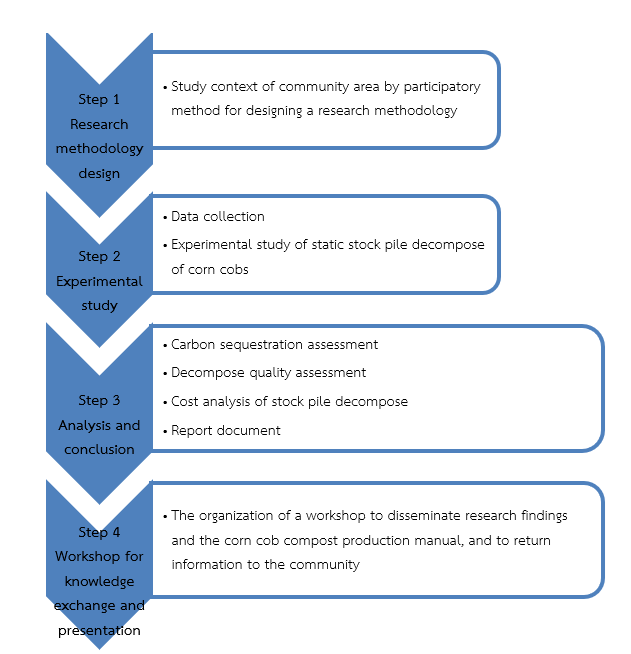
This research was a participatory community-based action research (CBPAR) study. The objectives were to evaluate the efficiency of compost production from corn cob residues using the non-turned Maejo Engineering Method 1 recipe in three aspects: (1) carbon sequestration and reduction of greenhouse gas emissions; (2) compost quality from different types of corn cob residues; and (3) compost production cost. The sample group included five volunteer corn farmers from Ban Kha sub-district, Mueang district, Lampang province, as well as twelve representatives from the sub-district Administrative Organization, including community development staff, village leaders, and headmen. Three types of research instruments were used: focus group record forms, experimental record forms, and questionnaires. Data were analyzed using frequency, percentage, mean, standard deviation, and content analysis. The results demonstrated that compost production was highly efficient in reducing greenhouse gas emissions, decreasing from 2,914.82 kg carbon equivalent (baseline) to only 556.59 kg carbon equivalent, a reduction of 2,358.23 kg, or 80.9%. For compost quality, pile 1 (shredded corn cobs) provided the best results, with 40.4% organic matter, meeting Grade 1 standards for most parameters, except phosphorus (P2O5), which was 0.23%, lower than the standard. Cost analysis showed a total production cost of 8,102 THB, or 1.69 THB per kilogram of raw material, with major cost components consisting of raw material (51.8%), labor and fuel (26.3%), equipment rental (12.3%), and additives (9.5%). Farmers expressed a high level of satisfaction with the research findings and publication manual, with overall satisfaction rated as high.
References
Highland Research and Development Institute (Public Organization). 2024. Compost helps reduce burning and benefits us economically (How). Retrieved from https://hkm.hrdi.or.th/Knowledge/detail/714 [in Thai]
Keng, Z.X., J.J.M.Tan, B.L. Phoon, C.C. Khoo, I. Khoiroh, S. Chong, C. Supramaniam, A. Singh and G.T. Pan. 2023. Aerated static pile composting for industrial biowastes: from engineering to microbiology. Bioengineering 10(8): 938 https://doi.org/10.3390/bioengineering10080938
Lampang Provincial Commerce Office. 2024. The situation of maize procurement for animal feed, production year 2024/2025. Retrieved from https://lampang.moc.go.th/th/content/category/detail/id/104/iid/74130 [in Thai]
Luske, B. 2010. Reduced Greenhouse Gas Emissions due to Compost Production and Compost Use in Egypt. Driebergen: Louis Bolk Institute. 30 p.
Min, H., X. Huang, D. Xu, Q. Shao, Q. Li, H. Wang and L. Ren. 2022. Determining the effects of compost substitution on carbon sequestration, greenhouse gas emission, soil microbial community changes, and crop yield in a wheat field. Life 12(9): 1382 https://doi.org/10.3390/life12091382
Nammakhun, Y., P. Tongtanee and R. Nunta. 2025. The Project evaluation of the sustainable economic and social enhancement: the case study of Wiang Mok sub-district northern of Thailand. Community and Social Development Journal 26(2): 164–179. [in Thai]
Nordahl, S.L., C.V. Preble, T.W. Kirchstetter and C.D. Scown. 2023. Greenhouse gas and air pollutant emissions from composting. Environmental Science & Technology 57(6): 2235–2247.
Pookkaman, W. and A. Kantasa-ard. 2018. Cost reduction in the plantation of longan and mango by implementing the integrated agricultural cost reduction model and integer linear programming optimization model: case study of plantation area in Sakaeo province Thailand. Journal of Industrial Education 17(2): 13–22. [in Thai]
Popradit, A., J. Wiangnon, P. Jitrabiab and N. Pakvilai. 2022. Organic fertilizer application using leaf waste according to Maejo Engineering Method 1. Thai Environmental Engineering Journal 36(3): 47–54. [in Thai]
Ruairuen, W., N. Khammanee and P. Noparat. 2022. Production and properties of compost from agroforestry waste materials. Retrieved from https://wjst.wu.ac.th/index.php/stssp/article/view/25728 [in Thai]
Shen, B., L. Zheng, X. Zheng, Y. Yang, D. Xiao, Y. Wang, Z. Sheng, and B. Ai. 2024. Insights from meta-analysis on carbon to nitrogen ratios in aerobic composting of agricultural residues. Bioresource Technology 413(2024): 1-10 https://doi.org/10.1016/j.biortech.2024.131416
Thailand Greenhouse Gas Management Organization (Public Organization). 2025. Document for greenhouse gas reduction calculation LESS-WM-03: production of compost or soil conditioner from organic waste (8th ed.). Retrieved from https://ghgreduction.tgo.or.th/th/calculation/less-calculate-document/less-waste/item/550-less-wm-03.html [in Thai]
Thitanuwat, B., C. Polprasert and A.J. Englande Jr. 2016. Quantification of phosphorus flows throughout the consumption system of Bangkok Metropolis, Thailand. Science of The Total Environment 542: 1106–1116. https://doi.org/10.1016/j.scitotenv.2015.09.065 [in Thai]
Thola, J., P. Abdul Salam, S. Dhakal and E. Winijkul. 2022. Sustainable options for reducing open burning of corn residues: case study of Mae Chaem district, Thailand. Polish Journal of Environmental Studies 31(6): 5851–5861.
U.S. Department of Energy. 2025. A generic counterfactual greenhouse gas emission factor for life-cycle assessment of manure-derived biogas and renewable natural gas. Washington, DC: U.S. Department of Energy. 20 p
Wong, J.W.C. 2004. Composting and Compost Utilization in Agriculture. Hong Kong: Department of Biology, Hong Kong Baptist University. 34 p..
Yasmin, N., K. Samal, M. Jamuda and A. Panda. 2022. Emission of greenhouse gases (GHGs) during composting and vermicomposting: measurement, mitigation, and perspectives. Energy Nexus 7: 100092 https://doi.org/10.1016/j.nexusenerg.2022.100092
Downloads
Published
How to Cite
Issue
Section
License
Copyright (c) 2026 Journal of Agricultural Research and Extension

This work is licensed under a Creative Commons Attribution-NonCommercial-NoDerivatives 4.0 International License.
This article is published under a Creative Commons Attribution-NonCommercial-NoDerivatives 4.0 International License (CC BY-NC-ND 4.0), which allows others to share the article with proper attribution to the authors and prohibits commercial use or modification. For any other reuse or republication, permission from the journal and the authors is required.


