
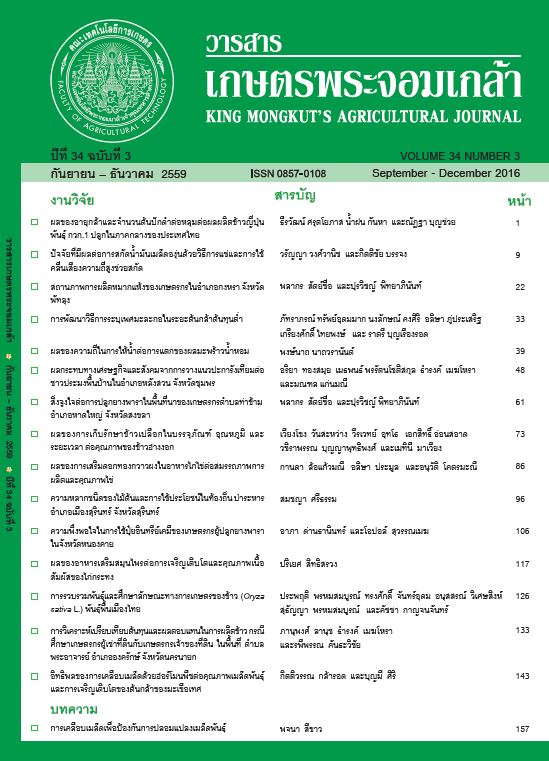
ปัจจัยที่มีผลต่อการสกัดน้ำมันเมล็ดองุ่นด้วยวิธีการแช่ และการใช้คลื่นเสียงความถี่สูงช่วยสกัด
Article Sidebar
Main Article Content
บทคัดย่อ
เมล็ดองุ่นพันธุ์ชีราซ (Vitis vinifera cv Shiraz) มีปริมาณน้ำมันทั้งหมดร้อยละ 13.61 โดยน้ำหนักแห้ง นำ
มาสกัด เป็นน้ำมันเมล็ดองุ่น งานวิจัยนี้มีวัตถุประสงค์เพื่อศึกษาปัจจัยที่มีผลต่อการสกัดน้ำมันเมล็ดองุ่น ได้แก่
อัตราส่วนของตัวทำละลายต่อผงเมล็ดองุ่น และระยะเวลาในการสกัด เพื่อหาสภาวะที่เหมาะสมสำหรับการสกัดด้วย
วิธีการแช่ (maceration extraction; ME) และวิธีการใช้คลื่นเสียงความถี่สูงช่วยสกัด (ultrasound-assisted extraction;
UAE) ตลอดจนผลของวิธีการสกัดต่อปริมาณผลผลิตและคุณภาพของน้ำมันเมล็ดอง่นุ พบว่าสภาวะที่เหมาะสมสำหรับ
วิธี ME คือ อัตราส่วนของตัวทำละลายต่อผงเมล็ดองุ่น 6 ต่อ 1 โดยปริมาตรต่อน้ำหนัก ใช้เวลาในการสกัด 30 นาที
ให้ปริมาณผลผลิตร้อยละ 11.13 โดยน้ำหนักแห้ง และวิธี UAE ที่ความถี่ 20 กิโลเฮิรตซ์ กำลังไฟฟ้า 750 วัตต์ ค่าแอม
พลิจูดร้อยละ 80 โดยใช้อัตราส่วนของตัวทำละลายต่อผงเมล็ดองุ่น 2 ต่อ 1 โดยปริมาตรต่อน้ำหนัก และใช้คลื่นเสียง
ความถี่สูงสกัดตลอดระยะเวลา 15 นาที ให้ปริมาณผลผลิตร้อยละ 11.42 โดยน้ำหนักแห้ง ซึ่งเป็นวิธีที่มีประสิทธิภาพ
โดยช่วยลดปริมาณการใช้ตัวทำละลายได้ถึง 3 เท่าและลดระยะเวลาในการสกัดเป็น 2 เท่าของวิธี ME จากวิเคราะห์
สมบัติทางเคมีกายภาพของน้ำมันที่ได้ซึ่งเป็นน้ำมันดิบ ได้แก่ ความหนืด ค่าเพอร์ออกไซด์ ค่าไอโอดีน และค่าสปอน
นิฟิเคชัน มีค่าอยู่ในเกณฑ์มาตรฐานน้ำมันบริโภค แต่ยังมีค่าความเป็นกรดและค่ากรดไขมันอิสระสูงเกินมาตรฐาน
Article Details
วารสารเกษตรพระจอมเกล้า
เอกสารอ้างอิง
จิระวัฒน์ เอี่ยมวัฒน์ ปารมี เพ็งปรีชา ภัทรนันทร์ กมลนัทธ์ และ กนกวรรณ ไพรพนาพงศ์. 2557. การสกัดและลักษณะน้ำมันจากเมล็ด
องุ่นไทย ที่สกัดด้วยคาร์บอนไดออกไซด์เหนือสภาวะวิกฤต. ว.วิทย์.กษ. 45(2)(พิเศษ): 157-160.
ชุติมา วันเพ็ญ บุษราภรร์ งามปัญญา พิมพ์ชนก จตุรพิรีย์ และ ปราโมทย์ คูวิจิตรจารุ.2556. ผลของการพรีทรีตเม้นต์ด้วยอัลตราซาวด์ต่อ
การสกัดอินนูลินจากหัวแก่นตะวัน. วารสารวิจัยและพัฒนา มจธ. 36: 249-258.
นิธิยา รัตนาปนนท์. 2548. วิทยาศาสตร์การอาหารของไขมันและน้ำมัน. โอเดียนสโตร์. กรุงเทพฯ. 256 น.
พงษ์ศิริ วินิจฉัย และ วารุณี ธนะแพสย์. 2550. การศึกษาวิธีการสกัดและการวิเคราะห์หาองค์ประกอบทางเคมีในน้ำมันเมล็ดเสาวรส.
การประชุมทางวิชาการของมหาวิทยาลัยเกษตรศาสตร์ ครั้งที่ 45. มหาวิทยาลัยเกษตรศาสตร์ กรุงเทพฯ. หน้า 664-672.
สำนักงานมาตรฐานผลิตภัณฑ์อุตสาหกรรม. 2533. มาตรฐานผลิตภัณฑ์อุตสาหกรรมนํ้ามันและไขมันสำหรับบริโภค. มอก.47-2533.
Abdullah, M. and A.B. Koc. 2013. Kinetic of ultrasound-assisted oil extraction from black seed (Nigella Sativa). J Food
Process Preserv. 37: 814-823.
Akhter, H., Hamid, S. and Bashir, R., 2006, Variation in lipid composition and physico-chemical constituent among six
cultivars of grape seeds. J Chem Soc Pakistan. 28(1): 97-100.
AOAC. 2011. Official Methods of Analysis of the Association of Official Analytical Chemists, 19th ed.
Association of Official Analytical Chemists Inc., Arlington, Virginia.
AOCS. 1997. Official methods and recommended practices of the American Oil Chemists’ Society 5th ed. Champaign
Illinois, USA.
AOCS. 2009. Official methods and recommended practices of the American Oil Chemists’ Society 6th ed. Champaign
Illinois, USA.
Bail, S., G. Stuebiger, S. Krist, H. Unterweger and G. Buchbauer. 2008. Characterisation of various grape seed oils by
volatile compounds, triacylglycerol composition, total phenols and antioxidant capacity. Food Chem. 108: 1122-1132.
Baumann, A.R., S.E. Martin and H. Feng. 2005. Power ultrasound treatment of Listeria monocytogenes in apple cider. J
Food Prot. 11: 2333-2340.
Codex alimentarius, 1981. Food standard codex.19 -1981.
Fernandes, L., S. Casal, R. Cruz, J.A. Pereira and E. Ramalhosa. 2013. Seed oils of ten traditional Portuguese grape varieties
with interesting chemical and antioxidant properties. Food Res Int. 50: 161-166.
Goula, A.M. 2013. Ultrasound-assisted extraction of pomegranate seed oil - Kinetic modeling. J Food Eng. 117: 492-498.
Hemwimol, S., P. Pavasant and A. Shotipruk. 2006. Ultrasound-assisted extraction of anthraquinones from roots of Morinda
citrifolia. Ultrason Sonochem. 13: 543-548.
Jadhav, D., R. B.N, P.R. Gogate, and V.K. Rathod. 2009. Extraction of vanillin from vanilla pods: A comparison study of
conventional soxhlet and ultrasound assisted extraction. J Food Eng. 93: 421-426.
Kamel, B., H. Dawson and Y. Kakuda. 1985. Characteristics and composition of melon and grape seed oils and cakes. J
Am Oil Chem Soc. 62: 881-883.
Malićanin, M., V. Rac, V. Antić, M. Aćnti, L.M. Palade, P. Kefalas and V. Rakić. 2014. Content of antioxidants, antioxidant
capacity and oxidative stability of grape seed oil obtained by ultrasound assisted extraction. J Am Oil Chem Soc.
91: 989-999.
Mason, T.J. 1998. Power ultrasound in food processing—The way forward, pp.105-126. In M.J.W. Povey and T.J. Mason, eds.
Ultrasound in Food Processing. Blackie Academic and Professional, London. 282p.
Matthäs, B. 2008. Virgin grape seed oil: Is it really a nutritional highlight?. Eur J Lipid Sci Tech. 110: 645-650.
Pinelo, M., M. Rubilar, M. Jerez, J. Sineiro and M.J. Núñez. 2005. Effect of solvent, temperature, and solvent-to-solid ratio
on the total phenolic content and antiradical activity of extracts from different components of grape pomace. J Agric
Food Chem. 53: 2111-2117.
Vayupharp, B. and V. Laksanalamai. 2012. Recovery of antioxidants from grape seeds and its application in fried food.
J Food Process Technol. 3: 152.
Zhang, Z.-S., L.-J. Wang, D. Li, S.-S. Jiao, X.D. Chen and Z.-H. Mao. 2008. Ultrasound-assisted extraction of oil from
flaxseed. Sep Purif Technol. 62: 192-198.
