
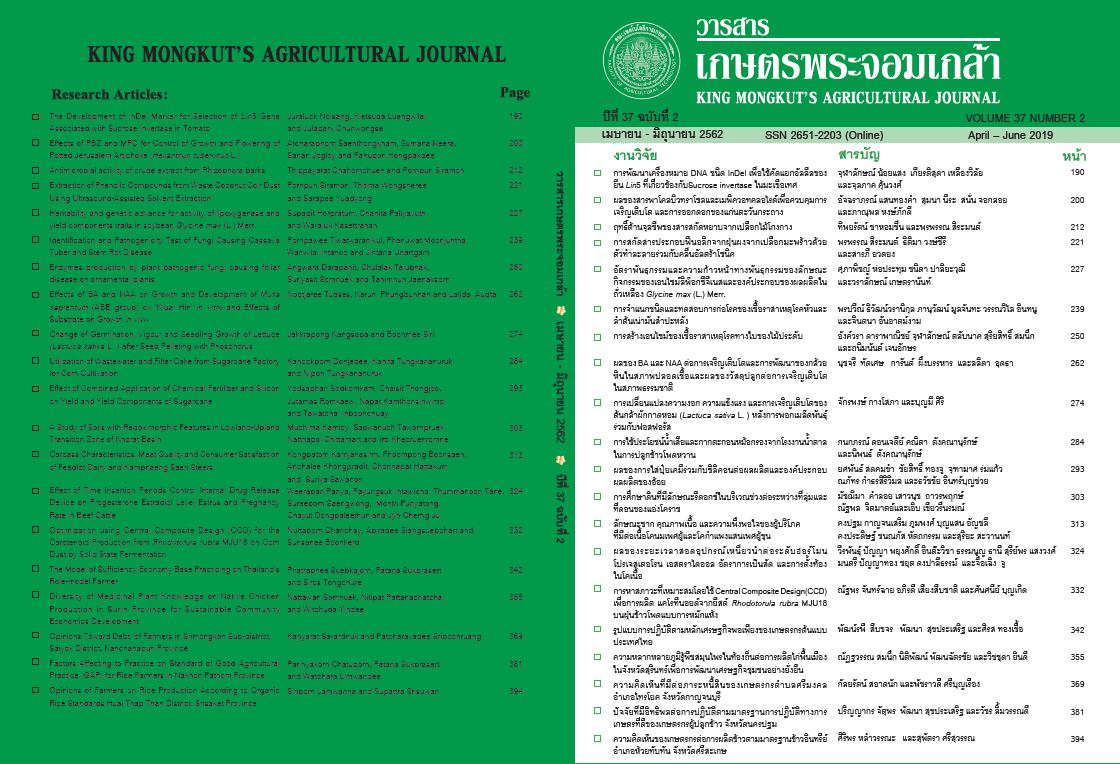
Optimization using Central Composite Design (CCD) for the Carotenoid Production from Rhodotorula rubra MJU18 on Corn Dust by Solid State Fermentation
Article Sidebar
Main Article Content
Abstract
The study on the production of carotenoid from Rhodotorula rubra MJU18 yeast in dry fermented
corn dust was aimed to produce carotenoid from R. rubra MJU18 yeast in corn dust. Carotenoids in
animal feed is not only an important factor in the production of animals to get good growth and increased
productivity, it also reduces the amount of agricultural waste air pollution from burn corn dust of farmers.
The initial conditions used for fermentation were 50 percent humidity, 30 ๐C, pH 7, glucose as a carbon
source at 0.1 grams (volume/volume) using ammonium sulphate as a nitrogen source at 0.01g.
(volume/volume) and yeast extract was used as a growth promoter at 0.01 g. (volume/volume). The maximum
carotenoid content in 96 hours of fermentation was 18.79 g/g corn dust. And the carotenoids content was
22.60 μg/g dry weight corn dust. From study of the optimal conditions for growth and carotene production
by Central Composite Design (CCD), it was found that the optimum pH value was 5.5., glucose was
the carbon source at 15 g/kg., ammonium sulphate was a nitrogen source at 2 g/kg., Yeast extract was
a growth promoter at 2 g/kg. And temperature at 30 ๐C with a growth of 58.32 g/g corn dust. The amount
of carotenoid was 61.12 μg/g dry weight corn dust, so it can be used to ferment corn dust with
R. rubra MJU18 yeast. However, it is necessary to study at the industrial level, to reduce the haze and to
increase the value of agricultural waste.
Article Details
King Mongkut's Agricultural Journal
References
บนรำข้าวแบบการหมักแห้ง. ภาควิชาจุลชีววิทยา คณะวิทยาศาสตร์. มหาวิทยาลัยเทคโนโลยีพระจอมเกล้าธนบุรี.
สาวิตรี ลิ่มทอง. 2549. ยีสต์: ความหลากหลาย และเทคโนโลยีชีวภาพ.กรุงเทพฯ. สำนักพิมพ์ มหาวิทยาลัเกษตรศาสตร์.
ณัฐพร จันทร์ฉาย และชาญณรงค์ สุขชา. 2554. สภาวะที่เหมาะสมต่อการผลิตแคโรทีนอยด์ และความสามารถในการต้านอนุมูลอิสระ
ของยีสต์ (Rhodotorula rubra). ใน การประชุมวิชาการแม่โจ้วิจัยครั้งที่ 1.
ณัฐพร จันทร์ฉาย และศันศนีย์ บุญเกิด. 2559. การผลิตแคโรทีนอยด์จากยีสต์ Rhodotorula rubra MJU11 บนฝุ่นข้าวโพดแบบการหมัแห้ง.
วารสารเกษตรพระจอมเกลา้ คณะเทคโนโลยกี ารเกษตร สถาบนั เทคโนโลยพี ระจอมเกลา้ เจา้ คณุ ทหารลาดกระบงั . 34(2): 122-132.
สุมารี สุขเถียร์. 2552. สภาวะที่เหมาะสมบางประการสำหรับการผลิตแคโรทีนอยด์จากเชื้อ Rhodotorula rubra. สาขาวิชาเทคโนโลยี
ชีวภาพ มหาวิทยาลัยแม่โจ้-แพร่ เฉลิมพระเกียรติ.
Chanchay, N. 2013. Optimal condition for growth of Rhodotorula rubra and antioxidation characteristics of its carotenoid.
Biotechnology. PhD. Thesis. : Chiang Mai University.
Foss, P. Storebakken, T., Schiedt, K., Liaaen, J., Austreg, E. and Steriff, K. 1984. Carotenoids in diets for salmonids I :
pigmentation of rainbow trout with the individual optical isomers of astaxanthin in comparison with canthaxanthin.
Aquaculture 41 : 213-226.
Vazquez, M. 2001. Effect of the Light on Carotenoid Profiles of Xanthophyllom aces dendrorhous Strains (Formerly Phaffia
rhodozyma). Food technol. Biotechnol 39 : 123-128.
