
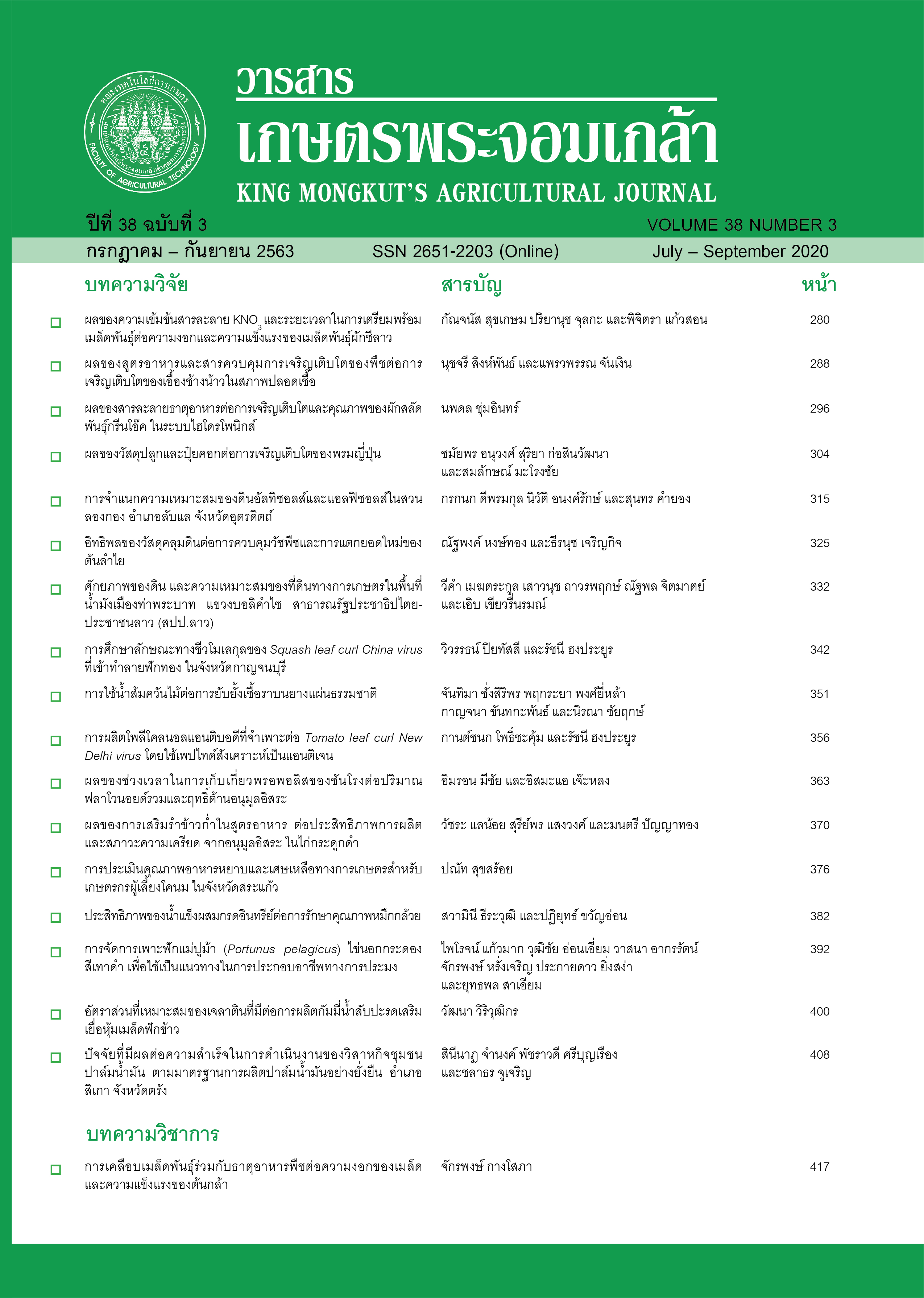
Influence of Harvesting Times on the Total Flavonoid Content and Antiradical Activity of Stingless Bee Propolis
Article Sidebar
Main Article Content
Abstract
Propolis from stingless bees is a natural product and has been reported to possess a variety of the biological activities and beneficial chemical constituents. It is constructed from a mixture of rubber from the tree species in the habitat of the beehive and beeswax. The effect of the harvesting time of propolis on its total flavonoid content was measured over a one-year period. The propolis was collected six times (once every 2 months) from two stingless bee species, Geniotrigona thoracica and Heterotrigona itama, in Sai Buri, Pattani province, Thailand.
In addition, the correlation of total flavonoid content with antiradical activities was evaluated. The result showed that the G. thoracica and H. itama propolis gave total flavonoid content in the range of 42.33-169.67 and 93.33-186.00 mg quercetin equivalent / 100g extract, respectively. A high in flavonoids was determined in G. thoracica propolis at harvesting times during the months of December to January and August to September, while the H. itama propolis had a high total flavonoid content during the months of October to November, December to January and August to September. The difference of total flavonoid content with respect to harvest times for each species might be related to the plant diversity of each season. There was little association between antioxidant activities and total flavonoid content. This may relate to the synergistic or antagonistic effects of other compounds present in propolis extracts. However, these data indicated that harvesting time had an effect on the chemical constituents and biological activity of stingless bee propolis.
Article Details
King Mongkut's Agricultural Journal
References
รุ่งรัตน์ นิลธเสน. 2559. ไนตริกออกไซด์กับโรคหลอดเลือดตีบแข็ง. วารสารวิทยาศาสตร์และเทคโนโลยี หัวเฉียวเฉลิมพระเกียรติ 21(1): 71-79.
บุษราคัม สิงห์ชัย, จันทร์จิรา ขอจุลซ้วน และปาริฉัตร ด้วงทอง. 2560. พฤกษเคมีและฤทธิ์ทางชีวภาพของชาเล็บรอก. วารสารวิทยาศาสตร์และเทคโนโลยี 25(5): 830-838.
อัญชลี สวาสดิ์ธรรม. 2556. มหัศจรรย์ชันโรง. กรุงเทพฯ: ทริปเพิ้ล กรุ๊ป.
อิมรอน มีชัย และอิสมะแอ เจ๊ะหลง. 2561. ปริมาณฟีนอลิกรวมและฤทธิ์ต้านอนุมูลอิสระของน้ำผึ้งชันโรงในช่วงเวลาการเก็บเกี่ยวที่แตกต่างกัน. วารสารวิทยาศาสตร์และเทคโนโลยี มทร.ธัญบุรี 8(2):65-72.
Athikomkulchai, S., Awale, S., Ruangrungsi, N., Ruchirawat, S., and Kadota, S. 2013. Chemical constituents of Thai propolis. Fitoterapia 88: 96-100.
Bankova, V. S., De Castro, S. L., and Marcucci, M. C. 2000. Propolis: recent advances in chemistry and plant origin.
Apidologie 31(1): 3-15.
Batista, M. C. A., Abreu, B. V. B., Dutra, R. P., Cunha, M. S., Amaral, F. M. M., Torres, L. M. B., and Ribeiro, M. N. S. 2016.
Chemical composition and antioxidant activity of geopropolis produced by Melipona fasciculata (Meliponinae) in flooded fields and cerrado areas of Maranhão State, northeastern Brazil. Acta Amazonica 46(3): 315-22.
Bendary, E., Francis, R. R., Ali, H. M. G., Sarwat, M. I., and El Hady, S. 2013. Antioxidant and structure-activity relationships (SARs) of some phenolic and anilines compounds. Annals of Agricultural Sciences 58(2): 173-181.
Castaldo, S., and Capasso, F. 2002. Propolis, an old remedy used in modern medicine. Fitoterapia 73(Suppl.1): S1-S6.
Cheurthong, P., Naksing, R., and Jongjitvimol, T. 2016. Niche of stingless bee, Tetragonilla collina in Wat Jadee Yod Duan, Phitsanulok province. PSRU Journal of Science and Technology 1(2): 34-44.
Freitas, M. O., Ponte, F. A. F., Lima, M. A. S., and Silveira, E. R. 2008. Flavonoids and triterpenes from the nest of the stingless bee Trigona spinipes. Journal of the Brazilian Chemical Society 19(3): 532-35.
Huang, S., Zhang, C. P., Wang, K., Li, G. Q., and Hu, F. L. 2014. Recent advances in the chemical composition of propolis. Molecules 19(12): 19610-19632.
Ibrahim, N., Mohd Niza, N. F. S., Mohd Rodi, M. M., Zakaria, A. J., Ismail, Z., and Mohd, K. S. 2016. Chemical and biological analyses of Malaysia stingless bee propolis extracts. Malaysian Journal of Analytical Sciences 20(2): 413-422.
Ishizu, E., Honda, S., Vongsak, B., and Kumazaw, S. 2018. Identification of plant origin of propolis from Thailand stingless.
Natural Product Communications 13(8): 973-975.
Liben, T., Atlabachew, M., and Abebe, A. 2018. Total phenolic, flavonoids and some selected metal content in honey and propolis samples from South Wolo zone, Amhara region, Ethiopia. Cogent Food & Agriculture 4: 1-12.
Makchuchit, S., Itharat, A., and Tewtrakul, S. 2010. Antioxidant and nitric oxide inhibition activities of Thai medicinal plants.
The Journal of Medical Association of Thailand 93(suppl.7): s227-s235.
Meda, A., Lamien, C. E., Romito, M., Millogo, J., and Nacoulma, O. G. 2005. Determination of the total phenolic, flavonoid and proline contents in Burkina Fasan honey, as well as their radical scavenging activity. Food Chemistry 91(3): 571-577.
Meechai, I., Phupong, W., Chunglok, W., and Meepowpan, P. 2016. Anti-radical activities of xanthones and flavonoids from
Garcinia schomburgkiana. International Journal of Pharmacy and Pharmaceutical Sciences 8(9): 235-238.
Moreno, M. I., Isla, M. I., Sampietro, A. R., and Vattuone, M. A. 2000. Comparison of the free radical-scavenging activity of propolis from several regions of Argentina. Journal of Ethnopharmacology 71(1-2):109-114.
Ng, R. F. L., Abidin, N. Z., Shuib, A. S., and Ali, D. A. I. 2015. Inhibition of nitric oxide production by Solanum melongena and Solanum macrocarpon on RAW 264.7 cells. Frontiers in Life Science 8(3): 241-248.
Panche, A. N., Diwan, A. D., and Chandra, S. R. 2016. Flavonoids: an overview. Journal of Nutritional Science 5(e47): 1-15.
Rao, U. S. M., Ahmad, B. A., and Moh, K. S. 2016. In vitro nitric oxide scavenging and anti-inflammatory activity of different solvent extract of various parts of Musa paradisiaca. Malaysian Journal of Analytical Sciences 20(5): 1191-1202.
Salatino, A., Teixeira, É. W., Negri, G., and Message, D. 2005. Origin and chemical variation of Brazilian propolis.
Evidence-Based Complementary and Alternative Medicine 2(1): 33-38.
Sanpa, S., Popova, M., Tunkasiri, T., Eitssayeam, S., Bankova, V., and Chantawannakul, V. 2017. Chemical profiles and antimicrobial activities of Thai propolis collected from Apis mellifera. Chiang Mai Journal of Science 44(2): 438-448.
Sanpa, S., Sutjarittangtham, K., Tunkasiri, T., Eitssayeam, S., and Chantawannaku, P. 2012. Ultrasonic extraction of Thai propolis for antimicrobial and antioxidant properties. Advanced Materials Research 506: 371-374.
Vit, P., Pedro, S. R. M., and Roubik, D. W. 2012. Pot-honey: a legacy of stingless bees. New York: Springer.
Wang, X., Sankarapandian, K., Cheng, Y., Woo, S. O., Kwon, H. W., Perumalsamy, H., and Ahn, Y. J. 2016. Relationship between total phenolic contents and biological properties of propolis from 20 different regions in South Korea. BMC Complementary and Alternative Medicine 16(65): 1-12.
Zarate, M. S. H., Juárez, M. R. A., García, A. C., López, C. O., Chávez, A. J. G., Garfia, J. J. N. S., and Ramos, F. A. 2018. Flavonoids, phenolic content, and antioxidant activity of propolis from various areas of Guanajuato, Mexico.
Journal of Food Science and Technology 38(2): 210-215.
