
Optimization for Stability of Chlorophyll Pigment from Chara corallina Using Response Surface Methodology
Article Sidebar
Main Article Content
Abstract
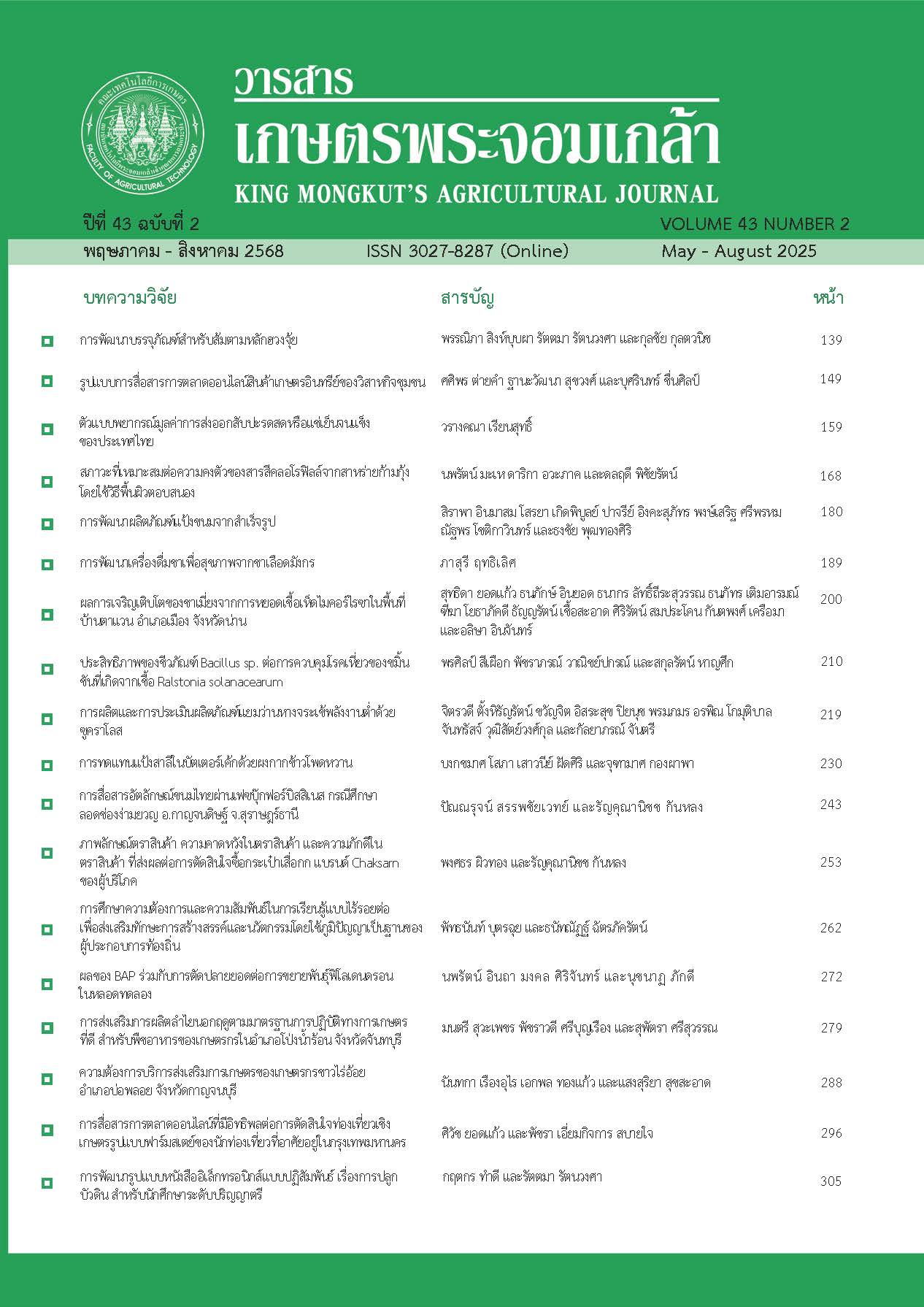
This experiment aimed to study the optimum conditions for maintaining the stability of chlorophyll in Chara corallina with sodium bicarbonate (NaHCO3) solution using RSM (Response Surface Methodology). Factors used in the study were NaHCO3 concentration (X1), reaction temperature (X2) and reaction time (X3). Chlorophyll concentration (ug.g-1) and green value of chlorophyll (-a*) were analyzed. The results showed that the R-Square (R2) value of the regression equation coefficients for chlorophyll concentration was 92.98%. This demonstrated that the concentration of NaHCO3, reaction temperature and reaction time could have explained 92.98% of the variation or change in chlorophyll concentration. For measuring green values, the results were similar to those for measuring chlorophyll concentration. The optimum conditions for maintaining the stability of chlorophyll were that the NaHCO3 concentration was 0.3 %, the reaction temperature was 90 °C, and the reaction time was 10 minutes. The above conditions yielded the highest chlorophyll concentration (7.647 ug.g-1). The results of this study can be used to maintain the stability of chlorophyll in Chara coralline. Maintaining the stability of chlorophyll allows for more efficient utilization of chlorophyll.
Article Details

This work is licensed under a Creative Commons Attribution-NonCommercial-NoDerivatives 4.0 International License.
King Mongkut's Agricultural Journal
References
Albanese, D., Russo, L., Cinquanta, L., Brasiello, A., & Di Matteo, M. (2007). Physical and chemical changes in minimally processed green asparagus during cold storage. Food Chemistry, 101(1), 274-280.
Amin, K. A., Abdel H. H., & Abd Elsttar, A. H. (2010). Effect of food azo dyes tartrazine and carmoisine on biochemical parameters related to renal, hepatic function and oxidative stress biomarkers in young male rats. Food and Chemical Toxicology, 48(10), 2994–2999.
Aparicio-Ruiz, R., & Gandul-Rojas, B. (2014). Decoloration kinetics of chlorophylls and carotenoids in virgin olive oil by autoxidation. Food Research International, 65(Part B), 199-206.
Benlloch-Tinoco, M., Kaulmann, A., Corte-Real, J., Rodrigo, D., Martínez-Navarrete, N., & Bohn, T. (2015). Chlorophylls and carotenoids of kiwifruit puree are affected similarly or less by microwave than by conventional heat processing and storage. Food Chemistry, 187(1), 254-262.
Comunian, T.A., Monterrey-Quintero, E. S., Thomazini, M., Balieiro, J. C. C., Piccone, P., Pittia, P., & Favaro-Trindade, C. S. (2011). Assessment of production efficiency, physicochemical properties and storage stability of spray-dried chlorophyllide, a natural food colourant, using gum Arabic, maltodextrin and soy protein isolate-based carrier systems. International Journal of Food Science and Technology, 46(6), 1259-1265.
Cuny, P., Romano, J. C., Beker, B., & Rontani, J. F. (1999). Comparison of the photodegradation rates of chlorophyll chlorin ring and phytol side chain in phytodetritus: is the phytyldiol versus phytol ratio (CPPI) a new biogeochemical index?. Journal of Experimental Marine Biology and Ecology, 237(2), 271-290.
Elbe, V. J. H., Huang, A. S., Attoe, E. L., & Nank, K. W. (1986). Pigment composition and color of conventional and very green canned beans. Journal of Agricultural and Food Chemistry, 34(1), 54-55.
Erge, H. S., Karadeniz, F., Koca, N., & Soyer, Y. (2008). Effect of heat treatment on chlorophyll degradation and color loss in green peas. GIDA, 33(5), 225-233.
Gaur, S., Shivhare, U. S., Sarkar, B. C., & Ahmed, J. (2007). Thermal chlorophyll degradation kinetics of mint leaves puree. International Journal of Food Properties, 10(4), 853-865.
Ghidouche, S., Rey, B., Michel, M., & Galaffu, N. (2013). A Rapid tool for the stability assessment of natural food colours. Food Chemistry, 139(1-4), 978-985.
Gold, H. J., & Weckel, K. G. (1959). Degradation of chlorophyll to pheophytin during sterilization of canned green peas by heat. Food Technology, 13(5), 281-285.
Gunawan, M. I., & Barringer, S. A. (2000). Green color degradation of blanched broccoli (Brassica Oleracea) due to acid and microbial growth. Journal of Food Processing and Preservation, 24(3), 253-263.
Hu, R. (1999). Food Product Design. Technomic Publishing Company, Inc.
Hung, S. M., Hsu, B. D., & Lee, S. (2014). Modelling of isothermal chlorophyll extraction from herbaceous plants. Journal of Food Engineering, 128(1), 17-23.
Inanc, A. L. (2016). Differential method to determine thermal degradation kinetics of chlorophyll in virgin olive oil. Italian Journal of Food Science, 28(1), 90-95.
Jokopriyambodo, W., Sudarsono, & Rohman, A. (2014). The antiradical activity of insoluble water Suji (Pleomele angustifolia N. E. Brown) leaf extract and its application as natural colorant in bread product. Journal of Food and Pharmaceutical Sciences, 2(1), 52-56.
Jone, I. D., Wite, R. C., Gidds, E., Stutler, L., & Nelson, L. A. (1977). Experimental formation of zinc and copper complexes of chlorophyll derivatives in vegetable tissue by thermal processing. Journal of Agricultural and Food Chemistry, 25(1), 149-153.
Kaur, N., Aggarwal, P., & Rajput, H. (2018). Effect of different blanching treatments on physicochemical, phytochemical constituents of cabinet dried broccoli. Chemical Science Review and Letters, 7(25), 262-271.
Kaushal, M., sharma, K. D., & Attri, S. (2013). Effect of blanching on nutritional quality of dehydrated colocasia, Colocasia esculenta (L.) Schott leaves. Indian Journal of Natural Products and Resources, 4(2), 161-164.
Kidmose, U., Edelenbos, M., NØrbæk, R. & Christensen, L. P. (2002). Color stability in vegetables. In: MacDougall, D. B. (Ed.), Color in Food: Improving Quality, pp 179-232. CRC Press/Woodhead Publishing Limited.
Koca, N., Karadeniz, F., & Burdurlu, H. S. (2007). Effect of pH on chlorophyll degradation and colour loss in blanched green peas. Food Chemistry, 100(2), 609-615.
LaBorde, L. F., & Elbe, V. J. H. (1994). Chlorophyll derivatives in heated green vegetable. Journal of Agricultural and Food Chemistry, 42(5), 1100-1130.
Lau, M. H., Tang, J., & Swanson, B. G. (2000). Kinetics of textural and color changes in green asparagus during thermal treatments. Journal of Food Engineering, 45(4), 231–236.
McCann, D., Barret, A., Cooper, A., Crumpler, D., Dalen, L., Grimshaw, K., Kitchin, E., Lok, K., Porteous, L., Prince, E., Sonuga-Barke, E., Warner, J. O., & Stevenson, J. (2007). Food additives and hyperactive behaviour in 3-year-old and 8/9-year-old children in the community: a randomised, double-blinded, placebo-controlled trial. The Lancet, 370(9598), 1560–1567.
McQuistan, T. J., Simonich, M. T., Pratt, M. M., Pereira, C. B., Hendricks, J. D., Dashwood, R. H., Williams, D. E., & Bailey, G. S. (2012). Cancer chemoprevention by dietary chlorophylls: A 12,000-animal dose–dose matrix biomarker and tumor study. Food and Chemical Toxicology, 50(2), 341-352.
Ngamwonglumlert, L., Devahastin, S., & Chiewchan, N. (2017). Natural colorants: Pigment stability and extraction yield enhancement via utilization of appropriate pretreatment and extraction methods. Critical Reviews in Food Science and Nutrition, 57(15), 3243-3259.
Ngo, T., & Zhao, Y. (2007). Formation of zinc chlorophyll derivative complexes in thermally processed green pears (Pyrus communis L.). Journal of Food Science, 72(7), 397-404.
O¨zkan, G., & Ersus Bilek, S. (2015). Enzyme-assisted extraction of stabilized chlorophyll from spinach. Food Chemistry, 176(1), 152–157.
Pinsirodom, P. (2003). Effect of temperature, pH and ZnCl2 on the green color stability of pandan (Pandanus tectorius) leaf extract. Journal of Agricaltural and Food Chemistry, 33(1), 277-282.
Rahayuningsih, E., Pamungkas, M. S., Olvianas, M., & Putera, A. D. P. (2018). Chlorophyll extraction from suji leaf (Pleomele angustifolia Roxb.) with ZnCl2 stabilizer. Journal of Food Science and Technology, 55(3), 1028-1036
Salama, M. F., & Moharram, H. A. (2007). Relationship between colour improvement and metallo-chlorophyll complexes during blanching of peas and broccoli. Alexandria Journal of Food Science and Technology, 4(2), 11-18.
Shahid, M., Shahid-Ul-Islam., & Mohammad, F. (2013). Recent advancements in natural dye applications: A review. Journal of Cleaner Production, 53(1), 310-331.
Sigurdson, G. T., Tang, P., & Giusti, M. M. (2017). Natural colorants: Food colorants from natural sources. The Annual Review of Food Science and Technology, 8(1), 261-280.
Sinha, K., Saha, P.D., & Datta, S., (2012). Extraction of natural dye from petals of Flame of forest (Butea monosperma) flower: process optimization using Response Surface Methodology (RSM). Dyes and Pigments, 94(1), 212–216.
Solymosi, K. & Mysliwa-Kurdziel, B. (2017). Chlorophylls and their derivatives used in food industry and medicine. Mini Reviews in Medicinal Chemistry, 17(13), 1194-1222.
Subramoniam, A., Asha, V. V., Nair, S. A., Sasidharan, S. P., Sureshkumar, P. K., Rajendran, K. N., Karunagaran, D., & Ramalingam, K. (2012). Chlorophyll revisited: Anti-inflammatory activities of chlorophyll a and inhibition of expression of TNF-α gene by the same. Inflammation, 35(3), 959-966.
Tijskens, L. M. M., Schijvens, E. P. H., & Biekman, E. S. A. (2001). Modelling the change in colour of broccoli and green bean during blanching. Innovative Food Science and Emerging Technologies, 2(4), 303-313.
Tonucci, L. H., & Elbe, V. J. H. (1992). Kinetic of the formation of zinc complex of chlorophyll derivatives. Journal of Agricultural and Food Chemistry, 40(12), 2341-2344.
Tumolo, T., & Lanfer-Marquez, U. M. (2012). Copper chlorophyllin: A food colorant with bioactive properties?. Food Research International, 46(2), 451-459.
Wang, Y., Zhou, X., Wang, W., Wu, Y., Qian, Z., & Peng, Q. (2021). Sodium bicarbonate, an inorganic salt and a potential active agent. Chinese Chemical Letters, 32(12), 3687-3695.
Willows, R. D. (2004). Chlorophylls. In Davies, K. M. (Ed.), Plant pigments and their manipulation, pp. 23-46. CRC Press.
Yilmaz, C., & Gokmen, V. (2016). Chlorophyll. In Caballero, B., Finglas, P. M., & Toldra F. (Ed.), Encyclopedia of Food and Health, pp. 37-41. Academic Press.
Zhang, J. H., Han, C., & Liu, Z. H. (2009). Absorption spectrum estimating rice chlorophyll concentration: preliminary investigations. Journal of Plant Breeding and Crop Science, 1(5), 223-229.
