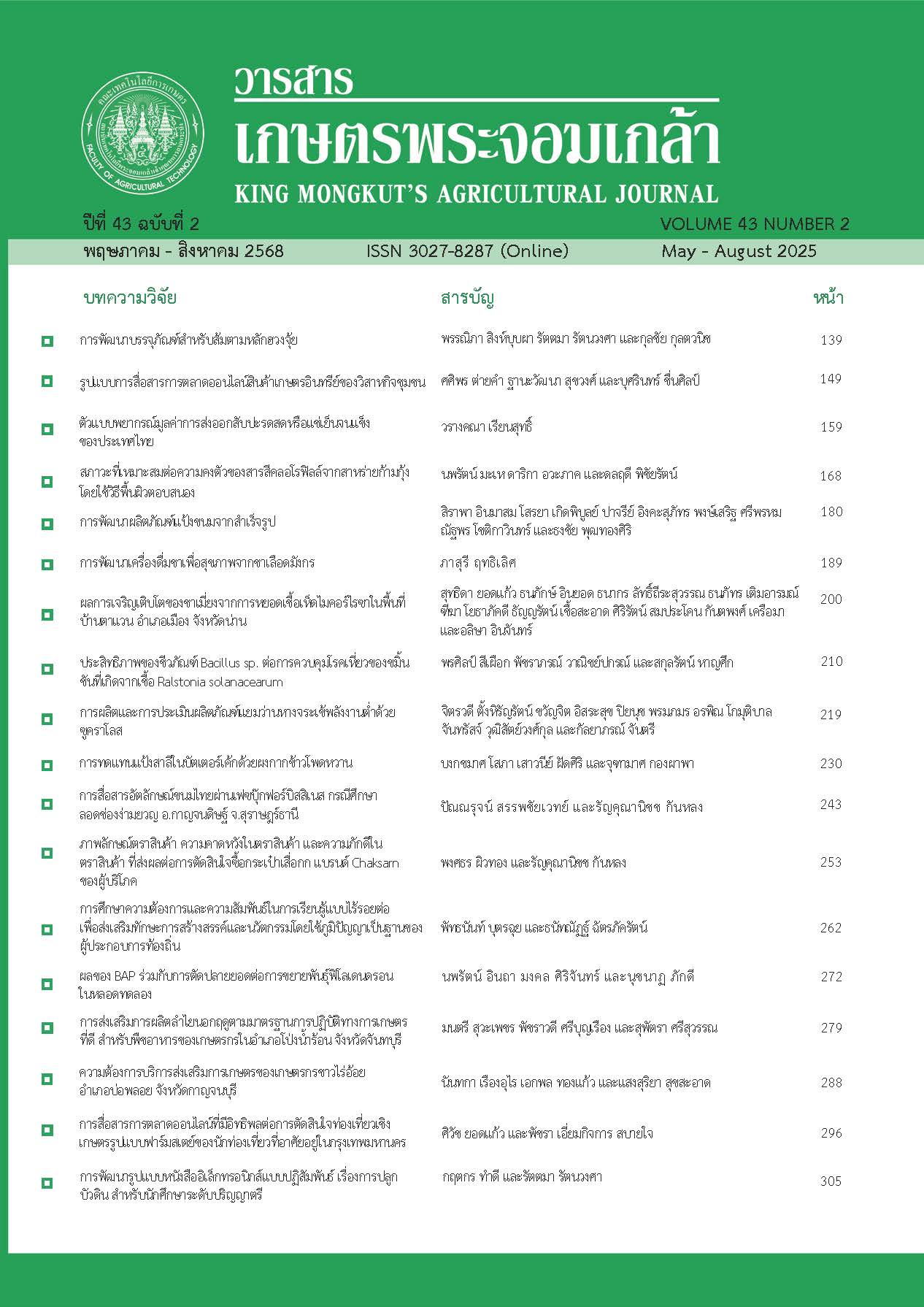
การพัฒนาเครื่องดื่มชาเพื่อสุขภาพจากชาเลือดมังกร
Article Sidebar
Main Article Content
บทคัดย่อ
งานวิจัยนี้มีวัตถุประสงค์เพื่อแปรรูปชาเลือดมังกรเป็นเครื่องดื่มเพื่อสุขภาพจากต้นเลือดมังกร (Peristrophe roxburghiana) โดยศึกษาองค์ประกอบทางเคมีและสารพฤกษเคมีจากใบชาเลือดมังกร จากนั้นแปรปริมาณใบชาเลือดมังกรเป็น 4 ระดับ ได้แก่ 0.125, 0.250, 0.375 และ 0.500% โดยน้ำหนักต่อปริมาตร เพื่อพัฒนาเป็นเครื่องดื่มชาเลือดมังกร จากนั้นศึกษา การใช้สารสกัดน้ำตาลหล่อฮังก๊วยแทนน้ำตาลทราย ได้แก่ 0, 0.10, 0.15, 0.20, 0.25, 0.30% ต่อน้ำหนักของน้ำชา และศึกษาอัตราส่วนของคอลลาเจนและอินูลินที่เหมาะสมต่อคุณภาพของเครื่องดื่มชาเลือดมังกร วิเคราะห์คุณภาพผลิตภัณฑ์ ได้แก่ ค่าความสว่าง (L*), ค่าความเป็นสีแดง (a*), ค่าความเป็นสีเหลือง (b*), chroma (C*) และ hue angle (hº), ค่าความใส (clarity, T670), ค่าความเป็นกรด-ด่าง (pH) และประเมินคุณภาพทางประสาทสัมผัส จากการศึกษาพบว่าชาเลือดมังกรมีองค์ประกอบ ทางเคมี ได้แก่ ปริมาณความชื้น โปรตีน ไขมัน เถ้า เส้นใย และคาร์โบไฮเดรต เท่ากับ 7.19, 19.35, 0.33, 17.39 และ 15.84% โดยน้ำหนักแห้ง ตามลำดับ มีปริมาณรวมของสารโพลีฟีนอล และฤทธิ์การต้านอนุมูลอิสระด้วยวิธี 2,2-diphenyl-l-picrylhydrazyl (DPPH) เท่ากับ 4,905.94 mg eq GA/g น้ำหนักแห้ง และ 179.74 mmole TE/g น้ำหนักแห้ง ตามลำดับ ปริมาณชาเลือดมังกร ที่เหมาะสมต่อการผลิตน้ำชาเท่ากับ 0.375% โดยน้ำหนักต่อปริมาตร ให้น้ำชามีเฉดสีแดง ปริมาณสารสกัดน้ำตาลหล่อฮังก๊วย ที่เหมาะสมเท่ากับ 0.20% ต่อน้ำหนักของน้ำชา และมีอัตราส่วนของคอลลาเจนต่ออินูลินที่เหมาะสมเท่ากับ 0.50:1.00 มีคะแนนการยอมรับทางประสาทสัมผัสในระดับคะแนนความชอบปานกลางเท่ากับ 7.30 คะแนน มากที่สุดอย่างมีนัยสำคัญทางสถิติ (p≤0.05) คุณค่าทางโภชนาการของผลิตภัณฑ์เครื่องดื่มชาเลือดมังกรผสมคอลลาเจนและอินูลิน 1 ขวด ปริมาตรสุทธิ 180 มิลลิลิตร ให้พลังงาน 10 กิโลแคลอรี ใยอาหาร 2 กรัม และมีปริมาณโซเดียม 25 มิลลิกรัม ต่อหน่วยบริโภค
Article Details

อนุญาตภายใต้เงื่อนไข Creative Commons Attribution-NonCommercial-NoDerivatives 4.0 International License.
วารสารเกษตรพระจอมเกล้า
เอกสารอ้างอิง
AOAC. (2000). Official Methods of Analysis. 17th Ed. Association of official analytical chemists.
Benito-Ruiz, P., Camacho-Zambrano, M. M., Carrillo-Arcentales, J. N., Mestanza-Peralta, M. A., Vallejo-Flores, C. A., Vargas-López, S. V., & Zurita-Gavilanes, L. A. (2009). A randomized controlled trial on the efficacy and safety of a food ingredient, collagen hydrolysate, for improving joint comfort. International Journal of Food Science and Nutrition, 60(2), 99-113.
Bilek, S. E., & Bayram, S. K. (2015). Fruit juice drink production containing hydrolyzed collagen. Journal of Functional Foods, 14(1), 562-569.
Brockington, S. F., Walker, R. H., Glover, B. J., Soltis, P. S., & Soltis, D. E. (2011). Complex pigment evolution in the Caryophyllales. New Phytologist, 190(4), 854-864.
Castaneda-Ovando, A., de Lourdes Pacheco-Hernandez, M., Paez-Hernandez, M. E., Rodriguez, J. A., & Galan-Vidal, C. A. (2009). Chemical studies of anthocyanins: A review. Food Chemistry, 113(4), 859-871.
Chaichana, N., Ruanto, P., Punyamneesorn, W., & Jaiban, S. (2019). Investigation of nutritional composition and antioxidant activity of Lablab purpures (L.) sweet and Acanthopanax trifoliatus Merr. (2562). Ramkhamhaeng Research Journal Science and Technology, 22(1), 23-29. (in Thai).
Coussement, P. (1999). Inulin and oligofructose as dietary fiber: analytical, nutrition and legal aspects. In Cho, S. S., Prosky, L., & Greher, M. (Eds.). Complex Carbohydrates in Food, pp. 411-429. Marcel Dekker.
Ertan, K., Turkyilmaz, M., & Ozkan, M. (2018). Effect of sweeteners on anthocyanin stability and colour properties of sour cherry and strawberry nectars during storage. Journal of Food Science and Technology, 55(10), 4346-4355.
Evitasari, R. T., Edia, R., & Mindaryani, A. (2019). Dyeing of cotton fabric with natural dye from Peristophe bivalis extract. In Proceedings of AIP Conference, pp. 1-11. Global Resource Conservation (ICGRC) and AJI from Ritsumeikan University.
Food Standards Australia New Zealand. (2018). Risk and Technical Assessment Report-Appication A1129 Monk Fruit Extract as a Food Additive. Retrieved from https://www.foodstandards.gov.au/code/applications/documents/a1129%20sd1.pdf
Guillerminet, F., Beaupied, H., Fabien-Soulé, V., Tomé, D., Benhamou, C. L., Roux, C., & Blais, A. (2010). Hydrolyzed collagen improves bone metabolism and biomechanical parameters in ovariectomized mice: an in vitro and in vivo study. Bone, 46(3), 827-834.
Hoebregs, H. (1997). Fructans in foods and food product, Ion-exchange chromatographic method: collaborative study. Journal of AOAC International, 80(5), 1029-1037.
Katsube, T., & Tabata, H. (2004). Screening for antioxidant activity in edible plant products: Comparison of low-density lipoprotein oxidation assay, DPPH radical scavenging assay, and folin-ciocalteu assay. Journal of Agricultural and Food Chemistry. 52(8), 2391-2396.
Ketmai, W., Sumpunthamit, T., & Sutummawong, N. (2011). Nutritional values and antioxidant properties of 4 selected local vegetables in Kong-hra District, Phatthalung Province. Thaksin University Journal, 13(3), 133-140. (in Thai).
Khue, D. B., Mai, D. S., Tuan, P. M., Oanh, D. T. B., & Van, L. T. H. (2014). Peristrophe roxburghiana-a review. Annals Food Science and Technology, 15(1), 1-9.
Koyama, Y. I., Hirota, A. Takahara, H., Kuwaba, K., Kusubata, M., Matsubara, Y., & Kasugai, S. (2001). Ingestion of gelatin has differential effect on bone mineral density and body weight in protein undernutrition. Journal of Nutritional Science and Vitaminology, 47(1), 84-86.
Lin, P., Hua, N., Hsu, Y. C., Kan, K. W., Chen, J. H., Lin, Y. H., Lin, Y. H., & Kuan, C. M. (2020). Oral collagen drink for antiaging: Antioxidation, facilitation of the increase of collagen synthesis, and improvement of protein folding and DNA repair in human skin fibroblasts. Oxidative Medicine and Cellular Longevity, 2020(1), 1-9.
Lu, B., Li, M., & Yin, R. (2016). Phytochemical content, health benefits, and toxicology of common edible flowers: A review (2000-2015). Critical Reviews in Food Science and Nutrition, 56(Suppl.1), S130-S148.
Mao, Y. L., Wang, J. Q., Chen, G. S., Granato, D., Zhang, L., Fu, Y. Q., Gao, Y., Yin, J. F., Luo, L. X., & Xu, Y. Q. (2021). Effect of chemical composition of black tea infusion on the color of milky tea. Food Research International, 139(1), 109945.
Ministry of Public Health Notification. (No. 182) B.E. 2541. (1998). Re: Nutrition Labelling. Retrieved from: https://exfood.fda.moph.go.th/law/announ_moph151-200.php. (in Thai).
Ministry of Public Health Notification. (No. 392) B.E. 2561. (2018a). Issued by virtue of the food act B.E. 2522 Re. Nutrition Labelling (No. 3). Retrieved from: https://exfood.fda.moph.go.th/law/announ_moph351-400.php. (in Thai).
Ministry of Public Health Notification. (No. 394) B.E. 2561. (2018b). Issued by virtue of the food act B.E. 2522 Re. Food Products Required to Bear Nutrition Labelling and Guideline Daily Amounts, GDA Labelling. Retrieved from: https://exfood.fda.moph.go.th/law/announ_moph351-400.php. (in Thai).
Moskowitz, R. W. (2000). Role of collagen hydrolysate in bone and joint disease. Seminars in Arthritis and Rheumatism. 30(2), 87-99.
Naijitra, C., & Cheoymang, A. (2016). Evaluation of antioxidant activity, total phenolic and nicotine contents of 15 Thai herbs. Thai Science and Technology Journal, 24(2), 351-361. (in Thai).
National Food Institute. (2019). Thailand Food Market Report. Retrieved from: https://fic.nfi.or.th/upload/market_overview/1OCT2019-Thailand_BFY%20drinks.pdf (in Thai).
Othong, J., Klinmalai, L., & Chareonchai, A. (2020). The using inulin replaced with sugar in milk ice cream supplemented with chicken breast. Research Journal Rajamangala University of Technology Thanyaburi, 19(1), 39-50. (in Thai).
Parker, M. N., Lopetcharat, K., & Drake, M. A. (2018). Consumer acceptance of natural sweeteners in protein beverages. Journal of Dairy Science, 101(10), 8875-8889.
Patel, S. (2009). Sodium balance-an integrated physiological model and novel approach. Saudi Journal of Kidney Diseases and Transplantation, 20(4), 560-569.
Quan, N. V., Khang, D. T., Dep, L. T., Minh, T. N., Nobukazu, N., & Xuan, T. D. (2016). The potential use of a food-dyeing plant Peristrophe bivalvis (L.) Merr. In Northern Vietnam. International Journal of Pharmacology, Phytochemistry and Ethnomedicine, 4(1), 14-26.
Radovanovic, A., Stojceska, V., Plunkett, A., Jankovic, S., Milovanovic, D., & Cupara, S. (2015). The use of dry Jerusalem artichoke as a functional nutrient in developing extruded food with low glycemic index. Food Chemistry, 177(1), 81-88.
Rattanapanone, N. (2014). Food Chemistry. Odeon Store. (in Thai).
Rittilert, P. (2021). Physicochemical quality and sensory acceptance of Jerusalem Artichoke (Helianthus tuberosus L.) flower tea. Thai Journal of Science and Technology, 10(2), 196-207. (in Thai).
Rittilert, P. (2018). Processed Beverage Product of Indian Marsh Fleabane Tea Leaf Manual. Faculty of Agricultural Technology. Pathum Thani: Valaya Alongkorn Rajabhat University under the Royal Patronage. (in Thai).
Srisamran, R., Phunchaisri, C., Keokamnerd, T., & Daengprok, W. (2010). Effect of inulin on physical properties and sensory evaluation of low fat chicken sausage. In Proceedings of Maejo University Conference, pp. 421-427. International Education and Training Center. Maejo University. (in Thai).
Tanaka, M. Koyama, Y. I., & Nomura, Y. (2009). Effects of collagen peptide ingestion on UV-B-induced skin damage. Bioscience Biotechnology and Biochemistry, 73(4), 930-932.
Tanaviyutpakdee, P., & Srianujata, S. (2018). Intense sweeteners for health and weight control. Thai Journal of Science and Technology, 8(1), 93-104. (in Thai).
Thai Industrial Standards Institute. (2013). Thai Community Product Standard of Dried Mixed Herbs for Infusion (TCPS 996/2013). Thai Industrial Standards Institute. (in Thai).
Thai Industrial Standards Institute. (2015). Thai Community Product Standard of Tea (TCPS 120/2015). Thai Industrial Standards Institute. (in Thai).
United States Food and Drug Administration. (2018). Additional Information about High-Intensity Sweeteners Permitted for Use in Food in The United States. Retrieved from: https://www.fda.gov/food/food-additives-petitions/aspartame-and-other-sweeteners-food
Walrand, S., Chiotelli, E., Noirt, F., Mwewa, S., & Lassel, T. (2008). Consumption of a functional fermented milk containing collagen hydrolysate improves the concentration of collagen-specific amino acids in plasma. Journal of Agricultural and Food Chemistry, 56(17), 7790-7795.
Zague, V. (2008). A new view concerning the effects of collagen hydrolysate intake on skin properties. Archives of Dermatological Research, 300(9), 479-483.
Zhaojun, Y., Yunhui, Z., Xiaoquing, Y., Wenyuan, G., & Xinghua, J. (2012). Anti-inflammatory activity of chemical constituents isolated from Peristrophe roxburghiana. Latin American Journal of Pharmacy, 31(9), 1279-1284.
