
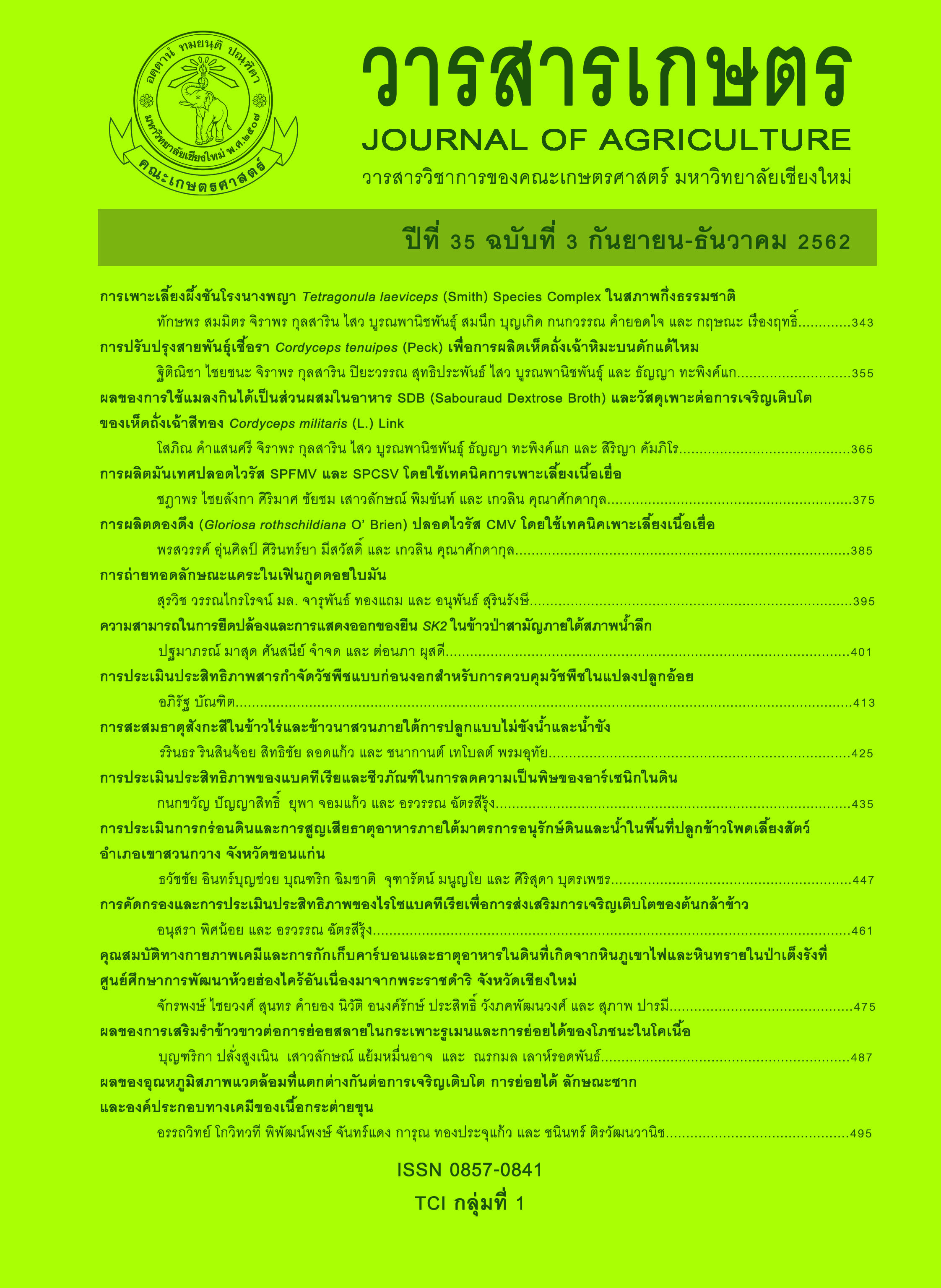
คุณสมบัติทางกายภาพเคมีและการกักเก็บคาร์บอนและธาตุอาหารในดินที่เกิดจากหินภูเขาไฟและหินทรายในป่าเต็งรังที่ศูนย์ศึกษาการพัฒนาห้วยฮ่องไคร้อันเนื่องมาจากพระราชดำริ จังหวัดเชียงใหม่
Article Sidebar
Main Article Content
บทคัดย่อ
การศึกษาเปรียบเทียบคุณสมบัติทางฟิสิกส์ เคมี การกักเก็บคาร์บอนและธาตุอาหารในดิน ที่เกิดจากหินวัตถุต้นกำเนิดดินต่างกัน 2 ชนิด คือ หินภูเขาไฟและหินทรายในป่าเต็งรัง ของศูนย์ศึกษาการพัฒนาห้วยฮ่องไคร้อันเนื่องมาจากพระราชดำริ โดยใช้หลุมศึกษาลักษณะของดิน จำนวน 8 หลุม เก็บตัวอย่างดินตามระดับความลึก และนำไปวิเคราะห์คุณสมบัติทางกายภาพ และเคมีในห้องปฏิบัติการ จากผลการศึกษาพบลักษณะของดิน 2 กลุ่ม คือ ดินตื้น (ความลึก<40 ซม.) จัดอยู่ในอันดับ Inceptisols และดินลึก (ความลึก >100 ซม. ขึ้นไป) จัดอยู่ในอันดับ Ultisols และ Oxisols โดยที่ดินส่วนใหญ่มีปริมาณกรวดปนมากและมีความหนาแน่นต่ำยกเว้น ดินในอันดับ Oxisols โดยทั่วไปลักษณะของเนื้อดินหยาบถึงปานกลางในดินบน และปานกลางถึงละเอียดในดินล่าง ค่าปฏิกิริยาดินของดินที่เกิดจากหินทรายจะมีค่าต่ำกว่าดินที่เกิดจากหินภูเขาไฟ ปริมาณอินทรียวัตถุ คาร์บอน และไนโตรเจนทั้งหมดในดิน มีค่าสูงในดินบน และลดลงในดินล่าง ปริมาณของฟอสฟอรัสที่เป็นประโยชน์ และแคตไออนที่สกัดได้ (โพแทสเซียม แคลเซียม และแมกนีเซียม) มีค่าต่ำมากตลอดช่วงความลึกของดิน โดยที่ปริมาณอินทรียวัตถุ คาร์บอน ไนโตรเจน ฟอสฟอรัส และแคตไอออนที่สกัดได้ทั้งในดินตื้นและดินลึกบนหินภูเขาไฟมีค่าสูงกว่าหินทราย ซึ่งดินป่าเต็งรังที่เกิดจากหินทั้ง 2 ชนิดนี้ มีคุณสมบัติทางกายภาพและเคมี และการและความสามารถในการกักเก็บคาร์บอนและธาตุอาหารที่ต่างกัน ซึ่งเป็นปัจจัยมีผลต่อการเจริญเติบโต ผลผลิต และความหลากหลายของชนิดพืชในพื้นที่
Article Details
เอกสารอ้างอิง
Bunyavejchewin, S. 1983. Analysis of the tropical dry deciduous forest of Thailand. I. Characteristics of dominance types. Natural History Bulletin of the Siam Society 31(2): 109-122.
Department of Mineral Resources. 1999. Geology map of SANSAI 1:50,000 scale. Geological Survey Division, Department of Mineral Resources, Bangkok.
Khamyong, S. and N. Anongrak. 2016. Carbon and nutrient storages in an upper montane forest at Mt. Inthanon summit, northern Thailand. Environmental and Natural Resources Journal 14(1): 26-38.
Kimmins, J.P. 2004. Forest Ecology: A Foundation for Sustainable Forest Management and Environmental Ethics. Prentice Hall, Upper Saddle River, New Jersey. 611 p.
Naimphulthong, W. 2011. Plant diversity, soil characteristics and nutrient accumulations in sedimentary rock forest ecosystem at petrified wood forest park, Tak Province. M.S. Thesis. Chiang Mai University, Chiang Mai. 326 p.
Neal, G.D. 1967. Statistical Description of the Forest of Thailand. Military Research and Development Center, Bangkok. 346 p.
Nelson, D.W. and L.E. Sommers. 1996. Total carbon, organic carbon, and organic matter. pp. 961-1010. In: D.L. Sparks, A.L. Page, P.A. Helmke, R.H. Loeppert, P.N. Soltanpour, M.A. Tabatabai, C.T. Johnston and M.E. Sumner (eds.). Methods of Soil Analysis, Part 3. Chemical Methods. Agronomy No. 5. SSSA Book Series. Madison, Wisconsin.
Phonchaluen, S. 2009. Plant species diversity, soil characteristics and utilization of Ban Sai Thong community forest, Pa Sak Sub-district, Muang District, Lamphun Province. M.S. Thesis. Chiang Mai University, Chiang Mai. 192 p.
Phongkhamphanh, T., S. Khamyong and T. Onpraphai. 2015. Variations in plant diversity and carbon storage among subtypes communities in a dry dipterocarp community forest of Mae Tha Sub-district, Mae On District, Chiang Mai Province. Thai Journal of Forestry 34(3): 83-98.
Pye, K. 2007. Geological and Soil Evidence Forensic Application. CRC Press, Boca Raton, Florida. 335 p.
Schaetzl, R.J. and S. Anderson 2005. Soils: Genesis and Geomorphology. Cambridge University Press, New York. 817 p.
Schoeneberger, P.J., D.A. Wysocki, E.C. Benham and W.D. Broderson. 2002. Field Book for Describing and Sampling Soils. Version 2.0. Natural Resources Conservation Service, National Soil Survey. U.S. Government Printing Office, Lincoln, Nebraska. 227 p.
Seeloy-ounkeaw, T., S. Khamyong, N. Anongrak. K, Sringernyuang and T. Ounprapai. 2014. Characteristics of forest soils under different management in Ban Nong Tao community forest, Mae Wang District, Chiang Mai Province. Journal of Science and Technology. Mahasarakham University 33(5): 445-453.
Seramethakun, T. 2012. Plant species diversity, soil characteristics and carbon stocks in subtype communities of natural pine forest, Galyani Vadhana District, Chiang Mai Province. Ph.D. Dissertation. Chiang Mai University, Chiang Mai. 86 p.
Smitinand, T., T. Santisuk and C. Phengklai. 1980. The manual of Dipterocarpaceae of mainland southeast Asia. Natural History Bulletin of the Siam Society 12: 1-110.
Soil Survey Division. 1993. Soil survey manual. Soil Conservation Service. U.S. Department of Agriculture Handbook 18. U.S. Government Printing Office, Washington, D.C. 315 p.
Soil Survey Staff. 2004. Soil Survey Laboratory Methods Manual: Soil Survey Investigations Report No. 42, Version 4.0. U.S. Government Printing Office, Washington, D.C. 700 p.
Soil Survey Staff. 2014. Keys to Soil Taxonomy. 12th ed. USDA-Natural Resources Conservation Service Press, U.S. Government Printing Office, Washington, D.C. 360 p.
Waring, R.H., and S.W. Running. 1998. Forest Ecosystems: Analysis at Multiple Scales. Academic Press, San Diego. 370 p.
Wongin, P. 2011. Assessment of plant species diversity, forest condition and carbon stocks in dry dipterocarp forest ecosystem on a granitic rock at petrified wood forest park, Ban Tak District, Tak Province. M.S. Thesis. Chiang Mai University, Chiang Mai. 116 p.
