
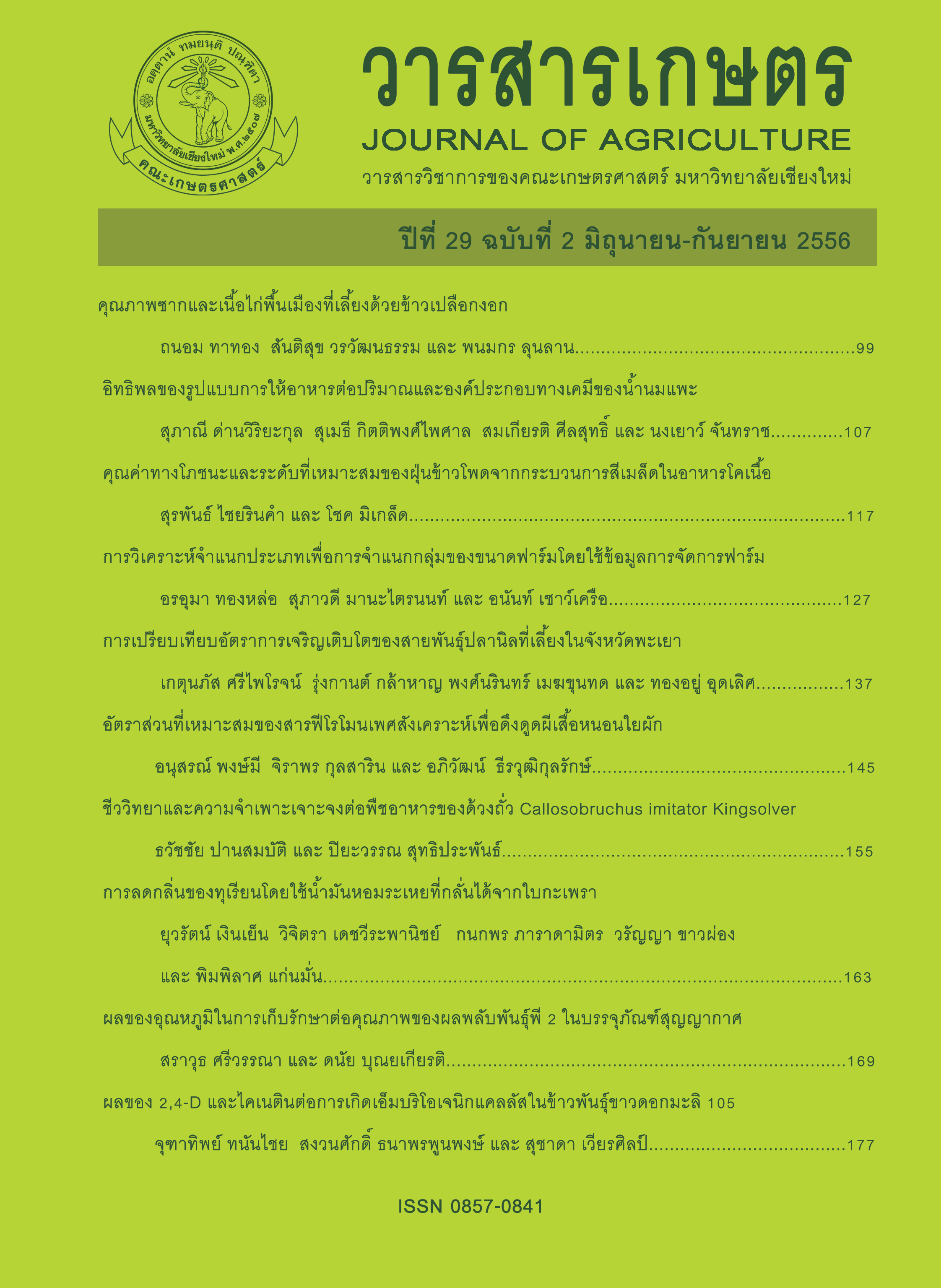
ผลของ 2,4-D และไคเนตินต่อการเกิดเอ็มบริโอเจนิกแคลลัสในข้าวพันธุ์ขาวดอกมะลิ 105
Article Sidebar
Main Article Content
บทคัดย่อ
ในการศึกษาครั้งนี้มีวัตถุประสงค์เพื่อเพิ่มปริมาณเอ็มบริโอเจนิกแคลลัสโดยการใช้ 2,4-D และไคเนติน โดยทำการทดลองที่ห้องเพาะเลี้ยงเนื้อเยื่อพืช ชั้น 2 อาคารเฉลิมพระเกียรติ คณะเกษตรศาสตร์ มหาวิทยาลัยเชียงใหม่ ซึ่งวางแผนการทดลองแบบ completely randomized design (CRD) ทำการเพาะเลี้ยงเมล็ดข้าวบนอาหารสูตร LS ดัดแปลงที่ทำการเติม 2,4-D ที่ความเข้มข้น 0, 2, 4, 6 และ 8 มิลลิกรัมต่อลิตร หลังจากทำการเพาะเลี้ยง 30 วัน พบว่าอาหารสูตร LS ดัดแปลงที่เติม 2,4-D ในปริมาณ 2 มิลลิกรัมต่อลิตร สามารถชักนำให้เกิดแคลลัสได้ 67.33 เปอร์เซ็นต์ ซึ่งเป็นชนิดไฟรเอเบิล 90.73 เปอร์เซ็นต์ และเกิดแคลลัสสีเหลืองปนเขียว 85.79 เปอร์เซ็นต์ ได้มากเมื่อเทียบกับชุดควบคุม สำหรับแคลลัสที่ได้ยังไม่สามารถที่จะพัฒนาเป็นเอ็มบริออยด์ได้ จึงใช้ 2,4-D ในปริมาณ 2 มิลลิกรัมต่อลิตร ร่วมกับไคเนตินที่ระดับความเข้มข้น 2, 4, 6 และ 8 มิลลิกรัมต่อลิตร หลังจากทำการเพาะเลี้ยง 30 วัน พบว่าอาหารสูตร LS ดัดแปลงที่เติม 2,4-D 2 มิลลิกรัมต่อลิตร และไคเนติน 2 มิลลิกรัมต่อลิตร สามารถชักนำให้เกิดแคลลัสสูงถึง 69.00 เปอร์เซ็นต์ โดยเป็นชนิดไฟรเอเบิล 95.64 เปอร์เซ็นต์ เกิดแคลลัสสีเหลืองปนเขียว 89.44 เปอร์เซ็นต์ และยังสามารถที่จะพัฒนาเป็นเอ็มบริออยด์ได้มากขึ้นกว่าการใช้ 2,4-D หรือไคเนตินที่ทุกระดับความเข้มข้น โดยเปอร์เซ็นต์การเกิดแคลลัส ชนิดและสีของแคลลัส ขึ้นอยู่กับอัตราส่วนความเข้มข้นของ 2,4-D และไคเนตินที่เหมาะสม
Article Details
เอกสารอ้างอิง
พิจิกา ทิมสุกใส. 2545. การคัดเลือกข้าวเพื่อให้ทนเค็มโดยวิธีการเพาะเลี้ยงเนื้อเยื่อ. วิทยานิพนธ์วิทยาศาสตรมหาบัณฑิต. มหาวิทยาลัยเทคโนโลยี สุรนารี. นครราชสีมา. 86 หน้า.
รังสฤษฏ์ กาวีต๊ะ. 2540. การเพาะเลี้ยงเนื้อเยื่อ: หลักการและเทคนิค. สำนักพิมพ์มหาวิทยาลัย เกษตรศาสตร์, กรุงเทพมหานคร. 219 หน้า.
ศิวพงศ์ จำรัสพันธุ์. 2546. การเพาะเลี้ยงเนื้อเยื่อพืช. คณะวิทยาศาสตร์และเทคโนโลยี สถาบันราชภัฏอุดรธานี, อุดรธานี. 187 หน้า.
สมดังใจ สายสิงห์ทอง สงวนศักดิ์ ธนาพรพูนพงษ์ และสุชาดา เวียรศิลป์. 2554. ผลของผงถ่านกัมมันต์ และ 2,4-D ต่อการเกิดแคลลัสของข้าวพันธุ์สุพรรณบุรี 1. วารสารเกษตร. 27(2): 175-185.
สมพร ประเสริฐส่งสกุล. 2549. การเพาะเลี้ยงเนื้อเยื่อกับการปรับปรุงพันธุ์พืช. ภาควิชาวิทยาศาสตร์ คณะวิทยาศาสตร์และเทคโนโลยี. มหาวิทยาลัยสงขลานครินทร์ วิทยาเขตปัตตานี. 127 หน้า.
Chand, S. and A. K. Sahrawat. 2001. Stimulatory effect of partial desiccation on plant regeneration in Indica rice (Oryza sativa L.). Journal of Plant Biochemistry and Biotechnology 10: 43-47.
Cha-um, S., B. Srianan, A. Pichakum and C. Kirdmanee. 2009. An efficient procedure for embryonic callus induction and double haploid plant regeneration through another culture of Thai aromatic rice (Oryza sativa L. subsp. Indica). In Vitro Cellular and Developmental Biology-Plant. 45: 171-179.
Ilahi, I., S. Bano, M. Jabeen and F. Rahim. 2005. Micropropagation of rice (Oryza sativa L. cv. Swat-II) through somatic embryogenesis. Pakistan Journal of Botany 37(2): 237-242.
Linsmaier, E. M. and F. Skoog. 1965. Organic growth factor requirements of tobacco tissue cultures. Physiologia Plantarum 18(1): 100-127.
Murashige, T. and F. Skoog. 1962. A revised medium for rapid growth and bio-assays with tobacco tissue cultures. Physiologia Plantarum 15(3): 473-497.
Premvaranon P., Thanapornpoonpong S., Karladee D. and Vearasilp S. 2007. Influence of some components in tissue culture media on caulogenesis inducement in Local Thai rice genotypes. The 2nd international conference on rice for the future November 5-9, 2007, Queen Sirikit National Convention Center, Bangkok, Thailand.
Rashid, H., S. Y. A. Bokhari and A. Quraishi. 2001. Callus induction, regeneration and hygromycin selesction of rice (Super Basmati). Journal Biological Sciences 1(12): 1145-1146.
Saqlan, S., M. Naqvi, R. Sultana and H. Rasheed. 2005. Tissue culture studies in Oryza sativa L. cvs. Basmati 385 and Super Basmati. Pakistan Journal of Botany 37(4): 823-828.
Vajrabhaya, M., T. Vajrabhaya, Nabors, M. W. and S. Yoshida. 1984. New varieties of rice for saline and acid soil through tissue culture. Progress Report II: callus growth and regeneration. Chulalongkron University. Bangkok. 41 p.
Zaidi, M. A., M. Narayanan, R. Sardana, I. Taga, S. Postel, R. John, M. Mcnulty, Y. Mottiar, J. Mao, E. Loit and I. Altosaar. 2006. Opitimizing tissue culture media for efficient transformation of different indica rice genotypes. Agronomy Research 4(2): 563-575.
Zhang, S. 1995. Effcient plant regeneration from indica (group 1) rice protoplast of one advanced breeding line and three varieties. Plant Cell Report 15: 68-71.
