
การเปรียบเทียบลายพิมพ์ดีเอ็นเอในไมโตคอนเดรียเพื่อการจำแนกพันธุ์ไหมไทยพื้นเมือง
Article Sidebar
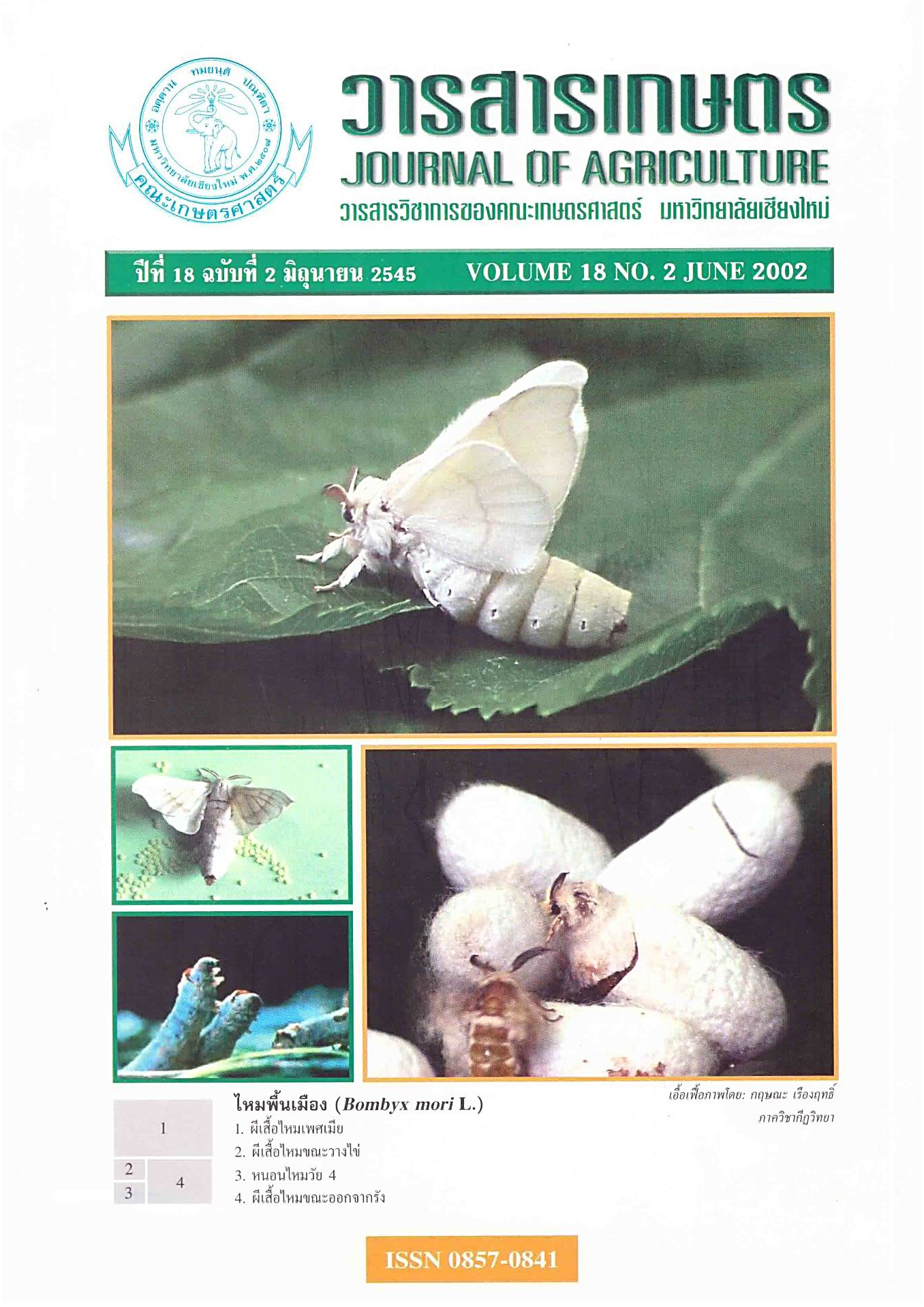
Main Article Content
บทคัดย่อ
พันธุ์ไหมไทยพื้นเมือง (Bombyx mori L.) มีหลายพันธุ์ที่แสดงถึงศักยภาพสำหรับนำไป ปรับปรุงพันธุ์ เพื่อให้ผลิตภัณฑ์จากไหมมีคุณภาพดียิ่งขึ้น อย่างไรก็ตามพันธุ์ไหมไทยพื้นเมืองเหล่านี้มีความสัมพันธ์ที่ใกล้ชิดกันมาก และลักษณะพื้นฐานทางสัณฐานวิทยาโดยเฉพาะในระยะตัวเต็มวัยมีลักษณะที่ไม่แตก ต่างกันทำให้เป็นการยากที่จะจำแนกพันธุ์ไหมในระยะนี้เพื่อใช้ในกระบวนการปรับปรุงพันธุ์ ดังนั้นวิธีทางอณูวิทยาที่นำมาใช้ คือ Polymerase Chain Reaction-Restriction Fragment Length Polymorphism (PCR-RFLP) เพื่อศึกษาความสัมพันธ์ระหว่างพันธุ์ไหมไทยพื้นเมืองทั้ง 5 พันธุ์ ได้แก่ โนนฤาษี นางลาย เขียวสกล นางเหลืองและนางน้อยศรีสะเกษ 1 และใช้ไหมป่า (Philosamia ricini Boisd.) เป็นตัวเปรียบเทียบนอกกลุ่ม โดยศึกษาส่วนของยีน cytochrome oxidase subunit 1–11 gene (COI-Coll gene จากไมโตคอนเดรีย และเพิ่มปริมาณดีเอ็นเอด้วยปฏิกิริยา Polymerase Chain Reaction (PCR) แล้วตัดชิ้นส่วนของดีเอ็นเอเป้าหมายด้วยเอนไซม์ตัดจำเพาะ (restriction enzyme) 9 ชนิดคือ Bfa I, Cla I, Hha I, Mbo I, Mse I, Msp I, Rsa I, Taq I และ Xnm I ที่ไม่สามารถจำแนกไหมป่าและพันธุ์ไหมไทยพื้นเมืองออกจากกันได้ อย่างไรก็ตามมีเอนไซม์ 5 ชนิดที่สามารถตัดชิ้นส่วนของ COI-COII gene เป้าหมายได้ และในจำนวนนี้ พบว่ามีเอนไซม์ 4 ชนิดคือ Bfa I, Mbo I, Rsa I, และ Taq I ผลิตแบบแผนลายพิมพ์ดีเอ็นเอที่สามารถจำแนกไหมป่าและพันธุ์ไหมไทยพื้นเมืองออกจากกันได้ นอกจากนี้พบว่ามีเพียงเอนไซม์เดียวคือ Mse I ที่จำแนกพันธุ์ไหมไทยพื้นเมืองออกจากไหมป่าได้แล้วยังสามารถจำแนกพันธุ์ไหมไทยพื้นเมืองออกจากกันได้เป็น 2 กลุ่ม ได้แก่ กลุ่มที่ 1 คือพันธุ์โนนฤาษี และนางลาย กลุ่มที่ 2 คือพันธุ์เขียวสกล นางเหลือง และนางน้อยศรีสะเกษ 1
Article Details
เอกสารอ้างอิง
วีณา เมฆวิชัย, สุรีรัตน์ เดี่ยววานิชย์ และสุจินดา มาลัย วิจิตรนนท์. 2544. การสกัดดีเอ็นเอ. หน้า 3.1-3.4. ใน: เอกสารประกอบการอบรมเชิงปฏิบัติการเทคนิคเพื่อการศึกษาวิวัฒนาการเชิงโมเลกุล. ภาควิชาชีววิทยาคณะวิทยาศาสตร์ จุฬาลงกรณ์มหาวิทยาลัย, กรุงเทพฯ.
สมโพธิ อัครพันธุ์, 2539. การพัฒนาหม่อนไหมในประเทศไทย. โรงพิมพ์ชุมนุมสหกรณ์การเกษตรแห่งประเทศ ไทย จำกัด, กรุงเทพฯ. 181 หน้า.
สุรินทร์ ปิยะโชคณากุล. 2536. พันธุวิศวกรรมเบื้องต้น. ภาควิชาพันธุศาสตร์ คณะวิทยาศาสตร์ มหาวิทยาลัยเกษตรศาสตร์, กรุงเทพฯ. 258 หน้า.
Hwang, J.S., J.S. Lee, T.W. Goo, E.Y. Yun, H.R. Sohn, H.R. Kim, and O.Y. Kwon. 1999. Molecular genetic relationships between Bombycidae and Satumiidae based on the mitochondrial DNA encoding of large and small rRNA. Genetic Analysis: Biomolecular Engineering 15: 223-228.
Langor, D.W., and F.A.H. Sperling. 1997. Mitochondrial DNA sequence divergence in weevils of the Pissodes strobi species complex (Coleoptera: Curculionidae). Insect Molecular Biology 6(3): 255-265.
Liu, Q.X., H. Ueda, and S. Hirose. 1998. Comparison of sequences of a transcriptional coactivator MBF2 from three lepidopteran species Bombyx mori, Bombyx mandarina and Samia cynthia. Gene 220: 55-59.
Lu, C., Y. Liu, S. Liao, Z. Zhou, Z. Xiang, X. Wang, M. Zhu, and H. Han. 2001. [Online]. Available: http://www.ncbi.nlm.nih.gov/Genbank/index.html. [30 November 2001]
Roehrdanz, R.L. 1993. An improved primer for PCR amplification of mitochondrial DNA in a variety of insect species. Insect Molecular Biology 2(2): 89-91
Roehrdanz, R.L. 1995. Amplification of complete insect mitochondrial genome in two easy pieces. Insect Molecular Biology 4(3): 169–172.
Sihanuntavong, D., S. Sittipraneed, and S. Klinbunga. 1999. Mitochondrial DNA diversity and population structure of the honeybee, Apis cerana, in Thailand. Journal of Apiculture Research 38 (3-4): 211-219.
Tuda, M., T. Fukatsu, and M. Shimada. 1995. Species differentiation of bruchid beetles (Coleoptera: Bruchidae) analyzed by mitochondrial DNA polymorphism. Applied Entomology and Zoology 30(2): 377-380.
Tazima, Y. 1964. The Genetic of Silkworm. Logops Press Limited, London. 253 p.
