
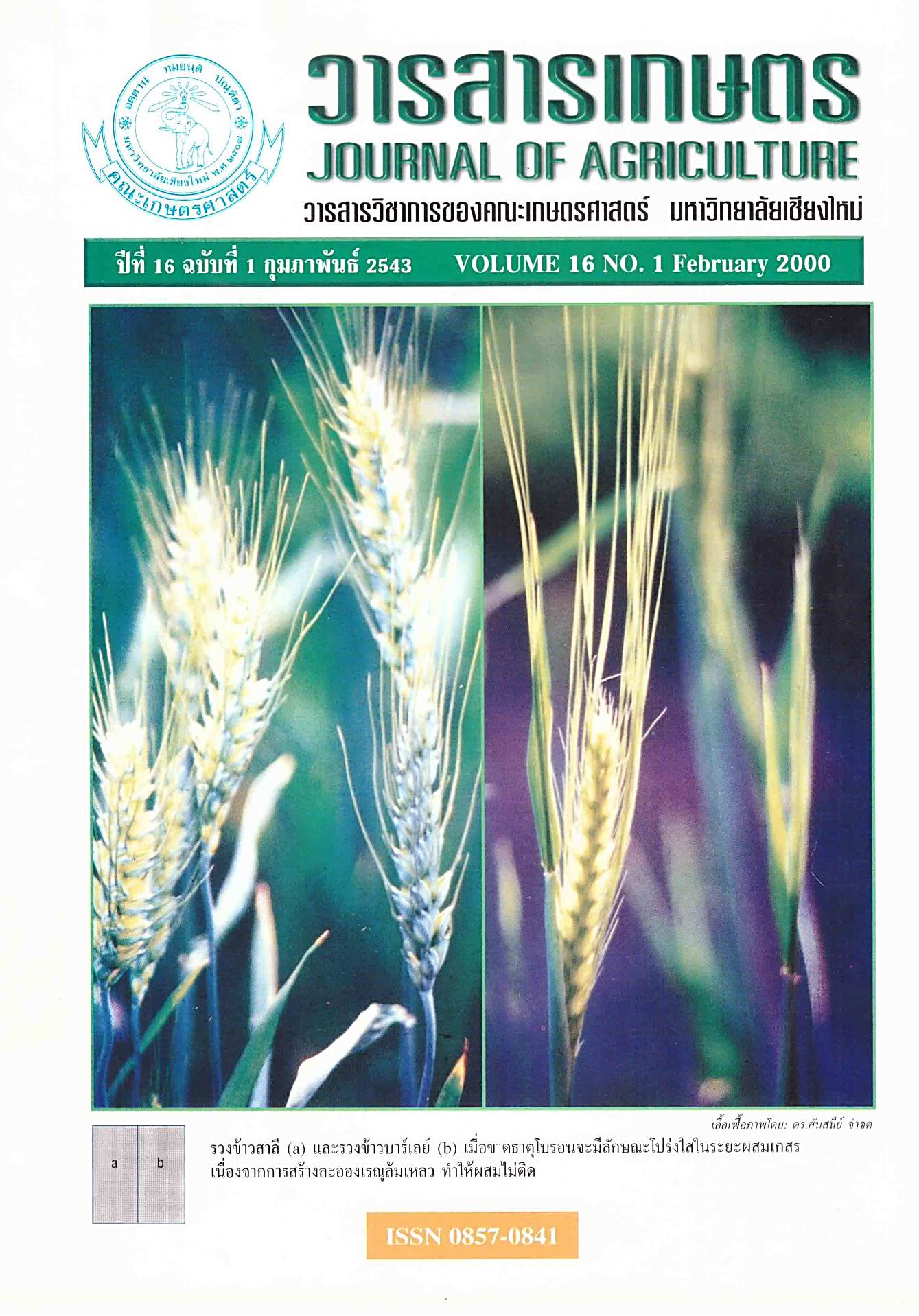
แหล่งพันธุกรรมของความทนทานต่อการขาดธาตุโบรอนในข้าวบาร์เลย์
Article Sidebar
Main Article Content
บทคัดย่อ
การทดลองครั้งนี้ได้ศึกษาการตอบสนองของสายพันธุ์ข้าวบาร์เลย์ต่อการขาดธาตุโบรอน โดยศึกษาในฤดูปลูก 2540/41 และ 2541/42 ในฤดูปลูกแรกเป็นการทดสอบในขั้นต้นโดยใช้สายพันธุ์ข้าวบาร์เลย์จากชุดเปรียบเทียบผลผลิต BTYN 97/98 ปลูกในสภาพขาดโบรอนใน sand culture เปรียบเทียบกับข้าวสาลีพันธุ์มาตรฐานที่ทราบระดับความทนทานต่อการขาดโบรอน เพื่อคัดเลือกสายพันธุ์ข้าวบาร์เลย์ที่มีระดับความทนต่อการขาดโบรอนแตกต่างกันปลูกทดสอบในฤดูปลูกถัดไป
ฤดูปลูกที่สองเป็นการเปรียบเทียบสายพันธุ์ข้าวบาร์เลย์ที่คัดเลือกและข้าวสาลีพันธุ์มาตรฐาน ในแปลงทดลองวางแผนการทดลองแบบ split plot มี 4 ซ้ำ ให้ระดับโบรอน 4 ระดับเป็น main plot และพันธุ์เป็น sub plot พบความแตกต่างระหว่างพันธุ์ข้าวบาร์เลย์ในการตอบสนองต่อระดับธาตุโบรอนในลักษณะจำนวนเมล็ดต่อรวง จำนวนเมล็ดต่อช่อดอก ดัชนีการติดเมล็คและผลผลิต ความแปรปรวนทางพันธุกรรมพบว่าอยู่ในระดับที่ใกล้เคียงกับที่พบในข้าวสาลี ในขณะที่ข้าวบาร์เลย์สายพันธุ์อื่น ๆ มีปัญหาการขาดธาตุโบรอน สายพันธุ์ BRB9604 และ BRB 9642 ทนทานต่อการขาดโบรอนได้ดีพอ ๆ กับข้าวสาลี Fang60 ซึ่งมีความทนทานสูงสุดต่อการขาดโบรอน สายพันธุ์เหล่านี้สามารถแนะนำปลูกหรือใช้เป็นพ่อแม่พันธุ์ในโครงการปรับปรุงพันธุ์เพื่อส่งเสริมปลูกในท้องที่ที่ดินมีปัญหาขาดธาตุโบรอน
Article Details
เอกสารอ้างอิง
เบญจวรรณ ฤกษ์เกษม. 2538. โบรอนในการผลิตถั่วในภาคเหนือ. วารสารดินและปุ๋ย. 16:130-154.
เบญจวรรณ ฤกษ์เกษม และศันสนีย์ จำจด. 2532. การแก้ปัญหารวงลีบเนื่องจากการธาตุโบรอนในข้าวสาลีและข้าวบาร์เลย์. วารสารดินและปุ๋ย. 11:200-209.
สุทัศน์ ปินตาเสน. 2541. ผลของน้ำขังและโบรอนต่อการเป็นหมันของข้าวสาลี. วิทยานิพนธ์วิทยาศาสตร มหาบัณฑิต (เกษตรศาสตร์) สาขาวิชาพืชไร่ มหาวิทยาลัยเชียงใหม่.
Anantawiroon P., K.D. Subedi and B. Rerkasem. 1997. Screening for boron efficiency. In “Boron in Soils and Plants” (Eds.) R.W. Bell and B. Rerkasem.pp. 101-104. Kluwer Academic Publishers, the Netherlands.
Jamjod, S., C.E. Mann and B. Rerkasem. 1992. Screening for boron deficiency in wheat. In “Boron Deficiency in Wheat (Eds.) C.E. Mann and B. Rerkasem. pp. 79-82. CIMMYT Wheat Special Report No.11. CIMMYT, Mexico.
Jamjod, S. and B. Rerkasem. 1998. Boron and sterility in small grain cereals: problem and potential. In “Proc. Thailand International Temperate Cereals Conference” December 11-13, 1997. Chiang Mai, Thailand.
Marschner, H. 1995. Mineral Nutrition of Higher Plants. Academic Press, London. 889 p.
Pant, J., B. Rerkasem and R. Noppakoonwong. 1997. Effect of water stress on the boron response of wheat genotypes under low boron field conditions. Plant Soil 202:193-200.
Rerkasem, B. and S. Jamjod. 1997. Genotypic variation in plant response to low boron and implications for plant breeding. Plant Soil 193:169-180.
Rerkasem, B., S. Lordkaew and B. Dell. 1997. Boron requirement for reproductive development in wheat. Soil Sci. Plant Nutr. 43: 959-957.
Rerkaser, B., D.A. Saunders D.A. and B. Dell. 1989. Grain set failure and boron deficiency in wheat. J. Agric. (CMU) 5:1-10.
