
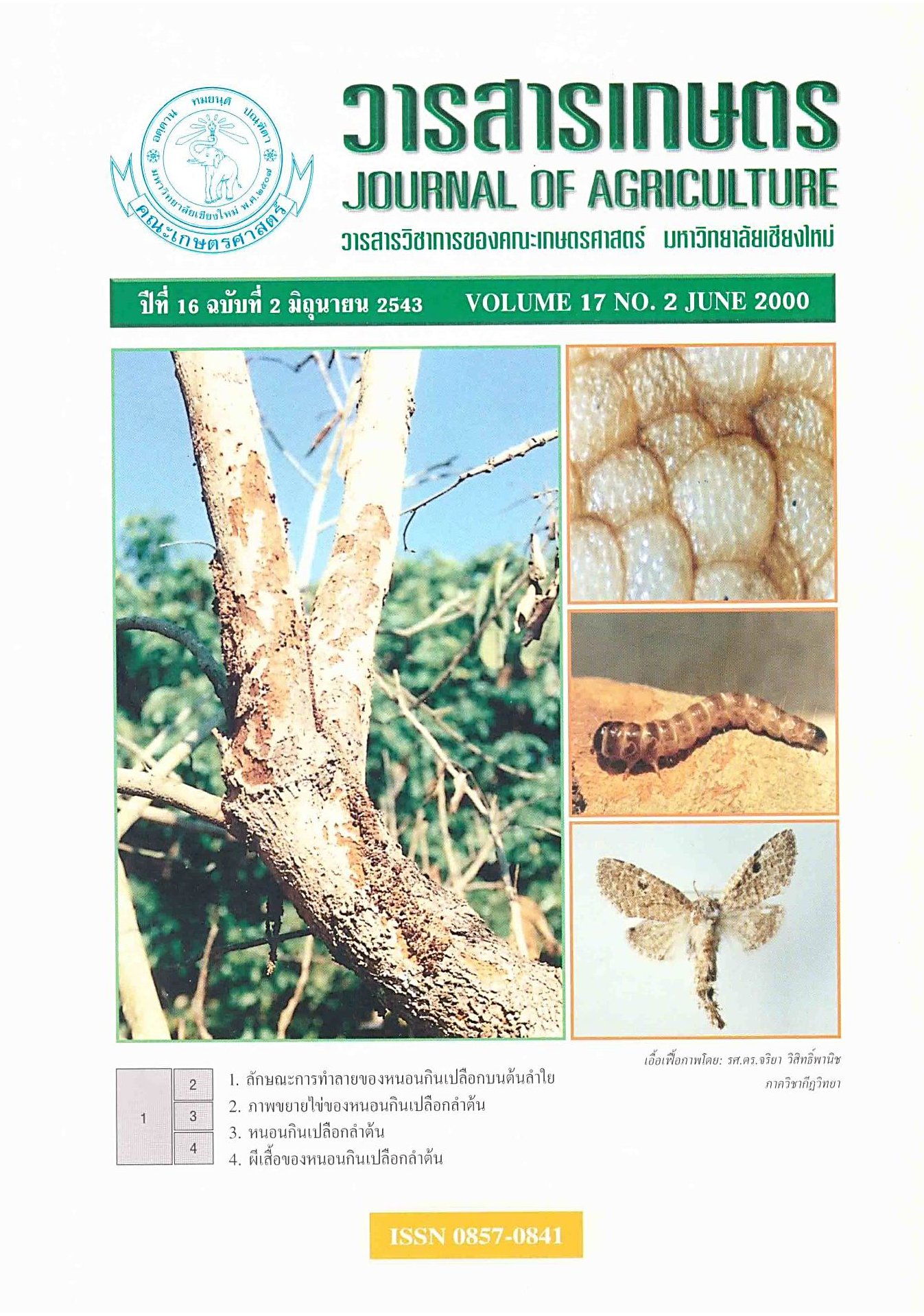
Infestation Characteristics, Life Cycle and Control of Bark Eating Borer <I>Indarbela</I> sp. 1 on Longan Tree
Article Sidebar
Main Article Content
Abstract
Adult male specimens of longan bark eating borer including the mounted genitalia microscopic glass slides were sent to The National History Museum, London, England, for identification. The insect was identified as Indarbela sp. 1 (Lepidoptera: Metarbelidae). Nevertheless, the specific name was undetermined at the moment.
Infestive damages of bark eating borer on declined and normal longan trees at Nam Bo Luang and Mae Hea, Chiang Mai and Pa Heaw, Lam Phun, were investigated. The number of insect infestations were significantly higher on declined trees than the normal one in all observed orchards. Furthermore on declined trees, most of the larvae were perferred to attack at the middle of the longan stems other than on the upper or lower parts of the stems, in the orchards at Nam Bo Luang and Mae Hea. However, the larvae populations of the insect at Pa Heaw were seemed to preferably attack both on the middle and upper positions of stems.
The life cycle of bark eating borer was examined under the laboratory conditions at 25.12 ±1.55 °C and with relative humidity of 58.5±6.67%. Result indicated that incubation period of eggs were approximately 3-4 days. The mean size of the eggs obtained from dissect adult females were 0.41±0.06 mm in width and 0.68 ±0.11 mm in length. The mean fecundity of the each female was 489,60±235.00 eggs.
Larvae under orchard conditions were collected and measured the head capsule sizes to indicate the larval stage. It was revealed that larval stage was divided into 8 instars. On average the geometric growth ratio of the insect was 1.63. The pupal period was 21.00±2.27 days and each size 14.30±2.79 in width and 3.48±0.63 mm in length. Adult moth was medium size. The width of fully expanded wings was 20.09±1.60 mm for male and 25.57±4.06 mm for female. The longevity of adult male and female were 4.81±1.72 and 4.88±1.36 days respectively.
Comparison of larval survival rates on declined and on normal trees were indicated that larvae were survived as high as 33.33% on declined trees whereas 11.67% were survived on normal tree. Most of the adults emerged in April.
Leaf sizes of declined trees were compared between infested and non infested branches. It was found that leaf size obtained from infested was significantly smaller than leaf from non infested branches.
Feeding behavior of the larva was studied under orchard conditions and in the greenhouse by removing all of the constructed tunnel covered the hole and feeding site of the larva and allowed to rebuild it till completion. The tunnel comprised of sticky fine thread like web together with larval feces and small pieces of longan bark. At night time the tunnel was significantly more extend than day time.
Controls of the larva in orchard conditions were trial by using Steinernema carpocapsae nematode at rate of 2,000 larvae/ml., Bacillus thuringiensis (Florbac FC) bacterium and fenitrothion (Sumithion 50% EC) insecticide at rate of 45 and 40 ml/20 liters of water, respectively. The result revealed that biological control of larva by Steinernema carpocapsae nematode was the best treatment. The efficacy of the nematode in control of the larva was significantly higher than bacterium and fenitrothion.
Article Details
References
ฉวีวรรณ หุตะเจริญ. 2533. แมลงศัตรูป่าไม้ของไทย. แสงเทียนการพิมพ์, กรุงเทพฯ. 171 หน้า
ชาตรี สิทธิกุล จริยา วิสิทธิ์พานิช และวิชชา สอาดสุด. 2539. การแพร่กระจายและความเสียหายของลำไยที่เป็นโรคหงอยในจังหวัดเชียงใหม่และลำพูน. วารสารเกษตร 12: 104-114.
สิริวัฒน์ วงษ์ศิริ. 2526. แมลงศัตรูพืชทางการเกษตรของประเทศไทย. สำนักพิมพ์โอเดียนสโตร์, กรุงเทพฯ. 424 หน้า.
สำนักงานเศรษฐกิจการเกษตร. 2538. ข่าวเศรษฐกิจการเกษตร. สำนักงานเศรษฐกิจการเกษตร, กระทรวงเกษตรและสหกรณ์, กรุงเทพฯ 41: 14-19.
Beeson, C. F. G. 1941. The Ecology and Control of the Forest Insects in India and Neighboring Countries. Goverment Printing Office, Madras. 767 pp.
Holloway, J. D. 1986. The Moth of Borneo’ s Key to Families : Family Cossidae, Metarbelidae, Ratardidae, Dudgeoneridae, Epipyropidae and Limacodidae. Malaysia. Natural Journal 40: 1-116.
Subhadrabandhu, S. 1990. Lychee and Longan Cultivation in Thailand. Department of Horticulture, Kasetsart University, Bangkok. 41 pp.
Vite, G. M. 1961. The influence of Water Supply on Oleoration Exudation Pressure and Resistance Bark Beetle Attack in Pinus pondorasa. Contrib. Boyce Thompson Inst 21 : 37-66.
