
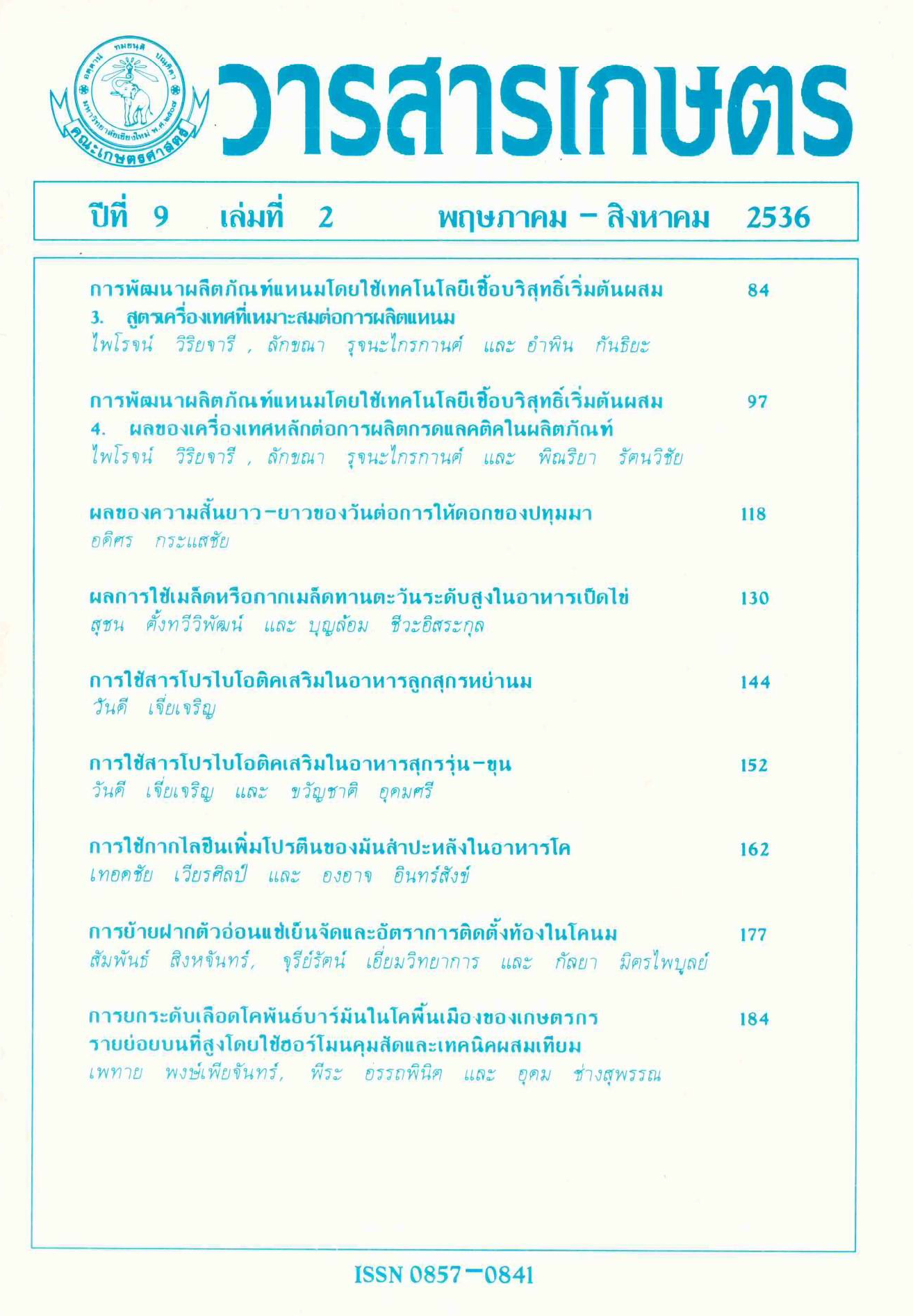
NHAM PRODUCT DEVELOPMENT USING MIXED BACTERIAL STARTER CULTURES 3. SUITABLE SPICES FORMULATION FOR NHAM PRODUCTION
Article Sidebar
Main Article Content
Abstract
For Nham formulation development, the use of different types of spices together with mixed bacterial starter cultures was established to investigate the rate of acid production and consumer acceptability. In this experiment, there were 6 types of spices used in Nham formulation such as white pepper powder, cinnamon, licorice, fresh white turmeric, coriander seed powder, and fresh ginger. It was found that the use of fresh white turmeric (4.0%) with minced garlic and bird chilli (4.0% and 2.0% respectively) was suitable for acid development in Nham. Because of this, the total acidity in the product increased upto 1.3533 ± 0.025% after 48 hours of fermentation consequently, the pH decreased to 4.30 ± 0.01. On account of the increase in acidity, the reducing sugars were totally used of 92.28%. Accordingly, the system was more acid after production, residual nitrite was rapidly changed to develop the pink colour. There were 123.4100 ± 0.6928 ppm after production and 20.6167 ± 0.8372 ppm after 48 hours of fermentation.
The Panelists did not accept and did not prefer to the product used cinnamon as spice in formulation for all attributes. Nevertheless, the use of other spices in Nham formulation was more acceptable and preferable.
Article Details
References
วิริยจารี, ไพโรจน์, และหันพงศ์กิตติกุล, อรัญ. (2533, 2535). ปฏิบัติการอุตสาหกรรมการหมัก. ภาควิชาวิทยาศาสตร์และเทคโนโลยีการอาหาร คณะอุตสาหกรรมเกษตร มหาวิทยาลัยเชียงใหม่.
AOAC. (1984) Official methods of Analysis (131d ed.) Association of Official Analyticalists, Washington D.C., USA
Bacus, J. (1984) Utilization of Microorganisms in Meat Processing. Research Studies Press. Ltd., England.
Gatchalian, M.M. (1981). Sensory Evaluation Methods with Statistical Analysis. Collage of Home Economics, University of the Philippiness, Philippines.
Ingolf, F.N., and Skjelkvale, R. (1982). Effect of natural spices and oleoresins on Lactobacillus plantarum in fermentation of dry sausage. J. Food Sci. 47: 1618-1621 and 1625.
Institute of Food Technologists. (1981). Sensory evaluation guide for testing food and beverage products. Food Technology 35(11): 50-59.
Larmond, E. 1977. Laboratory Methods for Sensory Evaluation of Food Research Branch, Canada Department of Agriculture, Publication 1637, Food Research Institute, Ottawa, Ont.
Miller, G.L (1959). Use of dinitrosalicylic acid reagent for determination of reducing sugars. Analytical Chemistry 31: 426-428.
Pearson, D. (1976). The Chemical Analysis of Foods. Churchill Livingstone. London and New York. Salzer, U.J., Broeker, U., Klie, H.F. and Liepe, H.U. (1977). Effect of pepper and pepper constituents on the microflora of sausage products. Fleischwirtschaft 57(11): 2011-2014.
Walonick, D.S. (1987). Stat-Packets. Walonick Associates Inc., Minneapoils, MN.
Wiriyacharee, P. (1990). The Systematic Development of a Controlled Fermentation Process Using Mixed Bacterial Starter Cultures for Nham, a Thai Semi-dry Sausage. Ph.D. Thesis in Product Development in Food Fermentation, Massey University, New Zealand.
Zaika, LL., and Kissinger, J.C. (1979). Effect of some spices and acid production by starter cultures. J. Food Protect. 42: 572-576.
Zaika, LL, and Kissinger, J.C. (1984). Fermentation enhancement by spices: Identification of active component. J. Food Sci., 49: 5-9.
