Guidelines Development for Participatory Forest Fire and Haze Management Khao I-To Waterfall National Reserved Forest, Prachinburi Province
Article Sidebar
Main Article Content
Abstract
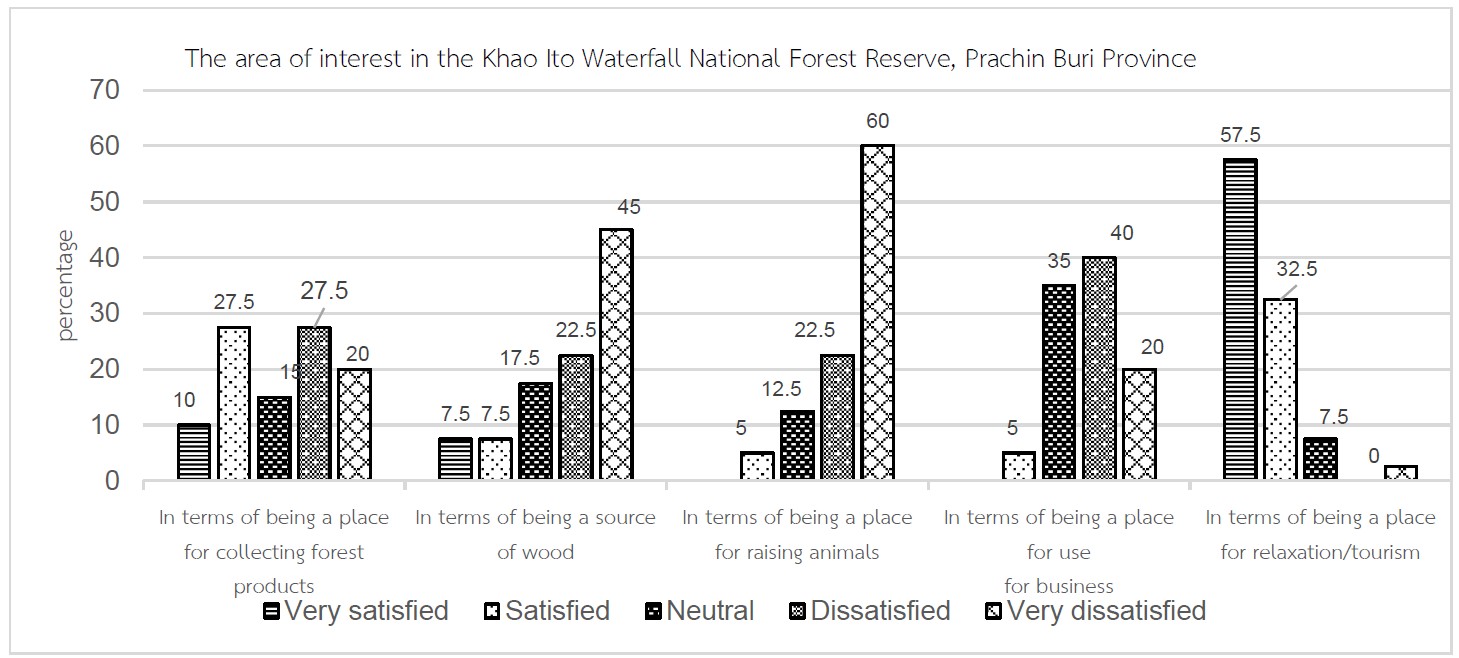
This research aimed to analyze stakeholders in forest fire and haze management by searching for stakeholders using the Snowball Sampling method and developing a participatory forest fire and haze management approach. The results of the study found that 40 stakeholders could be identified, divided into four groups using the Role-Interest Matrix: 1. High-Power and High-Interest group (Players) 2. High-Power but Low-Interest group (Context Setters) 3. Low-Power but High-Interest group (Subject) Forest Protection Unit Officer, (Khao Ito) 4. Low-Power and Low-Interest group (Crowd) While the opinions of stakeholders related to forest fire and haze management found that all stakeholders saw that the Khao Ito Waterfall National Forest Reserve in Prachin Buri Province was important and gave importance to the area for recreation/tourism, receiving the highest score of 177 points. The information sources on the campaign and public relations for forest fire and haze prevention found that most stakeholders received information on the campaign and public relations for forest fire and haze prevention from forestry officials/government officials. All stakeholders were aware that there were currently laws, regulations, and measures for forest fire and haze prevention in Prachin Buri Province. Stakeholders had the highest level of knowledge and understanding of laws, regulations, and measures for forest fire and haze prevention in Prachin Buri Province. Most stakeholders thought that the existing laws, regulations, and measures for forest fire and haze prevention could help reduce forest fire and haze problems. Most stakeholders thought that forest fires in the area were decreasing. The causes of forest fires and haze were mostly due to carelessness, and the loss of natural beauty was the impact of forest fire and haze with the highest level of impact.
Downloads
Article Details

This work is licensed under a Creative Commons Attribution-NonCommercial-NoDerivatives 4.0 International License.
ข้าพเจ้าและผู้เขียนร่วม (ถ้ามี) ขอรับรองว่า ต้นฉบับที่เสนอมานี้ยังไม่เคยได้รับการตีพิมพ์และไม่ได้อยู่ในระหว่างกระบวนการพิจารณาตีพิมพ์ลงในวารสารหรือสิ่งตีพิมพ์อื่นใด ข้าพเจ้าและผู้เขียนร่วม (ถ้ามี) ยอมรับหลักเกณฑ์และเงื่อนไขการพิจารณาต้นฉบับ ทั้งยินยอมให้กองบรรณาธิการมีสิทธิ์พิจารณาและตรวจแก้ต้นฉบับได้ตามที่เห็นสมควร พร้อมนี้ขอมอบลิขสิทธิ์ผลงานที่ได้รับการตีพิมพ์ให้แก่วารสารวนศาสตร์ คณะวนศาสตร์ มหาวิทยาลัยเกษตรศาสตร์ กรณีมีการฟ้องร้องเรื่องการละเมิดลิขสิทธิ์เกี่ยวกับภาพ กราฟ ข้อความส่วนใดส่วนหนึ่ง หรือ ข้อคิดเห็นที่ปรากฏในผลงาน ให้เป็นความรับผิดชอบของข้าพเจ้าและผู้เขียนร่วม (ถ้ามี) แต่เพียงฝ่ายเดียว และหากข้าพเจ้าและผู้เขียนร่วม (ถ้ามี) ประสงค์ถอนบทความในระหว่างกระบวนการพิจารณาของทางวารสาร ข้าพเจ้าและผู้เขียนร่วม (ถ้ามี) ยินดีรับผิดชอบค่าใช้จ่ายทั้งหมดที่เกิดขึ้นในกระบวนการพิจารณาบทความนั้น”
References
Amlao, S. 2015. An Analysis of Forest Fier Effect on Tourism in Nam Nao National Park. Naresuan University, Phitsanulok, Thailand. (in Thai)
Cohen, J.M., Uphoff, N.T. 1981. Rural Development Participation: Concept and Measures for Project Design Implementation and Evaluation. Cornell University, New York.
Department of Health, Ministry of Public Health. 2015. Standards for Monitoring Health Effects from Dust Particles Smaller than 10 Microns (PM10). Technology Promotion Association (Thai-Japan), Bangkok, Thailand. (in Thai)
Forest Fire Control Office, RFD. 2000. Forest Fire Control Policy. Forest Fire Control Office, Royal Forest Department, Bangkok, Thailand. (in Thai)
Hutanuwatr, N., Hutanuwatr N. 2002. SWOT: Strategic Planning for Community Enterprises. 5th ed. Local Development Institute, Bangkok, Thailand. (in Thai)
Intamat, P., Kreuma, K., Khayo, T., Pakkhettanan, J. Khayo, P. 2021. People’s participation and knowledge in Forest Fire Control. Thai Journal of Forest Ecology Research, 5(2): 61-76. (in Thai)
Ketpranit, S., Tangtham, N., Saengthongprao, S., Thammanon, P., Phumiphaphan, N., Akka-akon, S. 1991. Complete Report on Forest Fires and their Impacts on Forest Systems in Thailand. Faculty of Forestry, Kasetsart University, Bangkok, Thailand. (in Thai)
Khunthong, S., Mianmit, N., Wanthongchai, K. 2024. Guidelines for Forest Fire Management in Community Forest at MaePong sub-district, Doi Saket district,Chiang Mai province. Thai Journal of Forestry, 43(1): 87-97. (in Thai)
Komonkhongyu, S. 2018. Guide to Networking and Public Participation in Preventing and Solving Forest Fire and Haze Problems. Department of National Parks, Wildlife and Plant Conservation, Bangkok, Thailand. (in Thai)
Mendelow, A. 1991. Stakeholder Mapping. In: Proceedings of the 2nd International Conference on Information Systems, Cambridge, UK.
Nakseeharach, D. 2016. Forest Laws of ThaiLand and the dynamics of Asean cooperation for preventing transboundary haze pollution from Forest Fires. Journal of Environmental Management, 12(1): 98–113. (in Thai)
Olander, S., Landin, A. 2005. Evaluation of stakeholder influence in the implementation of construction projects. International Journal of Project Management, 23: 321-328.
Royal Forest Department. 2020. Active Fire Hotspot Database from Satellite Images by FIRMS & NOAA. https://wildfire.forest.go.th/firemap/index.html, 21 February 2025.
Samchusri, S., Niyom, V., Rattana, K. 2012. People participation in forest fire protection for a forest development and swamp ecosystem under the Royal Pakpanang Watershed Project, Suanluang subdistrict, Chaloem Phra Kiat district, Nakhon Si Thammarat province. Thai Journal of Forestry, 31(3): 75-84. (in Thai)
Suwan, P. 1983. Attitude: Measurement of Change and Health Behavior. Odeon Store Publishing, Bangkok, Thailand. (in Thai)
Songma, N., Manorom, K., Srikham, W., Thongtua, K. 2012. Co-manangement of Forest Fire Control between government and communities: A case study of Dongyai Forest, Sangtornoi sub – district, Amnatcharoen province, Thailand. Journal of Liberal Arts, Ubon Ratchathani University, 8(1): 197–215. (in Thai)
