
Possibility of Using Organic Rice Straw Fermentation Liquid to Replace Chemical Fertilizers in Water Meal (Wolffia sp.) Cultivation
DOI:
https://doi.org/10.14456/jare-mju.2026.27Keywords:
Wolffia sp., organic fertilizer, rice straw fermentation liquid, water meal productionAbstract
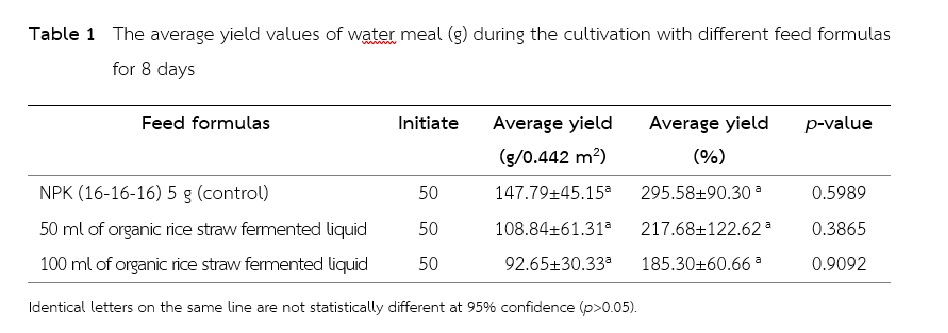
This study aimed to compare the yields of water meal (Wolffia sp.) Cultivated in feed formulas containing different levels of organic rice straw fermentation the liquid as an ingredient, and water quality in the cultivating ponds. The experiments were conducted using a Completely Randomized Design (CRD) divided into three treatments with three replications each. Treatment 1 used 5 g of NPK (16-16-16) fertilizer (control formula), while 50 and 100 ml of organic rice straw fermentation liquid were used for treatments 2 and 3, respectively. All treatments used 50 grams of fresh water meal and 50 liters of water in a circular cement pond with a surface area of 0.442 m2, and the study period was 8 days.
The results showed that the yield of water meal and water quality were not statistically different at the 95 percent confidence level (p>0.05). Therefore, there is a possibility of using organic rice straw fermentation liquid to replace chemical fertilizers in the production of organic water meal for human and animal’ food in the future.
References
Abdelhamid, T. 2004. The Self-destruction and Renewal of Loan Construction Theory: A Prediction form Boyd’s Theory. pp. 1–19. In 12th Annual Conference of the International Group for Lean Construction. Elsinore: International Group for Lean Construction.
Alianto, A., E.M. Adiwilaga and A. Damar. 2004. Primary productivity of phytoplankton and its relationships with nutrients and light in the waters of Banten bay. Journal of Fisheries and Aquatic Science 15: 21–26. [in Indonesian]
Appenroth, Klaus-J., K. S. Sree, M. Bog, J. Ecker, C. Seeliger, V. Böhm, S. Lorkowski, K. Sommer, W. Vetter, K. Tolzin-Banasch, R. Kirmse, M. Leiterer, C. Dawczynski, G. Liebisch and G. Jahreis. 2018. Nutritional value of duckweed species of the genus Wolffia (Lemnaceae) as human food. Frontiers in Chemistry 6(483): 1–13. https://doi.org/10.3897/zookeys.695.13771
Bever, A. De., P.A. Ndakidemi and C.P. Laubscher. 2012. Effects of different combinations of Hoagland’s solution and Azolla filiculoides on growth and development of Beta vulgaris subsp. cycla ‘Fordhook Giant’ grown in hydroponic cultures. International Journal of the Physical Sciences 7(33): 5281–5287. https://doi.org/10.5897/IJPS12.320
Braglia, L., M. Lauria, K.J. Appenroth, M. Bog, D. Breviario, A. Grasso, F. Gavazzi and L. Morello. 2021. Duckweed species genotyping and interspecific hybrid discovery by tubulin-based polymorphism fingerprinting. Frontiers in Plant Science 12: 625670. https://doi.org/10.3389/fpls.2021.62567
Chookhampaeng, S., S. Puntura and C. Chookhampaeng. 2022. Effect of light, aeration and nutrient concentration on Wolffia (Wolffia globosa (Roxb.) Hartog and Plas) growth. Asian Journal of Plant Sciences (21): 559–564. https://doi.org/10.3923/ajps.2022.559.564
Giel, P. and K. Bojarczuk. 2011. Effects of high concentrations of calcium salts in the substrate and its pH on the growth of selected rhododendron cultivars. Acta Societatis Botanicorum Poloniae 80(2): 105–114. https://doi.org/10.5586/asbp.2011.021
Gougoulias, N. 2015. Study on polyphenols content and antioxidative properties of whole grain flours from some cereal and leguminous crops. Oxidation Communications 38(1): 46–54.
Hu, Z., F. Yang, Y. Zhuolin, T. Xueping, L. Jinmeng, J. Yanling, H. Kaize, L. Penghui, D. Anping, H. Yuhong and Z. Hai. 2022. Determining the nutritional value and antioxidant capacity of duckweed (Wolffia arriza) under protein artificial conditions. LWT- Food Science and Technology 153(7): 112477. https://doi.org/10.1016/j.lwt.2021.112477
Ivan, K. and V. Katya. 2013. Wolffia globosa (Roxburgh) Hartog Et Las (Lemnaceae): a new species in Bulgarian flora. Journal of Biological and Scientific Opinion 1(4): 356–357. https://doi.org/10.7897/2321-6328.01416
Ketkaew N. and L. Innoom. 2022. Effects of Using Combined Feeding Commercial Diet and Water Meal on Growth of Hybrid Catfish (Clarias macrocephalus x Clarias gariepinus). pp. 97–105.
In Academic Conference 6th National Vocational Education Technology and Innovation Conference, September 9, 2022, Miracle Grand Convention Hotel. Bangkok: Northern Vocational Education Institute 2. [in Thai]
Ketkaew, N. and S. Rakthai. 2021. Efficiency of Wolffia globosa (L.) Wimm production under light control system. Journal of Agricultural Research and Extension 39(3): 89–99. [in Thai]
Landolt, E. and R. Kandeler. 1987. Biosystematic Investigations in the Family of Duckweed (Lemnaceae). Vol. 2. Stiftuung Rübel, Zurich: Veroff. Geobot. Inst. ETH. 95 p.
Mani, N. and S. Ngoijansri and J. Pholsan. 2021. Study on the raising of carp by using water meal as food in the earthen pond of farmers, Yasothon Province.Retrieved from https://www4.fisheriesgo.th/local/filedocument/20220926113628_1_file.pdf [in Thai]
Matchakeo, U., S. Phaewcham and K. Lommetta. 2015. The Use of Dried Ground Taro to Replace Soy Bean in the Formula Diel of Feeding Silver Barb and Grass Carp. pp. 125-135. In The 9th Rampaiphanni Research Conference “Integrating Research for Sustainable Local Development”. Chanthaburi: Rambhai Barni Rajabhat University. [in Thai]
Moon, B. 2025. Wastewater treatment with leaves natural innovations that are treated with nature. Retrieved from https://wolffiaplus.com/author/admin_blurrymoon/ [in Thai]
Munkit, J. 2018. Effects of water meal feed and stocking density on growth of tinfoil barb (Barbonymus schwanenfeldii). Veridian E-Journal Science and Technology Silpakorn University 5(1): 1–13. [in Thai]
Panwanichdamrong, K. 2009. Study of Factors Affecting the Growth of Wolffia eggs (Wolffia arrhiza (Linn.) Wimm.) and Mass Propagation Methods. Master Thesis. Kasetsart University. 97 p. [in Thai]
Phichit Freshwater Aquaculture Research and Development Center. 2021. Cultivation of water meal in cement ponds. Retrieved from https://www4.fisheries.go.th/local/file_document/20221012095559_1_file.pdf [in Thai]
Raksaphram, S. and N. Ratchaphimon. 2018. The Effect of Replacing Fish Meal with Water Meal in the Formula for Raising Goldfish. pp. 1–5. In National Academic Conference “Walailak Research” 10th time. Nakhon Si Thammarat: Walailak University. [in Thai]
Rodroil, A., S. Nukwan S. Tiranarat and M. Aiumsub. 2009. Species and Distribution of Aquatic Plants in the East of Thailand. Bangkok: Institute of Aquatic Plants and Ornamental Fish Research, Department of Fisheries. 290 p. [in Thai]
Rodroil, A., S. Nukwan and U. Saijan. 2012. Species and Distribution of Aquatic Plants in the Upper-Northeast of Thailand. Bangkok: Institute of Aquatic Plants and Ornamental Fish Research, Department of fisheries. 316 p.
Rowchai, S. and S. Somboon. 2007. Study on factors effecting growth of wolffia (Wolffia arrhiza (L.) (Wimm.). Fisheries Journal 60(5): 405–413. [in Thai]
Ruekaewma, N., S. Piyatiratitivorakul and S. Powtongsook. 2015. Culture system for Wolffia globosa L. (Lemnaceae) for hygiene human food. Songklanakarin Sci. Technol 37(5): 575–580. [in Thai]
Sanwila, S. 1999. Growth and Amount of Prodine of Water Meal (Wolffia arrhiza (Linn.) Wimm.) Cultivated with Different Food Formulas and Light Intensity Levels in Outdoor Conditions. Master Thesis. Mahasarakham University. 80 p. [in Thai]
Sodkomkham, S. 2024. Fish sandwiches, natural food, easy to make, not much investment, helps save on fish food costs. Retrieved from https://www.khaosod.co.th/technologychaoban/techno-news/article_270812 [in Thai]
Somboon, S. 2015. Cultivation and Utilization of Water Meal (Wolffia arrhiza (L.) Wimm). Kasetsart News 60(2): 61–72. [in Thai]
Spring Green Evolution Co., Ltd. 2023. Benefits of rice straw and processing to increase agricultural value. Retrieved from https://www.sgethai.com
Suphanburi Provincial Agriculture Office. 2025. Rice straw…an important resource that Thai farmers should not overlook. Retrieved from https://suphanburi.doae.go.th/?p=880 [in Thai]
Tan, S.P., S.E. Parks, C.E. Stathopoulos and P.D. Roach. 2014. Greenhouse-grown bitter melon: production and quality characteristics. Journal of the Science of Food and Agriculture 94(9): 1896–1903. https://doi.org/10.1002/jsfa.6509
Terra-Gro Fertilizer Co., Ltd. 2023. Farmer's guide. Retrieved from https://puimongkut.com/en/site/farmerguide
Xu, J., H. Zhao, A. Stomp and J.J. Cheng. 2012. The production of duckweed as a source of biofuels the production of duckweed as a source of biofuels. Biofuels 3: 589–601. https://doi.org/10.4155/bfs.12.31
Zhubin, H., Y. Fang, Z. Yi, X. Tian, J. Li, Y. Jin, K. He, P. Liu, A. Du, Y. Huang and H. Zhao. 2022. Determining the nutritional value and antioxidant capacity of duckweed (Wolffia arrhiza) under artificial conditions. LWT-Food Science and Technology 153(2022): 112477. https://doi.org/10.1016/j.lwt.2021.112477
Downloads
Published
How to Cite
Issue
Section
License
Copyright (c) 2026 Journal of Agricultural Research and Extension

This work is licensed under a Creative Commons Attribution-NonCommercial-NoDerivatives 4.0 International License.
This article is published under a Creative Commons Attribution-NonCommercial-NoDerivatives 4.0 International License (CC BY-NC-ND 4.0), which allows others to share the article with proper attribution to the authors and prohibits commercial use or modification. For any other reuse or republication, permission from the journal and the authors is required.