การศึกษาเปรียบเทียบปริมาณสารออกฤทธิ์ทางชีวภาพและสภาวะที่เหมาะสมในการสกัดสาร โดยเทคนิคไมโครเวฟในดอกกล้วยไม้เอื้องผึ้ง
DOI:
https://doi.org/10.14456/jare-mju.2026.10คำสำคัญ:
กล้วยไม้เอื้องผึ้ง , สารออกฤทธิ์ทางชีวภาพ , สารฟลาโวนอยด์บทคัดย่อ
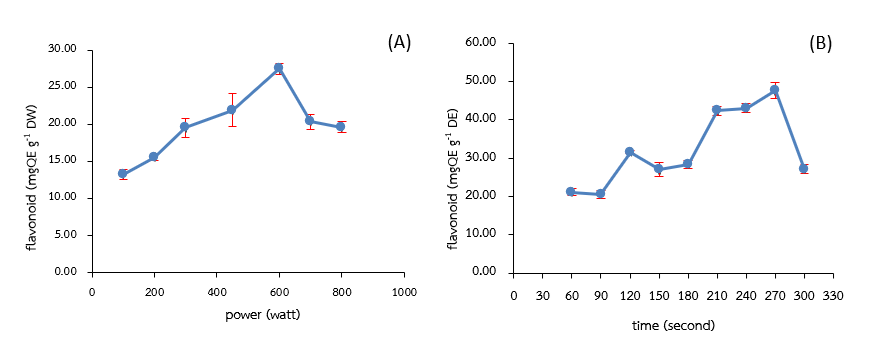
การศึกษาเปรียบเทียบปริมาณสารออกฤทธิ์ทางชีวภาพและสภาวะที่เหมาะสมในการสกัดสารโดยเทคนิคไมโครเวฟในดอกกล้วยไม้เอื้องผึ้ง ได้ทำการทดสอบเปรียบเทียบปริมาณสารจากชิ้นส่วนลำต้น ใบ ดอก และราก โดยนำส่วนต่าง ๆ เหล่านี้มาทำการสกัดด้วยคลื่นไมโครเวฟ หลังจากนั้นนำสารสกัดที่ได้ไปทำการวิเคราะห์หาปริมาณสารประกอบฟีนอลรวมด้วยวิธี Folin-ciocalteu สารประกอบฟลาโวนอยด์รวมด้วยวิธีอะลูมิเนียมคลอไรด์ ฤทธิ์ต้านอนุมูลอิสระวิเคราะห์ด้วยวิธีการยับยั้งด้วย 2, 2-Dyphenyl-1-picrylhydrazyl (DDPH) และฤทธิ์ในการยับยั้งการทํางานของเอนไซม์ ไทโรซิเนสด้วยวิธี Modified dopachrome พบว่าส่วนดอกมีปริมาณสารฟลาโวนอยด์มากที่สุด ที่ปริมาณ 32.53±0.76 mg QE g-1 DW ทดสอบสภาวะที่เหมาะสมในการสกัดสารโดยเทคนิคไมโครเวฟ ด้วยปัจจัยที่แตกต่างกัน คือ กำลังไฟที่ใช้ในการสกัด ระยะเวลาที่ใช้ในการสกัด อัตราส่วนเอทานอลต่อน้ำ รวมทั้งจำนวนครั้งในการสกัด พบว่ากำลังไฟฟ้าที่ใช้ในสกัดที่เหมาะสม คือ 600 วัตต์ ระยะเวลาในการสกัด คือ 270 วินาที อัตราส่วน (ethanol : water) คือ 100:0 และใช้จำนวน 1 ครั้งในการสกัดให้ผลดีที่สุด การศึกษานี้แสดงให้เห็นว่าดอกกล้วยไม้เอื้องผึ้งมีสารออกฤทธิ์ทางชีวภาพ ที่สามารถนำไปเป็นส่วนผสมของยาหรือผลิตภัณฑ์บำรุงผิว และทราบวิธีการสกัดสารโดยเทคนิคไมโครเวฟที่เหมาะสม สามารถเป็นแนวทางในการศึกษาวิจัยให้แก่นักวิจัย นักศึกษา และผู้ที่สนใจทั่วไปนำไปต่อยอดงานวิจัยในอนาคตได้
เอกสารอ้างอิง
Chang, C.H., H.Y. Lin, C.Y. Chang and Y.C. Liua. 2006. Comparisons on the antioxidant properties of fresh, freeze-dried and hot-air-dried tomatoes. Journal of Food Engineering 77: 478–485.
Mapoung, S., W. Semmarath, P. Arjsri, S. Umsumarng, K. Srisawad, P. Thippraphan, S. Yodkeeree and P. Limtrakul (Dejkriengkraikul). 2021. Determination of phenolic content, antioxidant activity, and tyrosinase inhibitory effects of functional cosmetic creams available on the Thailand market. Plants 10(1383): 1–18.
Nguyen, H.A., K.H. Lin, M.Y. Huang, C.M. Yang, T.H. Shin, T.C. Hsiung, Y.C. Lin and F.C. Tsao. 2018. Antioxidant activities of the methanol extracts of various parts of Phalaenopsis orchids with white, yellow, and purple flowers. Notulae Botanicae Horti Agrobotanici Cluj-Napoca 46(2): 457–465.
Obsuwan. K., B.R. Jeong and S. Maksup. 2019. Analysis of bioactive compounds, polysaccharides and antioxidant activity in different parts of Dendrobium Sonia Jo Daeng. Science, Engineering and Health Studies 13(2): 73–82.
Phunsawan, B. 2013. Free radicals, antioxidants, and antioxidant activity analysis. Journal of Science and Technology 21(3): 275–286.
Singh, R.P., K.N. Chidambara and G.K. Jayaprakasha 2002. Studies on the activity of pomegranate (Punica granatum) peel and seed extracts using in vitro models. Journal of Agricultural and Food Chemistry 50(1): 81–86.
Siriwattanamethanon, N. 2020. Multi-coloured food there are many benefits (Part 1): what are multicolored foods. Retrieved from https://pharmacy.mahidol.ac.th/knowledge/files/0148.pdf [in Thai]
Sopittummakhun, K. and P. Rattanasinganchan. 2017. Extraction and determination of antioxidant activity in herbal plant. Huachiew Chalermprakiet Science and Technology Journa 3(1): 86–94. [in Thai]
Suedee, A. 2017. Microwave-assisted extraction of active compounds from medicinal plants. EAU HEritAgE JoUrnAlScience and Technology 11(1): 1–14. [in Thai]
Taokaenchan, N., K. Areesrisom, P. Areesrisom, Y. Maifaey, J. Philadee and S. Sateinperakul. 2021. Contents of phenolic, flavonoid and antioxidant activity of Dendrobium spp. in Maejo University, Chiang Mai province. Journal of Science and Technology Yala Rajabhat University 7(1): 21–28. [in Thai]
Taokaenchan, N., K. Areesrisom, P. Areesrisom, V. Maifaey, R. Kongtanajaruanun and S. Sateinperakul. 2022. Comparison of different extraction methods and solvent ratios on yield, content of total phenolic and flavonoid in Kaempferia parviflora Wallich. ex Baker. Maejo Journal of Agricultural Production 4(1): 77–90. [in Thai]
Thanaphat, S. 2016. Extraction of active chemical constituent of herbal medicinal plant using microwave-assisted extraction technique. Retrieved from https://ccpe.pharmacycouncil.org/showfile.php?file=79
Ueda, Y., N. Apiphuwasukcharoen, S. Tsutsumi, Y. Matsuda, V. Areekul and S. Yasuda. 2019. Optimization of hot-water extraction of dried yacon herbal tea leaves: enhanced antioxidant activities and total phenolic content by response surface methodology. Food Science and Technology Research 25(1): 131–139.
Watcharakupt, O., P. Bunjong, C. Boonyarat and A. Sinthong. 2007. Radical Scavenging Agent. Bangkok: New Thaimit Printing. 262 p. [in Thai]
Yan, M-M, W., Liu, Y-J. Fu, Y-G. Zu, C-Y. Chen and M. Luo. 2010. Optimisation of the microwave-assisted extraction process for four main astragalosides in Radix astragali. Food Chemistry 119(4): 1663–1670.
ดาวน์โหลด
เผยแพร่แล้ว
รูปแบบการอ้างอิง
ฉบับ
ประเภทบทความ
สัญญาอนุญาต
ลิขสิทธิ์ (c) 2026 วารสารวิจัยและส่งเสริมวิชาการเกษตร

อนุญาตภายใต้เงื่อนไข Creative Commons Attribution-NonCommercial-NoDerivatives 4.0 International License.
บทความนี้ได้รับการเผยแพร่ภายใต้สัญญาอนุญาต Creative Commons Attribution-NonCommercial-NoDerivatives 4.0 International (CC BY-NC-ND 4.0) ซึ่งอนุญาตให้ผู้อื่นสามารถแชร์บทความได้โดยให้เครดิตผู้เขียนและห้ามนำไปใช้เพื่อการค้าหรือดัดแปลง หากต้องการใช้งานซ้ำในลักษณะอื่น ๆ หรือการเผยแพร่ซ้ำ จำเป็นต้องได้รับอนุญาตจากวารสาร