
ผลของตำแหน่งชิ้นส่วนใบต่อการชักนำแคลลัสในกาแฟโรบัสต้าพันธุ์ชุมพร 2
DOI:
https://doi.org/10.14456/jare-mju.2026.22คำสำคัญ:
การเพาะเลี้ยงเนื้อเยื่อกาแฟ, กาแฟโรบัสต้า, พันธุ์ชุมพร 2 , การชักนำแคลลัส , การสร้างแผลใบบทคัดย่อ
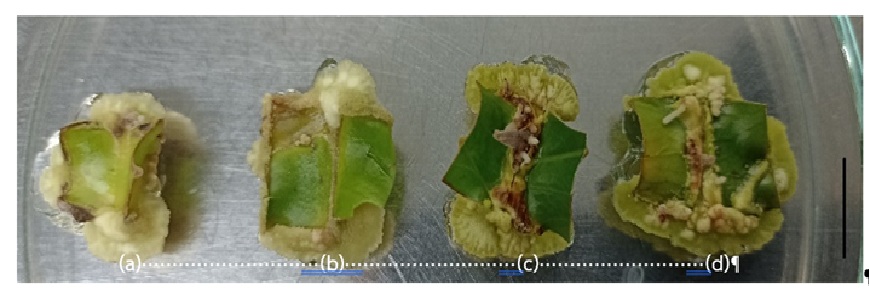
การชักนำแคลลัสจากชิ้นส่วนใบเป็นขั้นตอนสำคัญในการเพาะเลี้ยงเนื้อเยื่อกาแฟเพื่อการขยายพันธุ์ต้นกล้าจำนวนมากอย่างรวดเร็วและมีประสิทธิภาพ งานวิจัยนี้มีวัตถุประสงค์เพื่อศึกษาปัจจัยที่มีผลต่อการ ชักนำแคลลัสจากใบกาแฟโรบัสต้า (Coffea canephora) พันธุ์ชุมพร 2 ซึ่งเป็นพันธุ์ที่นิยมปลูกในภาคใต้ของประเทศไทย การศึกษาประกอบด้วย 3 การทดลองต่อเนื่อง ได้แก่ (1) ผลของแหล่งที่มาของชิ้นส่วนพืชต่อการฟอกฆ่าเชื้อและการชักนำแคลลัส (2) ผลของตำแหน่งชิ้นส่วนใบและสูตรอาหารเพาะเลี้ยง และ (3) ผลของการกรีดใบต่อการพัฒนาของแคลลัส โดยเก็บรวบรวมใบอ่อนคู่ที่ 2–3 จากยอดของต้นกาแฟจาก 4 แหล่ง ได้แก่ แปลงเกษตรกรในอำเภอคลองหอยโข่ง จังหวัดสงขลา แปลงสาธิต โรงเรือน และห้องควบคุมสภาพแวดล้อม ณ มหาวิทยาลัยราชภัฏสงขลา นำใบมาตัดแบ่งเป็น 3 ส่วน (โคนใบ กลางใบ และปลายใบ) ฟอกฆ่าเชื้อด้วยสารละลายโซเดียมไฮโปคลอไรต์ความเข้มข้น 1.2% เป็นเวลา 20 นาที จากนั้นเพาะเลี้ยงบนอาหารสูตร NPCM (ประกอบด้วยเกลือ 1/2MS ดัดแปลง, 2,4-D 0.5 มก./ล.และ 2ip 1 มก./ล.) และสูตร C (ประกอบด้วยเกลือ 1/2MS, 2,4-D 0.5 มก./ล. 2ip 2 มก./ล. และ IBA 1 มก./ล.) ในที่มืด 4 สัปดาห์ ตามด้วยสภาวะที่มีแสง 6 สัปดาห์ ร่วมกับการกรีดใบเพื่อเพิ่มพื้นที่ผิวสัมผัส ผลการทดลองพบว่า ใบจากห้องควบคุมสภาพแวดล้อมมีอัตราความปลอดเชื้อและการเกิดแคลลัสสูงที่สุด (ร้อยละ 95 และ 90 ตามลำดับ) ชิ้นส่วนโคนใบที่เพาะเลี้ยงบนอาหารสูตร NPCM ให้แคลลัสที่มีคุณภาพดีที่สุดในด้านลักษณะทางสัณฐานวิทยา มีจำนวนตำแหน่งการเกิดแคลลัสเฉลี่ย 5.3 ตำแหน่งต่อชิ้นส่วน และมีขนาดเส้นผ่านศูนย์กลาง 3.8 มม. การกรีดใบทั้งด้านหลังใบและท้องใบช่วยส่งเสริมการเกิดแคลลัสคุณภาพสูงที่มีเนื้อสัมผัสแน่นและมีสีเขียวเข้ม (ร้อยละ 100) ซึ่งเหมาะสมสำหรับการพัฒนาต่อเป็นอวัยวะหรือโซมาติกเอ็มบริโอ องค์ความรู้ที่ได้สามารถนำไปประยุกต์ใช้เพื่อเพิ่มประสิทธิภาพการผลิตแคลลัสคุณภาพสูง สำหรับการขยายพันธุ์กาแฟโรบัสต้าพันธุ์ชุมพร 2 ในเชิงพาณิชย์ต่อไป
เอกสารอ้างอิง
Asghari, F., B. Hossieni, A. Hassani and H. Shirzad. 2012. Effect of explant source and different hormonal combinations on direct regeneration of basil plants (Ocimum basilicum L.). Australian Journal of Agricultural Engineering 3: 12–17.
Campos, J., C.A. Souza, J.F. Rocha and M.C. Espindula. 2017. Leaf anatomy and its role in callus formation of Coffea arabica. Scientia Agricola 74(6): 501–508. https://doi.org/10.1590/1678-992x-2016-0123
Carsono, N., A. Purwanto, A. Rachmadi, A. Wahyudin and M. Setiawati. 2021. Callus induction and regeneration of rice (Oryza sativa L.) varieties under different 2,4-D concentrations and explant sources. Biodiversitas 22(5): 2618–2625. https://doi.org/3057/biodiv/d220520
Darwesh, R., M. Gawad, K. Ashebre and M. Abdelzaher. 2024. Optimization of closed-system cultivation for coffee micropropagation. Plant Cell, Tissue and Organ Culture 156(1): 89–101. https://doi.org/10.1007/s11240-023-02635-0
Ibrahim, R., S. Hosny, A. Amer and W. Vendrame. 2024. Somatic embryogenesis from leaf-derived callus of Coffea arabica. Plant Cell Reports 43(1): 45–55. https://doi.org/10.1007/s00299-023-03114-4
Ikeuchi, M., Y. Ogawa, A. Iwase and K. Sugimoto. 2017. Plant regeneration: cellular origins and molecular mechanisms. Development 144(9): 1442–1451. https://doi.org/10.1242/dev.134668
Li, J., D. Zhang, K. Ouyang and X. Chen. 2019. High frequency plant regeneration from leaf culture of Neolamarckia cadamba. Plant Biotechnology 36(1): 13–19. https://doi.org/10.5511/plantbiotechnology. 18.1119a
Maruka, R.A.R., M. Ananda, E. Yuniati and A.P. Paserang. 2023a. Strategy propagation of Coffea arabica L. by tissue culture techniques. pp. 205–208. In Proceedings of the 2nd International Interdisciplinary Conference on Environmental Sciences and Sustainable Developments 2022 Environment and Sustainable Development (IICESSD-ESD 2022). Palu: Universitas Tadulako.
Maruka, R., B. Daryono, Y.T.M. Astuti and E. Semiarti. 2023b. Comparative study of callus induction in Coffea arabica cultivars. Plant Biotechnology 40(2): 89–97. https://doi.org/10.5511/plantbiotechnology.23.0427a
Munawarti, A., R L Nurhury, R. Arimarsetiowati, E. Prastowo and L. Hakim. 2024. Induction and multiplication of callus of AS2K clones Coffea arabica L. through 2,4-D and BAP combination. Earth and Environmental Science 1356(2024): 012035. https://doi.org/10.1088/1755-1315/1356/1/012035
Pádua, M.S., L.V. Paiva, C.R.G. Labory, E. Alves and V.C. Stein. 2014. Induction and characterization of oil palm (Elaeis guineensis Jacq.) pro-embryogenic masses. Anais da Academia Brasileira de Ciências 86(4): 1563–1572. https://doi.org/10.1590/0001-3765201420130181
Pristiana, D. 2017. Aktivitas antioksidan dan kadar fenol berbagai ekstrak daun kopi (Coffea sp.): Potensi aplikasi bahan alami untuk fortifikasi pangan. Jurnal Aplikasi Teknologi Pangan 6(2): 89–92. https://doi.org/10.17728/jatp.205
Samson, N., C. Campa, L. Gal, M. Noirot, G. Thomas, T.S. Lokeswari and A. De Kochko. 2006. Effect of primary culture medium composition on high-frequency somatic embryogenesis in different Coffea species. Plant Cell, Tissue and Organ Culture 86: 37–45. https://doi.org/10.1007/s11240-006-9094-2
Santana-Buzzy, N., R. Rojas-Herrera, R.M. Galaz-Ávalos and V.M. Loyola-Vargas. 2007. Advances in coffee tissue culture and its practical applications. In Vitro Cellular & Developmental Biology-Plant 43(6): 507–520. https://doi.org/10.1007/s11627-007-9074-1
Santos, M.R.A., C.A. de Souza, J.F. da Rocha, L.V. de Araujo and M.C. Espindula. 2015. Comparison of economic efficiency between in vitro and field methods for vegetative propagation of Coffea canephora. Australian Journal of Basic and Applied Sciences 9(20): 1–7.
Setiawan, A., M. Rahmah, H. Trisnia and A. Jamsari. 2020. Browning suppression in coffee callus using ascorbic acid. Plant Cell, Tissue and Organ Culture 141(2): 321–329. https://doi.org/10.1007/s11240-020-01887-2
Tajetdini, F., M. Talebi, R. Naderi and D. Hassani. 2023. Effect of growth regulators on callus induction and plant regeneration from leaf explants of Coffea arabica L. cultivars. Scientific Reports 13(1): 6782. https://doi.org/10.1038/s41598-023-33814–8
Teshome, S. and T. Feyissa. 2015. In vitro callus induction and shoot regeneration from leaf explants of Glinus lotoides (L.)- an important medicinal plant. American Journal of Plant Sciences 6(9): 1329–1340. https://doi.org/10.4236/ajps.2015.69132
Tunjung, W.A.S., A.F. Widyasari, A. Iskandar, A.J. Nurulita, A.B. Sasongko, A. Indrianto and Maryani. 2021. Effect of 2,4-D and BAP on morphological characters and genetic stability of kaffir lime (Citrus hystrix DC.) callus cultures among generations. Chiang Mai University Journal of Natural Sciences 20(3): 1–14. https://doi.org/10.12982/cmujns.2021.067
Valdés, Y.C., M.R. Shukla, M.E.G. Vega and P.K. Saxena. 2021. Improved conservation of coffee (Coffea arabica L.) germplasm via micropropagation and cryopreservation. Agronomy 11(9): 1861. https://doi.org/10.3390/agronomy11091861
Yaroshko, O., T. Pasternak, E. Larriba and J.M. Pérez-Pérez. 2023. Optimization of callus induction and shoot regeneration from tomato cotyledon explants. Plants 12(16): 2942. https://doi.org/10.3390/plants12162942
Zuldin, N.N.M., I.M. Said, N.M. Noo, Z. Zainal, C.J. Kiat and I. Ismail. 2013. Induction and analysis of the alkaloid mitragynine content of a Mitragyna speciosa suspension culture system upon elicitation and precursor feeding. The Scientific World Journal 2013: 209434. https://doi.org/10.1155/2013/209434
ดาวน์โหลด
เผยแพร่แล้ว
รูปแบบการอ้างอิง
ฉบับ
ประเภทบทความ
สัญญาอนุญาต
ลิขสิทธิ์ (c) 2026 วารสารวิจัยและส่งเสริมวิชาการเกษตร

อนุญาตภายใต้เงื่อนไข Creative Commons Attribution-NonCommercial-NoDerivatives 4.0 International License.
บทความนี้ได้รับการเผยแพร่ภายใต้สัญญาอนุญาต Creative Commons Attribution-NonCommercial-NoDerivatives 4.0 International (CC BY-NC-ND 4.0) ซึ่งอนุญาตให้ผู้อื่นสามารถแชร์บทความได้โดยให้เครดิตผู้เขียนและห้ามนำไปใช้เพื่อการค้าหรือดัดแปลง หากต้องการใช้งานซ้ำในลักษณะอื่น ๆ หรือการเผยแพร่ซ้ำ จำเป็นต้องได้รับอนุญาตจากวารสาร