
Effects of Leaf Segment Positions on Callus Induction in Robusta Coffee (Coffea canephora) cv. Chumphon 2
DOI:
https://doi.org/10.14456/jare-mju.2026.22Keywords:
Coffee tissue culture, Coffea canephora, Chumphon 2, callus induction, leaf woundingAbstract
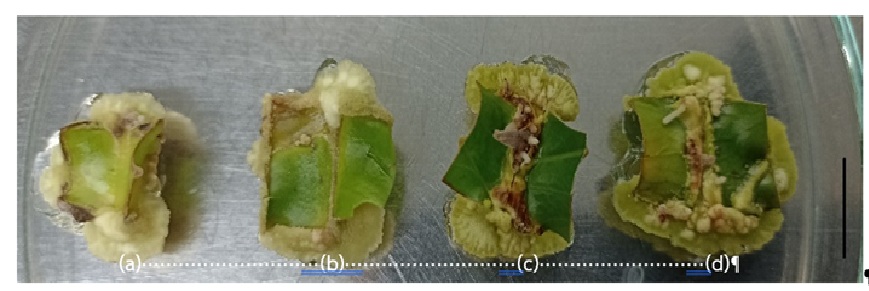
Callus induction from leaf explants is a crucial step in coffee tissue culture for rapid and efficient mass propagation of seedlings. This research aimed to study factors affecting callus induction from leaves of Robusta coffee (Coffea canephora) cv. Chumphon 2, a popular variety in southern Thailand. The study examined three sequential experiments to test: (1) the effects of explant origin on sterility and callus formation; (2) the effects of leaf segment position and culture medium; and (3) the effects of leaf incisions on callus development. Young leaves from the 2nd – 3rd pairs from the shoot apex were collected from four sources: farmers' fields in Khlong Hoi Khong district, Songkhla province; experimental plots; a greenhouse and a controlled environment room at Songkhla Rajabhat University. Each leaf was divided into three segments (base, middle, and apex), sterilized with 1.2% sodium hypochlorite for 20 minutes, then cultured on NPCM medium (containing 1/2MS modified salts, 0.5 mg L-1 2,4-D, and 1 mg L-1 2ip) and C medium (containing 1/2MS salts, 0.5 mg L-1 2,4-D, 2 mg L-1 2ip and 1 mg L-1 IBA) under dark conditions for four weeks followed by light conditions for six weeks, combined with leaf incisions to increase surface area. The results Results showed that leaves from the control environment room had the highest rates of sterility and callus formation (95 and 90%, respectively). Leaf base segments cultured on NPCM medium produced the best quality callus in terms of morphological characteristics, number of initiation sites (5.3 sites per explant), and diameter (3.8 mm). Incisions on both dorsal and ventral leaf surfaces promoted high-quality callus formation with a compact texture and dark green color (100%), suitable for further development into organs or somatic embryos. These findings can be applied to enhance the production of high-quality callus for commercial propagation of Coffea canephora cv. Chumphon 2.
References
Asghari, F., B. Hossieni, A. Hassani and H. Shirzad. 2012. Effect of explant source and different hormonal combinations on direct regeneration of basil plants (Ocimum basilicum L.). Australian Journal of Agricultural Engineering 3: 12–17.
Campos, J., C.A. Souza, J.F. Rocha and M.C. Espindula. 2017. Leaf anatomy and its role in callus formation of Coffea arabica. Scientia Agricola 74(6): 501–508. https://doi.org/10.1590/1678-992x-2016-0123
Carsono, N., A. Purwanto, A. Rachmadi, A. Wahyudin and M. Setiawati. 2021. Callus induction and regeneration of rice (Oryza sativa L.) varieties under different 2,4-D concentrations and explant sources. Biodiversitas 22(5): 2618–2625. https://doi.org/3057/biodiv/d220520
Darwesh, R., M. Gawad, K. Ashebre and M. Abdelzaher. 2024. Optimization of closed-system cultivation for coffee micropropagation. Plant Cell, Tissue and Organ Culture 156(1): 89–101. https://doi.org/10.1007/s11240-023-02635-0
Ibrahim, R., S. Hosny, A. Amer and W. Vendrame. 2024. Somatic embryogenesis from leaf-derived callus of Coffea arabica. Plant Cell Reports 43(1): 45–55. https://doi.org/10.1007/s00299-023-03114-4
Ikeuchi, M., Y. Ogawa, A. Iwase and K. Sugimoto. 2017. Plant regeneration: cellular origins and molecular mechanisms. Development 144(9): 1442–1451. https://doi.org/10.1242/dev.134668
Li, J., D. Zhang, K. Ouyang and X. Chen. 2019. High frequency plant regeneration from leaf culture of Neolamarckia cadamba. Plant Biotechnology 36(1): 13–19. https://doi.org/10.5511/plantbiotechnology. 18.1119a
Maruka, R.A.R., M. Ananda, E. Yuniati and A.P. Paserang. 2023a. Strategy propagation of Coffea arabica L. by tissue culture techniques. pp. 205–208. In Proceedings of the 2nd International Interdisciplinary Conference on Environmental Sciences and Sustainable Developments 2022 Environment and Sustainable Development (IICESSD-ESD 2022). Palu: Universitas Tadulako.
Maruka, R., B. Daryono, Y.T.M. Astuti and E. Semiarti. 2023b. Comparative study of callus induction in Coffea arabica cultivars. Plant Biotechnology 40(2): 89–97. https://doi.org/10.5511/plantbiotechnology.23.0427a
Munawarti, A., R L Nurhury, R. Arimarsetiowati, E. Prastowo and L. Hakim. 2024. Induction and multiplication of callus of AS2K clones Coffea arabica L. through 2,4-D and BAP combination. Earth and Environmental Science 1356(2024): 012035. https://doi.org/10.1088/1755-1315/1356/1/012035
Pádua, M.S., L.V. Paiva, C.R.G. Labory, E. Alves and V.C. Stein. 2014. Induction and characterization of oil palm (Elaeis guineensis Jacq.) pro-embryogenic masses. Anais da Academia Brasileira de Ciências 86(4): 1563–1572. https://doi.org/10.1590/0001-3765201420130181
Pristiana, D. 2017. Aktivitas antioksidan dan kadar fenol berbagai ekstrak daun kopi (Coffea sp.): Potensi aplikasi bahan alami untuk fortifikasi pangan. Jurnal Aplikasi Teknologi Pangan 6(2): 89–92. https://doi.org/10.17728/jatp.205
Samson, N., C. Campa, L. Gal, M. Noirot, G. Thomas, T.S. Lokeswari and A. De Kochko. 2006. Effect of primary culture medium composition on high-frequency somatic embryogenesis in different Coffea species. Plant Cell, Tissue and Organ Culture 86: 37–45. https://doi.org/10.1007/s11240-006-9094-2
Santana-Buzzy, N., R. Rojas-Herrera, R.M. Galaz-Ávalos and V.M. Loyola-Vargas. 2007. Advances in coffee tissue culture and its practical applications. In Vitro Cellular & Developmental Biology-Plant 43(6): 507–520. https://doi.org/10.1007/s11627-007-9074-1
Santos, M.R.A., C.A. de Souza, J.F. da Rocha, L.V. de Araujo and M.C. Espindula. 2015. Comparison of economic efficiency between in vitro and field methods for vegetative propagation of Coffea canephora. Australian Journal of Basic and Applied Sciences 9(20): 1–7.
Setiawan, A., M. Rahmah, H. Trisnia and A. Jamsari. 2020. Browning suppression in coffee callus using ascorbic acid. Plant Cell, Tissue and Organ Culture 141(2): 321–329. https://doi.org/10.1007/s11240-020-01887-2
Tajetdini, F., M. Talebi, R. Naderi and D. Hassani. 2023. Effect of growth regulators on callus induction and plant regeneration from leaf explants of Coffea arabica L. cultivars. Scientific Reports 13(1): 6782. https://doi.org/10.1038/s41598-023-33814–8
Teshome, S. and T. Feyissa. 2015. In vitro callus induction and shoot regeneration from leaf explants of Glinus lotoides (L.)- an important medicinal plant. American Journal of Plant Sciences 6(9): 1329–1340. https://doi.org/10.4236/ajps.2015.69132
Tunjung, W.A.S., A.F. Widyasari, A. Iskandar, A.J. Nurulita, A.B. Sasongko, A. Indrianto and Maryani. 2021. Effect of 2,4-D and BAP on morphological characters and genetic stability of kaffir lime (Citrus hystrix DC.) callus cultures among generations. Chiang Mai University Journal of Natural Sciences 20(3): 1–14. https://doi.org/10.12982/cmujns.2021.067
Valdés, Y.C., M.R. Shukla, M.E.G. Vega and P.K. Saxena. 2021. Improved conservation of coffee (Coffea arabica L.) germplasm via micropropagation and cryopreservation. Agronomy 11(9): 1861. https://doi.org/10.3390/agronomy11091861
Yaroshko, O., T. Pasternak, E. Larriba and J.M. Pérez-Pérez. 2023. Optimization of callus induction and shoot regeneration from tomato cotyledon explants. Plants 12(16): 2942. https://doi.org/10.3390/plants12162942
Zuldin, N.N.M., I.M. Said, N.M. Noo, Z. Zainal, C.J. Kiat and I. Ismail. 2013. Induction and analysis of the alkaloid mitragynine content of a Mitragyna speciosa suspension culture system upon elicitation and precursor feeding. The Scientific World Journal 2013: 209434. https://doi.org/10.1155/2013/209434
Downloads
Published
How to Cite
Issue
Section
License
Copyright (c) 2026 Journal of Agricultural Research and Extension

This work is licensed under a Creative Commons Attribution-NonCommercial-NoDerivatives 4.0 International License.
This article is published under a Creative Commons Attribution-NonCommercial-NoDerivatives 4.0 International License (CC BY-NC-ND 4.0), which allows others to share the article with proper attribution to the authors and prohibits commercial use or modification. For any other reuse or republication, permission from the journal and the authors is required.


