
ผลของการให้ปุ๋ยในระบบน้ำต่อการเจริญเติบโต ปริมาณ และคุณภาพเมล็ดพันธุ์ข้าวโพดอาหารสัตว์ ในพื้นที่จังหวัดสุพรรณบุรีและนครราชสีมา
DOI:
https://doi.org/10.14456/jare-mju.2026.3คำสำคัญ:
การจัดการปุ๋ยในระบบน้ำหยด , ผลผลิต และคุณภาพเมล็ดข้าวโพด, การจัดการปุ๋ยสำหรับข้าวโพดบทคัดย่อ
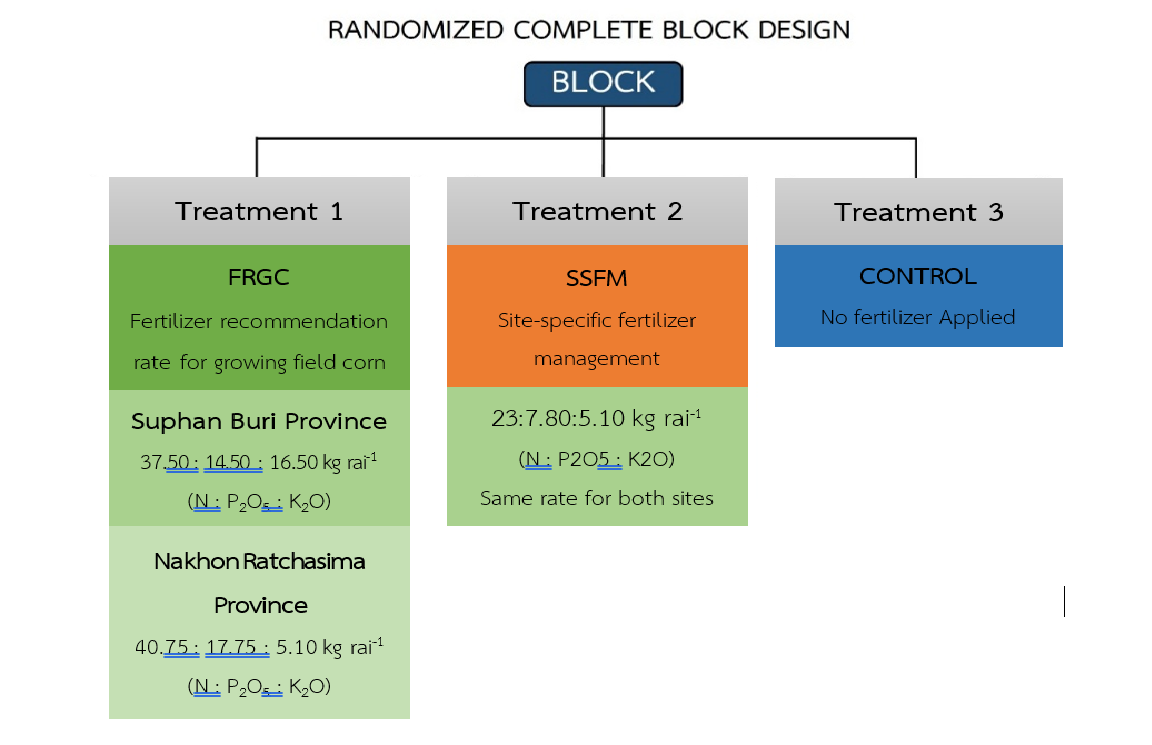
การศึกษาผลของการให้ปุ๋ยในระบบน้ำต่อการเจริญเติบโต ปริมาณ และคุณภาพเมล็ดพันธุ์ข้าวโพดอาหารสัตว์ ได้ดำเนินการในพื้นที่ปลูกข้าวโพดของเกษตรกรในเขตภาคกลาง ณ อำเภออู่ทอง จังหวัดสุพรรณบุรี และในเขตภาคตะวันออกเฉียงเหนือ ณ อำเภอเสิงสาง จังหวัดนครราชสีมา มีวัตถุประสงค์เพื่อเปรียบเทียบผลของกรรมวิธีการจัดการปุ๋ยในระบบน้ำหยดที่แตกต่างกันต่อการเจริญเติบโต ผลผลิต และคุณภาพเมล็ดพันธุ์ข้าวโพดอาหารสัตว์ ศึกษาโดยการวางแผนการทดลองแบบสุ่มสมบูรณ์ภายในบล็อก จำนวน 4 ซ้ำ ประกอบด้วยการจัดการปุ๋ยที่แตกต่างกัน 3 กรรมวิธี คือ 1) การใส่ปุ๋ยเคมีตามอัตราที่เกษตรกรปฏิบัติในการปลูกข้าวโพดเมล็ดพันธุ์อาหารสัตว์ (FRGM) (พื้นที่จังหวัดสุพรรณบุรี: 37.50 กก. N/ไร่ 14.50 กก. P2O5/ไร่ และ 16.50 กก. K2O /ไร่ และพื้นที่จังหวัดนครราชสีมา 40.75 กก. N/ไร่, 17.75 กก. P2O5/ไร่ และ 21.75 กก. K2O /ไร่); 2) ใส่ปุ๋ยเคมีตามอัตรา ที่เหมาะสมสำหรับการผลิตข้าวโพดเมล็ดพันธุ์อาหารสัตว์ (SSFM) (23.00 กก. N/ไร่, 7.80 กก. P2O5/ไร่ และ 5.10 กก. K2O ไร่) และ 3) กรรมวิธีควบคุมโดยไม่ใส่ปุ๋ยเคมี ผลการศึกษาพบว่า การจัดการปุ๋ยตามกรรมวิธีที่ 2 คือ การ ใส่ปุ๋ยไนโตรเจนในอัตรา 23.00 กก. N/ไร่ ฟอสฟอรัส ในอัตรา 7.80 กก./ไร่ และการใส่ปุ๋ยโพแทสเซียมในอัตรา 5.10 กก./ไร่ ก็เพียงพอต่อการผลิตข้าวโพดเพื่อให้ได้ผลผลิตที่ดี ทั้งนี้ การจัดการปุ๋ยตามกรรมวิธีที่ 1 และ 2 ไม่ส่งผลให้ข้าวโพดมีความสูง การสะสมน้ำหนักแห้ง ค่าความเขียวของใบ ความเข้มข้นธาตุอาหารหลักในใบ ปริมาณและคุณภาพผลผลิตข้าวโพดเมล็ดพันธุ์อาหาร สัตว์แตกต่างกันทั้ง 2 พื้นที่ โดยข้าวโพดที่ปลูกในพื้นที่จังหวัดสุพรรณบุรี มีปริมาณผลผลิตเฉลี่ยอยู่ในช่วง 1.84-1.85 ตัน/ไร่ และข้าวโพดที่ปลูกในพื้นที่จังหวัดนครราชสีมา มีปริมาณผลผลิตเฉลี่ยอยู่ในช่วง 1.02-1.12 ตัน/ไร่ (ความชื้นเมล็ดน้อยกว่า 30%) ดังนั้น การจัดการปุ๋ยตามกรรมวิธีที่ 2 ซึ่งใช้ปุ๋ยในอัตราที่ต่ำกว่าสามารถคงระดับผลผลิตที่ใกล้เคียงกับอัตราที่เกษตรกรใช้ ช่วยลดปริมาณการใช้ปุ๋ยโดยไม่กระทบต่อคุณภาพเมล็ดพันธุ์ข้าวโพดอาหารสัตว์
เอกสารอ้างอิง
Adhikari, K., B.R. Baral and J. Shrestha. 2016. Maize response to time of nitrogen application and planting seasons. Journal of Maize Research and Development 2(1): 83–93.
Alderman, S.C., W. Pfender and C.M. Ocamb. 2009. Diseases in seed production. Tall Fescue for the Twenty-first Century 53: 427–434.
Beegle, D.B., W. Piekielek and R. Fox. 2008. Early Season Chlorophyll Meter Test for Corn. Agronomy Facts 53. University Park: The Pennsylvania State University. 8 p.
Bibe, S.M., K.T. Jadhav and A.S. Chavan. 2017. Response of irrigation and fertigation management on growth and yield of maize. International Journal of Current Microbiology and Applied Sciences 6(11): 4054–4060.
Bray, R.H. and L.T. Kurtz. 1945. Determination of total, organic, and available forms of phosphorus in soils. Soil Science. 59(1): 39–45.
Canprasert, W. 1999. Field crop seed technology. Retrieved from https://kukr.lib.ku.ac.th/kukr_es/index.php?/KPS/search_detail/result/183336.
Delbaz, R., H. Ebrahimian and D. Ranazadeh. 2023. A global meta-analysis on surface and drip fertigation for annual crops under different fertilization levels. Agricultural Water Management 289: 108504.
Department of Agriculture. 2021. Soil Test-Based Fertilizer Recommendations for Major Economic Field Crops. 100 p. In Research Report. Bangkok: Department of Agriculture Ministry of Agriculture and Cooperatives, Thailand. [in Thai]
Food and Agriculture Organization of the United Nations. 2019. Standard Operating Procedure for Soil Organic Carbon Walkley-Black Method Titration and Colorimetric Method. Rome: FAO. 27 p.
Helmke, P.A. and L. Sparks. 1996. Lithium, Sodium, Potassium, Rubidium, and cesium. pp. 551–574. In Sparks, D.L., A.L. Page, P.A. Helmke and R.H. Loeppert (Eds.). Methods of Soil Analysis, Part 3: Chemical Methods. Madison, WI.: SSSA Book Series No.5. SSASA and American Society of Agronomy.
Kalra, Y.P. 1998. Handbook of Reference Methods for Plant Analysis. Boca Raton: CRC Press. 320 p.
Land Development Station. 2013. District soil map of Suphanburi province. Retrieved from http://r01.ldd.go.th/spb/SoilMap.html [in Thai]
Li, W., X. Gu and T. Chang. 2023. Optimizing nitrogen, phosphorus, and potassium fertilization regimes to improve maize productivity under double ridge-furrow planting with full film mulching. Agricultural Water Management 287: 108439
Lui, K., B.L. Ma and C. Li. 2011. Nitrogen phosphorus and potassium nutrient effects on grain filling and yield of high yielding summer corn. Journal of Plant Nutrition 34: 1516–1531.
Mallarino, A.P. and J.R. Webb. 1995. Long-term evaluation of phosphorus and zinc interactions in corn. Journal of Production Agriculture 8(1): 52–55.
Masood, T., R. Gul and H. Khan. 2011. Effect of different phosphorus levels on the yield and yield component of maize. Sarhad Journal of Agriculture 27(2): 167–170.
Matejovic, I. 2008. Total nitrogen in plant material determinated by means
of dry combustion: a possible alternative to determination by Kjeldahl digestion. Retrieved from https://www.tandfonline.com/doi/permissions
Morad, H., A. Mohammad and B. Simon. 2009. The effect of irrigation methods with effluent and irrigation scheduling on water use efficiency and corn yields in an arid region. Agricultural Water Management 96(1): 93–99.
Noppan, K. and C. Santasup. 2016. Appropriate fertilizer management for field corn seed production in Tak province. Journal of Agricultural Research and Extension 33(1): 10–19.
Office of Agricultural Economics. 2022. The situation of maize in Thailand. Retrieved from https://www.oae.go.th [in Thai]
Phanomtronitkul, M. 2000. Soil Water Management for Sustainable Systems. 1st Ed. Chiang Mai: Faculty of Agriculture, Chiangmai University. 487 p. [in Thai]
Rahmawati, R. 2017. Effect of nitrogen fertilizer on growth and yield of maize composite variety Lamuru. AgroTech Journal 2(2): 36–41.
Suwanwong, S. 2001. Plant Nutrient Analysis. Bangkok: Kasetsart University Press. 141 p. [in Thai]
UI-Allah, S., M. Ijaz and K. Mahmood. 2020. Potassium application improves grain yield and alleviates drought susceptibility in diverse maize hybrids. Plants 9(75): 1–11. https://doi.org/10.3390/plants9010075
Wichmann, W. 1992. IFA World Fertilizer Use Manual. Germany and France: BASF AG and IFA. 632 p.
Zarski, J. and R.T. Kusmierek. 2023. Effects of drip irrigation and topdressing nitrogen fertigation on maize grain yield in central Poland. Agronomy 13(2): 1–15. https://doi.org/10.3390/agronomy13020360
ดาวน์โหลด
เผยแพร่แล้ว
รูปแบบการอ้างอิง
ฉบับ
ประเภทบทความ
สัญญาอนุญาต
ลิขสิทธิ์ (c) 2026 วารสารวิจัยและส่งเสริมวิชาการเกษตร

อนุญาตภายใต้เงื่อนไข Creative Commons Attribution-NonCommercial-NoDerivatives 4.0 International License.
บทความนี้ได้รับการเผยแพร่ภายใต้สัญญาอนุญาต Creative Commons Attribution-NonCommercial-NoDerivatives 4.0 International (CC BY-NC-ND 4.0) ซึ่งอนุญาตให้ผู้อื่นสามารถแชร์บทความได้โดยให้เครดิตผู้เขียนและห้ามนำไปใช้เพื่อการค้าหรือดัดแปลง หากต้องการใช้งานซ้ำในลักษณะอื่น ๆ หรือการเผยแพร่ซ้ำ จำเป็นต้องได้รับอนุญาตจากวารสาร