
การพัฒนารูปแบบการเลี้ยงแพะพื้นเมืองแบบประณีตเพื่อเพิ่มประสิทธิภาพการผลิต สำหรับเยาวชนกลุ่มเปราะบางในสามจังหวัดชายแดนภาคใต้
DOI:
https://doi.org/10.14456/jare-mju.2026.12คำสำคัญ:
แพะประณีต , แพะพื้นเมือง , เยาวชนกลุ่มเปราะบาง (ไร้งานทำ)บทคัดย่อ
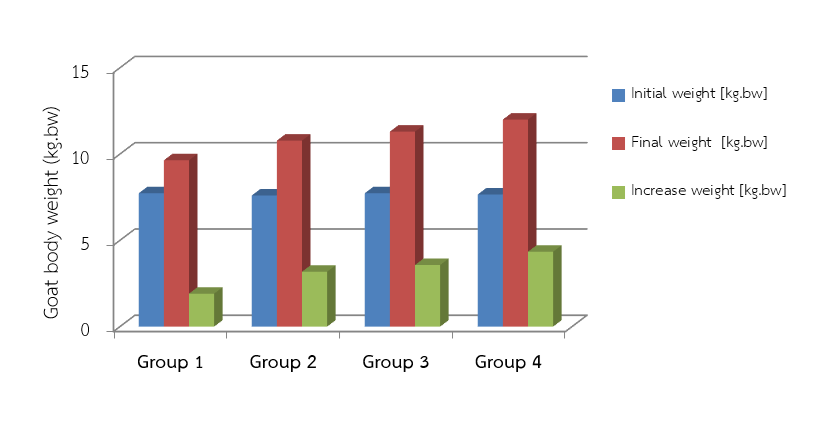
การศึกษาครั้งนี้มีวัตถุประสงค์เพื่อพัฒนาต้นแบบการเลี้ยงแพะพื้นเมืองแบบประณีตและพัฒนาศักยภาพ พร้อมยกระดับการเลี้ยงแพะพื้นเมืองกับเยาวชนกลุ่มเปราะบาง (ไร้งาน) ในสามจังหวัดชายแดนภาคใต้ โดยทำการศึกษาการเลี้ยงแพะแบบประณีต ใช้แผนการทดลองแบบสุ่มสมบูรณ์ (Completely Randomized Design: CRD) ใช้แพะพื้นเมืองอายุ 6-7 เดือน จำนวน 20 ตัว แบ่งเป็น 4 กลุ่ม ๆ ละ 5 ตัว กลุ่มที่ 1 ให้หญ้าเนเปียร์อย่างเดียว กลุ่มที่ 2 หญ้าเนเปียร์เสริมด้วยอาหารสำเร็จรูปทางการค้า 2% ของน้ำหนักตัว กลุ่มที่ 3 ให้หญ้าเนเปียร์ร่วมกับสูตรอาหารข้นสูตร A 2% ของ น้ำหนักตัว และกลุ่มที่ 4 ให้หญ้าเนเปียร์ร่วมกับสูตรอาหารข้นสูตร B 2% ของน้ำหนักตัว เลี้ยงแพะตลอดระยะเวลา 120 วัน พบว่ากลุ่มที่ 1, 2, 3 และ 4 น้ำหนักเฉลี่ยเริ่มต้น 7.73±1.00, 7.60±1.07, 7.73±0.81 และ 7.66±1.10 กิโลกรัมต่อตัว ตามลำดับ และสิ้นสุดการทดลองในสัปดาห์ที่ 16 การคำนวณของน้ำหนักแพะ ทั้ง 4 กลุ่ม พบว่าเพิ่มขึ้นร้อยละ 19.81, 29.50, 31.59 และ 36.17 ตามลำดับ เมื่อทำการวิเคราะห์คุณค่าโภชนะสูตรอาหารแพะสูตรต่าง ๆ สูตร A (ข้าวโพดหมักยีสต์) และสูตร B (รำข้าว+ปลาป่น) พบว่า โปรตีนรวม ไขมัน เยื่อใย และความชื้น สูตร A เท่ากับ 13.8, 8.1, 10.2 และ 40–50% ตามลำดับ สูตร B เท่ากับ 15.20, 4.5, 9.4 และ 40–50% ตามลำดับ ส่วนหญ้าเนเปียร์สด เท่ากับ 9.8, 0.6, 33.2 และ 9.3% ตามลำดับ และเมื่อนำหญ้าเนเปียร์ไปหมัก เท่ากับ 10.2, 10.2, 32.1 และ 9.9% ตามลำดับ จากการคำนวณต้นทุนของการผลิตอาหารข้นสูตร A ต้นทุนเฉลี่ย 5.80 บาทต่อกิโลกรัม (น้ำหนักแห้ง) 3.49 บาทต่อกิโลกรัม (น้ำหนักสด) และสูตร B ต้นทุนเฉลี่ย10.54 บาทต่อกิโลกรัม (น้ำหนักแห้ง) 6.33 บาทต่อกิโลกรัม (น้ำหนักสด) ส่งผลให้เกษตรกรสามารถลดต้นทุนค่าใช้จ่ายด้านอาหารมากกว่าร้อยละ 50 ได้
เอกสารอ้างอิง
Department of Livestock Development. 2023. Goat population statistics and operational plan 2023–2027. Bangkok: Ministry of Agriculture and Cooperatives. 104 p. [in Thai]
FAO. 2024. Analysing data from on-farm trials: ANOVA and factorial experiments. Retrieved from https://openknowledge.fao.org/server/api/core/bitstreams/a5abbb18-2bd2-4811-b1bef8bd1f8d4bf8/content/x5470e06.htm
Gómez-Limón, J.A. and L. Riesgo. 2012. Sustainability assessment of olive groves in Andalusia: a methodological proposal. New Medit 11(1): 39–49.
Hamid, A.M. 2024. Assistance in fattening goat farming business: Diversification strategy and productivity improvement "Gus Shor Farm" Kanugrahan Maduran Lamongan Village, Sahwahita. Community Engagement Journal 1(2): 79–95. https://doi.org/10.69965/sahwahita.v1i2.57
Khan, N. and M. Hussein. 2021. Analysis of profits and break even point of Jamnapari goat farming. Journal La Lifesci. 2(3): 8–14. https://doi.org/10.37899/journallalifesci.v2i3.377
Kongkaew, P. 2020. Community waste management and waste in goat farms. Bangkok: National Research Council of Thailand. 144 p. [in Thai]
Massachusetts Institute of Technology D-Lab, and Heifer International. 2016. Needs assessment of smallholder goat farmers in Odisha, India (D-Brief). Retrieved from https://d-lab.mit.edu/sites/default/files/inline-files/Heifer%20Goat%20Herder%20D-Brief%20v12%20(1).pdf
Mehanzel, S.H. 2012. Impact of Goat Development Project on Livelihood Assets: The Case of Northern Red Sea Region in Eritrea. Master Thesis. Wageningen University & Research Repository. 63 p.
Ministry of Agriculture and Fisheries, Livestock Research Improvement Division. (n.d.). Goat Management Systems. Jamaica: Bodles Research Station. 8 p.
Polviset, W. and N. Prakobsaeng. 2019. The Comparison of Protein Sources in Total Mixed Ration in Goats. 30 p. In Research Report. Maha Sarakham: Faculty of Agricultural Technology, Rajabhat Maha Sarakham University.
Santoso, A.B., K. Bekzhanov, S.F. Batubara, A.R. Hasyim, S. Hidayat, V. Aryati, R.A. Saptati and N.Chairuman. 2024. Feed sufficiency model on corn-goat integration in Deli Serdang Regency North Sumatra, Indonesia. International Journal of Design & Nature and Ecodynamics 19(2): 639–648. https://doi.org/10.18280/ijdne.190230
Sebsibe, A. and Z. Tadesse. 2011. Design of an Experiment to Compare Performance and Meat Quality Characteristics of Three Ethiopian Goat Genotypes under Varying Nutritional Conditions: Biometrics and Research Methods Teaching Resource Case Study 13. Nairobi, Kenya: International Livestock Research Institute (ILRI). 15 p.
Urošević, M., D. Drobnjak, N. Ersoy and P. Stoji. 2020. Osnovni principi organske proizvodnje u kozarstvu [basic principles of organic goat farming]. Veterinarska Stanica 51(1): 87–91. https://doi.org/10.46419/vs.51.1.9
ดาวน์โหลด
เผยแพร่แล้ว
รูปแบบการอ้างอิง
ฉบับ
ประเภทบทความ
สัญญาอนุญาต
ลิขสิทธิ์ (c) 2026 วารสารวิจัยและส่งเสริมวิชาการเกษตร

อนุญาตภายใต้เงื่อนไข Creative Commons Attribution-NonCommercial-NoDerivatives 4.0 International License.
บทความนี้ได้รับการเผยแพร่ภายใต้สัญญาอนุญาต Creative Commons Attribution-NonCommercial-NoDerivatives 4.0 International (CC BY-NC-ND 4.0) ซึ่งอนุญาตให้ผู้อื่นสามารถแชร์บทความได้โดยให้เครดิตผู้เขียนและห้ามนำไปใช้เพื่อการค้าหรือดัดแปลง หากต้องการใช้งานซ้ำในลักษณะอื่น ๆ หรือการเผยแพร่ซ้ำ จำเป็นต้องได้รับอนุญาตจากวารสาร