การเพิ่มมูลค่าซังข้าวโพดด้วยการทำปุ๋ยหมักเพื่อแก้ปัญหาสิ่งแวดล้อมระดับชุมชน ตำบลบ้านค่า อำเภอเมือง จังหวัดลำปาง
DOI:
https://doi.org/10.14456/jare-mju.2026.14คำสำคัญ:
ปุ๋ยหมักแบบไม่กลับกองวิศวกรรมแม่โจ้ 1 , ซังข้าวโพด , ปริมาณการลดปล่อยก๊าซ เรือนกระจก , วิเคราะห์ต้นทุนบทคัดย่อ
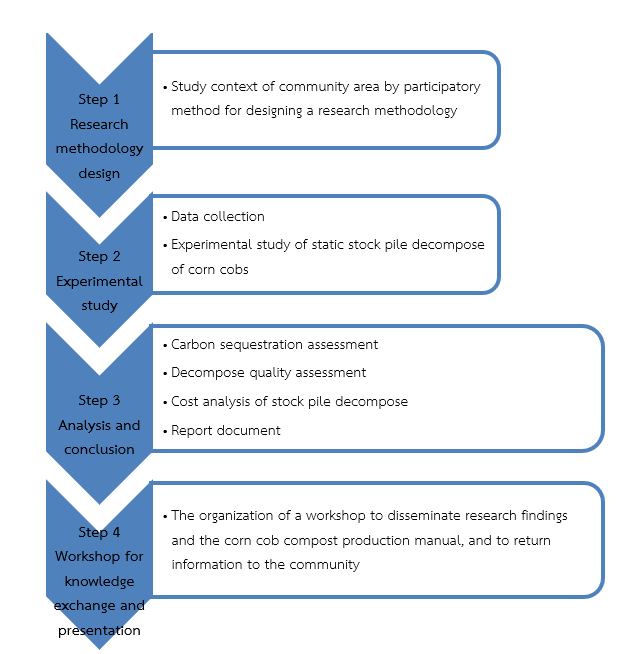
การวิจัยนี้เป็นการวิจัยชุมชนเชิงปฏิบัติการแบบมีส่วนร่วม (CBPAR) มีวัตถุประสงค์เพื่อประเมินประสิทธิภาพการผลิตปุ๋ยหมักจากเศษซากซังข้าวโพด ตามสูตรวิศวกรรมแม่โจ้ 1 แบบไม่กลับกอง ได้แก่ 1) การกักเก็บคาร์บอนและการลดการปล่อยก๊าซเรือนกระจก 2) คุณภาพปุ๋ยหมักจากลักษณะเศษซากซังข้าวโพด ที่แตกต่างกัน และ 3) ต้นทุนการผลิตปุ๋ยหมัก กลุ่มตัวอย่างได้แก่ เกษตรผู้ปลูกข้าวโพดในตำบลบ้านค่า อำเภอเมือง จังหวัดลำปาง จำนวน 5 คน ได้มาโดยอาสาสมัคร ตัวแทนจากอบต. พัฒนาชุมชน กำนันตำบล ผู้ใหญ่บ้าน จำนวน 12 คน เครื่องมือที่ใช้ในการวิจัยมี 3 ชนิด ได้แก่ แบบบันทึกการประชุมกลุ่ม แบบบันทึกการทดลองและแบบสอบถาม วิเคราะห์ข้อมูลด้วย ความถี่ ร้อยละ ค่าเฉลี่ย ค่าเบี่ยงเบนมาตรฐาน และการวิเคราะห์เนื้อหา ผลการวิจัยพบว่า การผลิตปุ๋ยหมักสามารถลดการปล่อยก๊าซเรือนกระจกได้อย่างมีประสิทธิภาพสูง โดยสามารถลดจาก 2,914.82 กิโลกรัมคาร์บอนเทียบเท่า (กรณีฐาน) เหลือเพียง 556.59 กิโลกรัมคาร์บอนเทียบเท่า คิดเป็นการลดลง 2,358.23 กิโลกรัมคาร์บอนเทียบเท่า หรือประสิทธิภาพการลด 80.9% ด้านคุณภาพปุ๋ยหมัก พบว่ากองปุ๋ยที่ 1 (ซังข้าวโพดบดย่อย) ให้คุณภาพดีที่สุดด้วยอินทรียวัตถุ 40.4% ผ่านเกรด 1 ในหลายพารามิเตอร์ ยกเว้นฟอสฟอรัส (P2O5) ที่มีค่า 0.23% ต่ำกว่า มาตรฐาน และต้นทุนการผลิตโดยผ่านการวิเคราะห์ต้นทุนแสดงให้เห็นว่าการผลิตปุ๋ยหมักมีต้นทุนรวม 8,102 บาท หรือ 1.69 บาทต่อกิโลกรัมวัตถุดิบ โดยวัตถุดิบหลักมีสัดส่วน 51.8% ค่าแรงงานและน้ำมัน 26.3% ค่าเช่าเครื่องบดย่อย 12.3% และวัตถุดิบเสริม 9.5% เกษตร มีความพึงพอใจต่อผลการวิจัยและคู่มือการแผยแพร่ โดยภาพรวมพบว่าอยู่ในระดับมาก
เอกสารอ้างอิง
Highland Research and Development Institute (Public Organization). 2024. Compost helps reduce burning and benefits us economically (How). Retrieved from https://hkm.hrdi.or.th/Knowledge/detail/714 [in Thai]
Keng, Z.X., J.J.M.Tan, B.L. Phoon, C.C. Khoo, I. Khoiroh, S. Chong, C. Supramaniam, A. Singh and G.T. Pan. 2023. Aerated static pile composting for industrial biowastes: from engineering to microbiology. Bioengineering 10(8): 938 https://doi.org/10.3390/bioengineering10080938
Lampang Provincial Commerce Office. 2024. The situation of maize procurement for animal feed, production year 2024/2025. Retrieved from https://lampang.moc.go.th/th/content/category/detail/id/104/iid/74130 [in Thai]
Luske, B. 2010. Reduced Greenhouse Gas Emissions due to Compost Production and Compost Use in Egypt. Driebergen: Louis Bolk Institute. 30 p.
Min, H., X. Huang, D. Xu, Q. Shao, Q. Li, H. Wang and L. Ren. 2022. Determining the effects of compost substitution on carbon sequestration, greenhouse gas emission, soil microbial community changes, and crop yield in a wheat field. Life 12(9): 1382 https://doi.org/10.3390/life12091382
Nammakhun, Y., P. Tongtanee and R. Nunta. 2025. The Project evaluation of the sustainable economic and social enhancement: the case study of Wiang Mok sub-district northern of Thailand. Community and Social Development Journal 26(2): 164–179. [in Thai]
Nordahl, S.L., C.V. Preble, T.W. Kirchstetter and C.D. Scown. 2023. Greenhouse gas and air pollutant emissions from composting. Environmental Science & Technology 57(6): 2235–2247.
Pookkaman, W. and A. Kantasa-ard. 2018. Cost reduction in the plantation of longan and mango by implementing the integrated agricultural cost reduction model and integer linear programming optimization model: case study of plantation area in Sakaeo province Thailand. Journal of Industrial Education 17(2): 13–22. [in Thai]
Popradit, A., J. Wiangnon, P. Jitrabiab and N. Pakvilai. 2022. Organic fertilizer application using leaf waste according to Maejo Engineering Method 1. Thai Environmental Engineering Journal 36(3): 47–54. [in Thai]
Ruairuen, W., N. Khammanee and P. Noparat. 2022. Production and properties of compost from agroforestry waste materials. Retrieved from https://wjst.wu.ac.th/index.php/stssp/article/view/25728 [in Thai]
Shen, B., L. Zheng, X. Zheng, Y. Yang, D. Xiao, Y. Wang, Z. Sheng, and B. Ai. 2024. Insights from meta-analysis on carbon to nitrogen ratios in aerobic composting of agricultural residues. Bioresource Technology 413(2024): 1-10 https://doi.org/10.1016/j.biortech.2024.131416
Thailand Greenhouse Gas Management Organization (Public Organization). 2025. Document for greenhouse gas reduction calculation LESS-WM-03: production of compost or soil conditioner from organic waste (8th ed.). Retrieved from https://ghgreduction.tgo.or.th/th/calculation/less-calculate-document/less-waste/item/550-less-wm-03.html [in Thai]
Thitanuwat, B., C. Polprasert and A.J. Englande Jr. 2016. Quantification of phosphorus flows throughout the consumption system of Bangkok Metropolis, Thailand. Science of The Total Environment 542: 1106–1116. https://doi.org/10.1016/j.scitotenv.2015.09.065 [in Thai]
Thola, J., P. Abdul Salam, S. Dhakal and E. Winijkul. 2022. Sustainable options for reducing open burning of corn residues: case study of Mae Chaem district, Thailand. Polish Journal of Environmental Studies 31(6): 5851–5861.
U.S. Department of Energy. 2025. A generic counterfactual greenhouse gas emission factor for life-cycle assessment of manure-derived biogas and renewable natural gas. Washington, DC: U.S. Department of Energy. 20 p
Wong, J.W.C. 2004. Composting and Compost Utilization in Agriculture. Hong Kong: Department of Biology, Hong Kong Baptist University. 34 p..
Yasmin, N., K. Samal, M. Jamuda and A. Panda. 2022. Emission of greenhouse gases (GHGs) during composting and vermicomposting: measurement, mitigation, and perspectives. Energy Nexus 7: 100092 https://doi.org/10.1016/j.nexusenerg.2022.100092
ดาวน์โหลด
เผยแพร่แล้ว
รูปแบบการอ้างอิง
ฉบับ
ประเภทบทความ
สัญญาอนุญาต
ลิขสิทธิ์ (c) 2026 วารสารวิจัยและส่งเสริมวิชาการเกษตร

อนุญาตภายใต้เงื่อนไข Creative Commons Attribution-NonCommercial-NoDerivatives 4.0 International License.
บทความนี้ได้รับการเผยแพร่ภายใต้สัญญาอนุญาต Creative Commons Attribution-NonCommercial-NoDerivatives 4.0 International (CC BY-NC-ND 4.0) ซึ่งอนุญาตให้ผู้อื่นสามารถแชร์บทความได้โดยให้เครดิตผู้เขียนและห้ามนำไปใช้เพื่อการค้าหรือดัดแปลง หากต้องการใช้งานซ้ำในลักษณะอื่น ๆ หรือการเผยแพร่ซ้ำ จำเป็นต้องได้รับอนุญาตจากวารสาร