
การเจริญเติบโตของปลาบึกที่เลี้ยงด้วยอาหารผสมสาหร่ายอาร์โธรสไปร่าผง สด และหมัก
DOI:
https://doi.org/10.14456/jare-mju.2026.32คำสำคัญ:
ปลาบึก, สาหร่ายอาร์โรสไปร่า , การเจริญเติบโตบทคัดย่อ
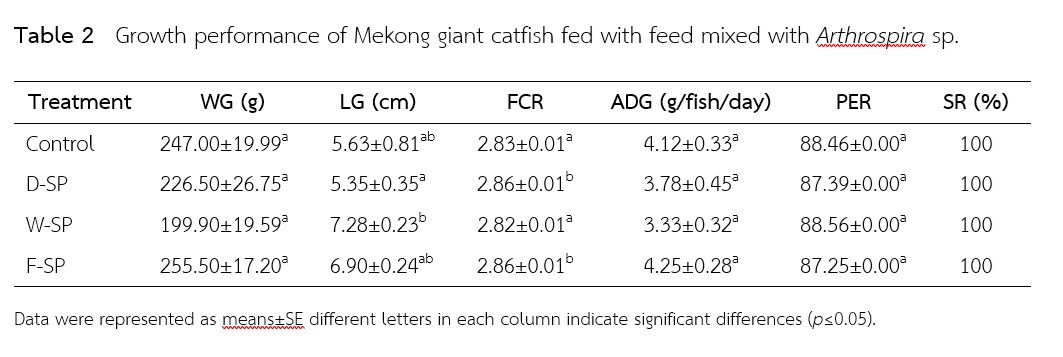
การศึกษาในครั้งนี้เป็นการเลี้ยงปลาบึกด้วยอาหารผสมสาหร่ายอาร์โธรสไปร่า (Arthrospira platensis) ดังนี้ อาร์โธรสไปร่าผง 3 เปอร์เซ็นต์ (D-SP) อาร์โธรสไปร่าสด 30 เปอร์เซ็นต์ (W-SP) อาร์โธรสไปร่าหมัก 30 เปอร์เซ็นต์ (F-SP) และอาหารควบคุม (control) เลี้ยงปลาบึกในกระชังที่กางในบ่อดิน จำนวน 30 ตัวต่อกระชัง ออกแบบการทดลองแบบ CRD ปลาบึกเริ่มต้นมีขนาด 47.09±0.00 กรัม ทุกชุดการทดลองมีจำนวน 3 ซ้ำ ให้อาหาร 5 เปอร์เซ็นต์ของน้ำหนักตัว เลี้ยงปลาบึกเป็นระยะเวลา 60 วัน ผลการทดลองพบว่า น้ำหนักเฉลี่ยที่เพิ่มขึ้นของปลาบึกในชุดcontrol มีค่าเท่ากับ 247.00±19.99 กรัม ส่วนในปลาบึกที่เลี้ยงด้วยอาหาร D-SP, W-SP และ F-SP มีน้ำหนักเฉลี่ยเพิ่มขึ้นเท่ากับ 226.50±26.75, 199.90±19.59 และ 255.50±17.20 กรัม อัตราการเจริญเติบโตต่อวัน พบว่าชุดทดลอง control, D-SP, W-SP และ F-SP มีค่า 4.12±0.33, 3.78±0.45, 3.33±0.32 และ 4.25±0.28 กรัมต่อตัว ต่อวัน ประสิทธิภาพการใช้โปรตีนพบว่า ชุดทดลอง มีประสิทธิภาพการใช้โปรตีน เท่ากับ 88.46±0.00, 87.39±0.00, 88.56±0.00 และ 87.25±0.00 เปอร์เซ็นต์ และอัตรารอดในทุกชุดทดลอง มีค่าเท่ากับ 100 เปอร์เซ็นต์ ไม่มีความแตกต่างอย่างมีนัยสำคัญทางสถิติ (p>0.05) ในส่วนของความยาวเฉลี่ยของชุดทดลองที่ได้รับอาหาร W-SP มีความยาวเฉลี่ยที่เพิ่มขึ้นมากที่สุด คือ 7.28±0.23 ซม. แตกต่างอย่างกับชุดทดลอง D-SP อย่างมีนัยสำคัญทางสถิติ (p<0.05) และอัตราการแลกเนื้อของชุดทดลองที่ได้รับอาหาร control และ W-SP มีค่า 2.83±0.01 และ 2.82±0.01 แตกต่างอย่างมีนัยสำคัญทางสถิติ (p<0.05) ส่วนต้นทุนในการผลิตปลา 1 กิโลกรัม พบว่าสูตรอาหาร W-SP มีต้นทุนค่าอาหาร ต่ำที่สุด การศึกษาครั้งนี้ สรุปได้ว่าอาหารที่ผสมสาหร่ายอาร์โธรสไปร่าสด ทำให้ปลาบึกยาวที่สุด และมีอัตราการแลกเนื้อต่ำ และมีต้นทุนในการผลิตปลา 1 กิโลกรัม ต่ำที่สุด จึงเหมาะสมที่จะนำไปใช้เป็นวัตถุดิบอาหาร ในการผลิตอาหารเพื่อเลี้ยงปลาบึก
เอกสารอ้างอิง
Alagawany, M., A.E. Taha, A. Noreldin, K.A. El-Tarabily and M.E. Abd El-Hack. 2021. Nutritional applications of species of Spirulina and Chlorella in farmed fish: a review. Aquaculture 542: 1–11 https://doi.org/10.1016/j.aquaculture.2021.736841
Altmann, B.A. and S. Rosenau. 2022. Spirulina as animal feed: opportunities and challenges. Foods 11(7): 965 https://doi.org/10.3390/foods11070965
Ansarifard, F., H.R. Islami, M.S. Mehrjan and M. Soltani. 2018. Effects of Arthrospira platensis on growth, skin color and digestive enzymes of koi, Cyprinus carpio. Iranian Journal of Fisheries Sciences 17(2): 381–393 https://doi.org/10.22092/IJFS.2018.115878
AOAC. 1990. Official Methods of Analysis. 15th Edition. Washington DC.: Association of Official Analytical Chemist. 1300 p.
Carneiro, W.F., T.F.D. Castro, T. Reichel, P.L. de Castro Uzeda, C.A. Martínez-Palacios and L.D.S Murgas. 2022. Diets containing Arthrospira platensis increase growth, modulate lipid metabolism, and reduce oxidative stress in pacu (Piaractus mesopotamicus) exposed to ammonia. Aquaculture 547: 1–11 https://doi.org/10.1016/j.aquaculture.2021.737402
de Marco Castro, E., E. Shannon and N. Abu-Ghannam. 2019. Effect of fermentation on enhancing the nutraceutical properties of Arthrospira platensis (Spirulina). Fermentation 5(1): 28 https://doi.org/10.3390/fermentation5010028
Dernekbasi, S., H. Unal, I. Karayucel and O. Aral. 2010. Effect of dietary supplementation of different rates of Spirulina (Spirulina platensis) on growth and feed conversion in guppy (Poecilia reticulata Peters, 1860). Journal of Animal and Veterinary Advances 9(9): 1395–1399 https://doi.org/10.3923/javaa.2010.1395.1399
Duncan, P.L. and P.H. Klesius. 1996. Effects of feeding Spirulina on specific and non–specific immune responses of channel catfish. Journal of Aquatic Animal Health 8: 308–313, https://doi.org/10.1577/1548-8667(1996)0080308:EOFSOS2.3.CO;2
Hill, C. 1980. The Secrets of Arthrospira. Boulder Creek, California: University of the Trees Press. 218 p.
Mengamphan, K. 2016. Mekong Gaint Catfish for Economy and Community. 1st Edition. Chiang Mai: Office of Academic and Development, Maejo University. 134 p.
Nareerat, S., M. Phinyo and A. Khieokhajonkhet. 2019. Effects of tamarind seed meal in diets on growth and feed efficiency in red tilapia (Oreochromis niloticus x O. mossambicus). Journal of Agriculture 35(2): 321–332. [in Thai]
Niccolai, A., E. Shannon, N. Abu-Ghannam, N. Biondi, L. Rodolfi and M.R. Tredici. 2019. Lactic acid fermentation of Arthrospira platensis (spirulina) biomass for probiotic-based products. Journal of Applied Phycology 31: 1077–1083. https://doi.org/10.1007/s10811-018-1602-3
Peerapornpisal, Y. 2009. Potential of freshwater macroalgae as food and medicine. Retrieved from https://www.researchgate.net/publication/348691116_Potential_of_freshwater_macroalgae_as_food_and_medicine
Pintasiri, T. and J. Promya. 2019. Effects of Arthrospira platensis supplemented diets on growth performance of rice-field carbs (Sayamia bangkokensis). Khon Kaen Agriculture Journal 47(2): 7–14. [in Thai]
Promya, J. and K. Saetan. 2005. Spirulina Cultivation for Health. Chiang Mai: Sirinat Printing. 39 p. [in Thai]
Rosenau, S., E. Oertel, C. Dietz, S. Wessels, J. Tetens, D. Mörlein and M. Ciulu. 2021. Total replacement of fishmeal by Spirulina (Arthrospira platensis) and its effect on growth performance and product quality of African catfish (Clarias gariepinus). Sustainability 13(16): 8726 https://doi.org/10.3390/su13168726
Saowakoon, S., P. Ngamsnae, K. Saowakoon, S. Phaukgeen, Y. hongtengsagool and T. Somnuk. 2013. Yield Increasing Technique of Mekong Giant Catfish (Pangasianodon gigas) Culture in Earthen Ponds and Cages for Technology Transfer to Farmer. 65 p. In research Report. Surin: Rrajamangala University of Technology Isan Surin Campus. [in Thai]
Sherif, E.M., I.M. Abd El-Razek, M.E. El-Sharawy, A.A. Amer, A.I. Zaineldin, M.S. Gewaily and M.A. Dawood. 2024. Growth performance, antioxidative status, and immune response of Nile tilapia (Oreochromis niloticus) fed dietary fermented Spirulina platensis. Aquaculture Reports 39: 1–13 https://doi.org/10.1016/j.aqrep.2024.102324
Suthus, P., J. Nachaipherm and Y. Philakhong. 2022. Commercial Culture of Mekong Giant Catfish (Pangasianodon gigas Chevey, 1930) with Sex-reversed Nile Tilapia in Earthen Pond Nong Khai. Nong Khai: Fisheries Provincial Office, Extension Paper No. 1/2022. 32 p. [in Thai]
Tongsanga, S. and S. Polprasit. 1991. Some Aspects on the Biology of the Mekong Giant Catfish, Pangasius gigas (Chevey). pp. 521–528. In Proceedings of the 29th Kasetsart University Annual Conference: Animals, Veterinary Medicine, Fisheries. Bangkok: Kasetsart University. [in Thai]
Tongsiri, S., K. Meng-Amphan and Y. Peerapornpisal. 2010. Effect of replacing fishmeal with Spirulina on growth, carcass composition and pigment of the Mekong giant catfish. Asian Journal of Agricultural Sciences 2(3): 106–110.
Venkataraman, L.V. 1983. A Monograph on Spirulina (Arthospira) platensis, Mysore: Central Food Technological Research Institute. 100 p.
Yooyen, T., S. Laysing, T. Chainapong and J. Pechsiri. 2025. The application of fishmeal processing wastes for reducing feed cost of butter catfish (Ompok bimaculatus) Culture. Recent Science and Technology 17(2): 262032. [in Thai]
Yu, J., C. Liu, M. Wang, Y. Liu, L. Ran, Z. Yu and Y. Wu. 2024. Nutrition and flavor analysis of Spirulina through co-fermentation with Lactobacillus acidophilus and Kluyveromyces marxianus and its effect on attenuating metabolic associated fatty liver disease. Journal of Functional Foods 116: 1–14 https://doi.org/10.1016/j.jff.2024.106
ดาวน์โหลด
เผยแพร่แล้ว
รูปแบบการอ้างอิง
ฉบับ
ประเภทบทความ
สัญญาอนุญาต
ลิขสิทธิ์ (c) 2026 วารสารวิจัยและส่งเสริมวิชาการเกษตร

อนุญาตภายใต้เงื่อนไข Creative Commons Attribution-NonCommercial-NoDerivatives 4.0 International License.
บทความนี้ได้รับการเผยแพร่ภายใต้สัญญาอนุญาต Creative Commons Attribution-NonCommercial-NoDerivatives 4.0 International (CC BY-NC-ND 4.0) ซึ่งอนุญาตให้ผู้อื่นสามารถแชร์บทความได้โดยให้เครดิตผู้เขียนและห้ามนำไปใช้เพื่อการค้าหรือดัดแปลง หากต้องการใช้งานซ้ำในลักษณะอื่น ๆ หรือการเผยแพร่ซ้ำ จำเป็นต้องได้รับอนุญาตจากวารสาร