การเปลี่ยนแปลงเมแทบอลอมิกส์กลุ่มปฐมภูมิที่เกี่ยวข้องกับความต้านทานโรคไหม้ในข้าว
DOI:
https://doi.org/10.14456/jare-mju.2026.25คำสำคัญ:
โรคไหม้ , เมแทบอลอมิกส์ , ข้าว , เชื้อ Pyricularia oryzae , เครื่อง GCxGC- TOFMSบทคัดย่อ
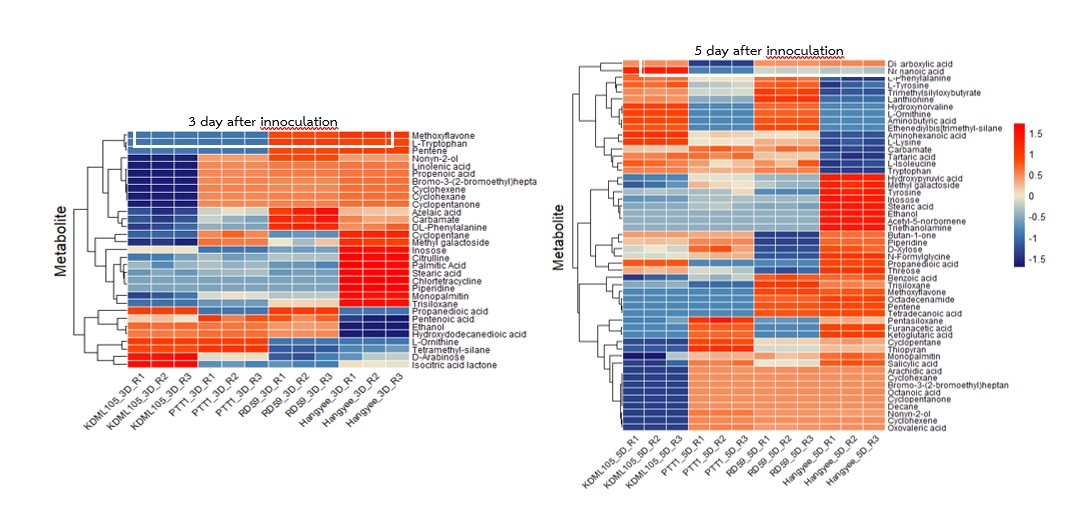
งานวิจัยนี้มีวัตถุประสงค์ในการนำเทคโนโลยีเมแทบอลอมิกส์มาใช้ในการศึกษาการเปลี่ยนแปลงของสารเมแทบอไลต์ที่เกิดขึ้นในข้าว เมื่อมีการเข้าทำลายของ เชื้อสาเหตุโรคไหม้ Pyricularia oryzae โดยพันธุ์ข้าว ที่นำมาทดลองประกอบด้วย พันธุ์ต้านทานโรค ได้แก่ ข้าวพันธุ์หางยี 71 และ กข59 และพันธุ์อ่อนแอต่อโรค ได้แก่ พันธุ์ขาวดอกมะลิ 105 และปทุมธานี 1 ทำการปลูกเชื้อให้กับต้นข้าวอายุ 30 วัน ด้วยเชื้อ P. oryzae บริเวณ ใบข้าวด้วยสปอร์แขวนลอยความเข้มข้น 5x10⁴ สปอร์ต่อมล. จากนั้นเก็บตัวอย่างใบข้าวหลังจากปลูกเชื้อ เป็นเวลา 8 ชม. 12 ชม. และ 1-7 วัน เพื่อนำมาวิเคราะห์ชนิดและปริมาณของสารเมแทบอไลต์ด้วยเครื่องแก๊สโครมาโทร กราฟี (GCxGC-TOFMS) ผลการทดลองพบความแตกต่างของสารเมแทบอไลต์ในข้าวพันธุ์ต้านทานและพันธุ์อ่อนแอ โดยข้าวพันธุ์ต้านทานพบการเพิ่มขึ้นอย่างมีนัยสำคัญทางสถิติ (p≤0.1) ของกรดอะมิโน phenylalanine citrulline และ shikimic acid ซึ่งเป็นสารตั้งต้นที่สำคัญของกระบวนการสังเคราะห์สารในกลุ่ม phenylpropanoid และ shikimate pathway ตามลำดับ หลังการปลูกเชื้อ P. oryzae เป็นเวลา 3 วันขึ้นไป ในขณะที่ข้าวพันธุ์อ่อนแอพบสารดังกล่าวหลังการปลูกเชื้อเป็นเวลา 5 วันขึ้นไป ซึ่งสารเหล่านี้มีความเกี่ยวข้องกับกลไกความต้านทานโรค ของพืช นอกจากนี้ในข้าวพันธุ์ต้านทานยังพบสาร methoxyflavone ซึ่งเป็นสารที่มีฤทธิ์ต้านอนุมูลอิสระ รวมไปถึง salicylic acid ที่ทำหน้าที่สำคัญเกี่ยวกับการ ส่งสัญญาณในการสร้างความต้านทาน หลังจากที่เชื้อสาเหตุโรคเข้าทำลายพืช ผลการศึกษานี้ช่วยเพิ่มความเข้าใจเกี่ยวกับกลไกความต้านทานโรคไหม้ของข้าว
เอกสารอ้างอิง
Agrios, G.N. 2005. Plant Pathology. 5th. New York: Academic Press. 922 p
Department of Foreign Trade. 2025. World and Thai rice situation December, 2025. Retrieved from https://www.dft.go.th/th-th/Service-DFT/Service-Information/DATA-Group-Product/Detail-DATA-Group-Product/ArticleId/29927/29927 [in Thai]
Dillon, V.M., J. Overton, R.J. Grayer and J.B. Harborne. 1997. Differences in phytoalexin response among rice cultivars of different resistance to blast. Phytochemistry 44: 599–603.
Francenia Santos-Sánchez, N., R. Salas-Coronado, B. Hernández-Carlos and C. Villanueva-Cañongo. 2019. Shikimic acid pathway in biosynthesis of phenolic compounds. IntechOpen 83815.
Hata E.M., M.T. Yusof and D. Zulperi. 2021. Induction of systemic resistance against bacterial leaf streak disease and growth promotion in rice plant by Streptomyces shenzhenesis TKSC3 and Streptomyces sp. SS8. The Plant Pathology Journal 37(2): 173–181.
International Rice Research Institute (IRRI). 2013. Standard Evaluation System (SES) for Rice. 5th. ed. Manila: IRRI. 65 p.
Jones, O., M. Maguire, J. Griffin, J. Young-Ho, J. Shibato, R. Rakwal, G. Agrawal and N.S. Jwa. 2011. Using metabolic profiling to assess plant-pathogen interactions: an example using rice (Oryza sativa) and the blast pathogen Magnaporthe grisea. European Journal of Plant Pathology 129: 539–554.
Kodama, O., J. Miyakawa, T. Akatsuka and S. Kiyosawa. 1992. Sakuranetin, a flavanone phytoalexin from ultraviolet-irradiated rice leaves. Phytochemistry 31: 3807–3809.
Lei, S. and B. Huang. 2022. Metabolic regulation of α-Ketoglutarate associated with heat tolerance in perennial ryegrass. Plant Physiology and Biochemistry 190: 164–173.
Madhavan, S., V. Paranidharan, A. Erban, A.M. Al-sadi, J. Kopka and R. Velazhahan. 2019. The metabolic response of suspension-cultured cells from blast-resistant and -susceptible rice (Oryza sativa L.) genotypes to a Pyricularia oryzae elicitor. Indian Phytopathology 72: 195–202.
Mekwatanakarn, P. and W. Mekwatanakarn. 2016. Thai Rice Blast. Ubon Ratchathani: Ubon Ratchathani University Press. 157 p. [in Thai]
Moselhy, S.S., T. Asami, K.O. Abualnaja, A.L. Al-Malki, H. Yamano, T. Akiyama, R. Wada, T. Yamagishi, M. Hikosaka, J. Iwakawa, K. Okada, M. Mori and T.A. Kumosani. 2016. Spermidine, a polyamine, confers resistance to rice blast. Journal of Pesticide Science 41(3): 79–82.
Parker, D., M. Beckmann, H. Zubair, D. Enot and Z. Caracuel-Rios. 2009. Metabolomic analysis reveals a common pattern of metabolic re-programming during invasion of three host plant species by Magnaporthe grisea. The Plant Journal 59: 723–737.
Piasai, O. 2017. Aquatic and Soil Fungi. Bangkok: Text and Journal Publication Co., Ltd. 251 p. [in Thai]
Settachaimongkon, S. and M. Luangwilai. 2017. Application of metabolomics technology for investigation of biomolecular profile of milk and dairy products. Journal of Food Technology, Siam University 12(1): 1–16. [in Thai]
Shimizu, T., F. Lin, M. Hasegawa, H. Nojiri, H. Yamane and K. Okada. 2012. The potential bioproduction of the pharmaceutical agent sakuranetin, a flavonoid phytoalexin in rice. Bioengineered 3(6): 352–357.
Stompor, M. 2020. A review on sources and pharmacological aspects of sakuranetin. Nutrients 12: 513.
Sun, R., S. Qin, T. Zhang, Z. Wang, H. Li, Y. Li and Y. Nie. 2019. Comparative phosphoproteomic analysis of blast resistant and susceptible rice cultivars in response to salicylic acid. BMC Plant Biology 19: 454.
Valletta, A., L.M. Iozia, L. Fattorini and F. Leonelli. 2023. Rice phytoalexins: half a century of amazing discoveries; part I: distribution, biosynthesis, chemical synthesis, and biological activities. Plants 12(2): 260.
Wu, Z., G. Wang, B. Zhang, T. Dai, A. Gu, X. Li, X. Cheng, P. Liu, J. Hao and X. Liu. 2021. Metabolic mechanism of plant defense against rice blast induced by probenazole. Metabolites 11(4): 246.
Yadav, V., Z. Wang, C. Wei, A. Amo, B. Ahmed, X. Yang and X. Zhang. 2020. Phenylpropanoid pathway engineering: an emerging approach towards plant defense. Pathogens 9: 312.
Zhan, S.W., Y. Yang, Z.M. Wu and K.T. Li. 2020. Induced defense responses against Rhizoctonia solani in rice seedling by a novel antifungalmycin N2 from Streptomyces sp. N2. Australasian Plant Pathology 49: 267–276.
ดาวน์โหลด
เผยแพร่แล้ว
รูปแบบการอ้างอิง
ฉบับ
ประเภทบทความ
สัญญาอนุญาต
ลิขสิทธิ์ (c) 2026 วารสารวิจัยและส่งเสริมวิชาการเกษตร

อนุญาตภายใต้เงื่อนไข Creative Commons Attribution-NonCommercial-NoDerivatives 4.0 International License.
บทความนี้ได้รับการเผยแพร่ภายใต้สัญญาอนุญาต Creative Commons Attribution-NonCommercial-NoDerivatives 4.0 International (CC BY-NC-ND 4.0) ซึ่งอนุญาตให้ผู้อื่นสามารถแชร์บทความได้โดยให้เครดิตผู้เขียนและห้ามนำไปใช้เพื่อการค้าหรือดัดแปลง หากต้องการใช้งานซ้ำในลักษณะอื่น ๆ หรือการเผยแพร่ซ้ำ จำเป็นต้องได้รับอนุญาตจากวารสาร