Primary Metabolomic Profiling Associated with Rice Blast Resistance
DOI:
https://doi.org/10.14456/jare-mju.2026.25Keywords:
blast disease, metabolomics, rice, Pyricularia oryzae, GCxGC-TOFMSAbstract
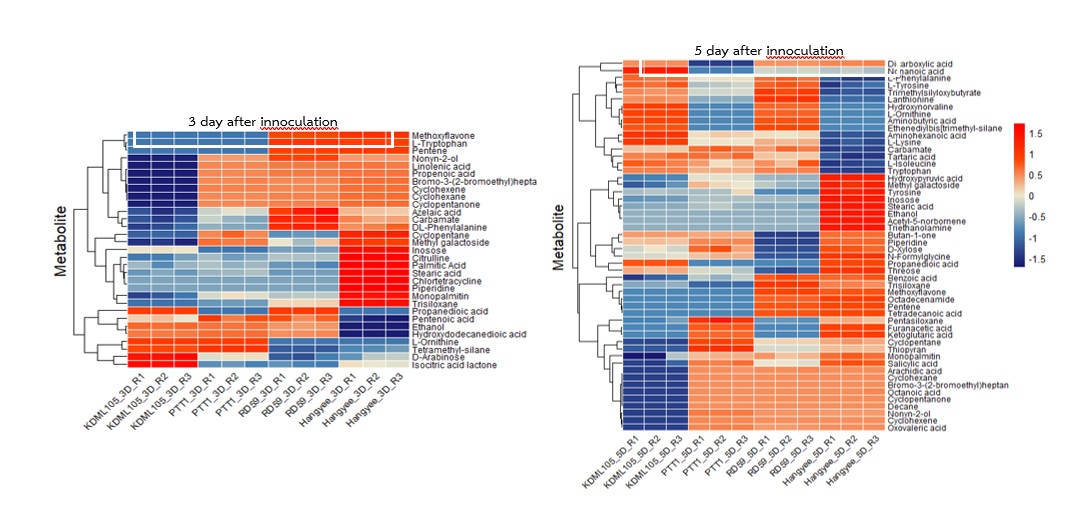
This research aimed to apply metabolomics technology to investigate changes in rice metabolites in response to infection by the rice blast pathogen Pyricularia oryzae. The blast-resistant rice varieties (Hangyee 71 and RD59) and blast-susceptible rice varieties (KDML 105 and PTT1) were used. The thirty-day-old rice plants were inoculated with a spore suspension of P. oryzae at a concentration of 5×10⁴ spores×mL-1. The leaf samples were collected 8 and 12 hours, and 1–7 days after inoculation. Metabolite profiling was performed using comprehensive two-dimensional gas chromatography with a time-of-flight mass spectrometer (GCxGC-TOFMS). The results revealed distinct metabolic profiles between the blast-resistant and blast-susceptible rice varieties. In the resistant rice varieties, a significant increase (p≤0.1) in phenylalanine, citrulline, and shikimic acid was detected three days after inoculation, whereas in the susceptible cultivars these metabolites were observed, starting five days after inoculation. These compounds are key precursors in the phenylpropanoid and shikimate pathways, which are associated with plant defense mechanisms. In addition, the resistant rice varieties showed the presence of methoxyflavone, an antioxidant compound, and salicylic acid, a plant hormone involved in defense induction. These findings provide insights into the metabolic mechanisms underlying rice blast resistance.
References
Agrios, G.N. 2005. Plant Pathology. 5th. New York: Academic Press. 922 p
Department of Foreign Trade. 2025. World and Thai rice situation December, 2025. Retrieved from https://www.dft.go.th/th-th/Service-DFT/Service-Information/DATA-Group-Product/Detail-DATA-Group-Product/ArticleId/29927/29927 [in Thai]
Dillon, V.M., J. Overton, R.J. Grayer and J.B. Harborne. 1997. Differences in phytoalexin response among rice cultivars of different resistance to blast. Phytochemistry 44: 599–603.
Francenia Santos-Sánchez, N., R. Salas-Coronado, B. Hernández-Carlos and C. Villanueva-Cañongo. 2019. Shikimic acid pathway in biosynthesis of phenolic compounds. IntechOpen 83815.
Hata E.M., M.T. Yusof and D. Zulperi. 2021. Induction of systemic resistance against bacterial leaf streak disease and growth promotion in rice plant by Streptomyces shenzhenesis TKSC3 and Streptomyces sp. SS8. The Plant Pathology Journal 37(2): 173–181.
International Rice Research Institute (IRRI). 2013. Standard Evaluation System (SES) for Rice. 5th. ed. Manila: IRRI. 65 p.
Jones, O., M. Maguire, J. Griffin, J. Young-Ho, J. Shibato, R. Rakwal, G. Agrawal and N.S. Jwa. 2011. Using metabolic profiling to assess plant-pathogen interactions: an example using rice (Oryza sativa) and the blast pathogen Magnaporthe grisea. European Journal of Plant Pathology 129: 539–554.
Kodama, O., J. Miyakawa, T. Akatsuka and S. Kiyosawa. 1992. Sakuranetin, a flavanone phytoalexin from ultraviolet-irradiated rice leaves. Phytochemistry 31: 3807–3809.
Lei, S. and B. Huang. 2022. Metabolic regulation of α-Ketoglutarate associated with heat tolerance in perennial ryegrass. Plant Physiology and Biochemistry 190: 164–173.
Madhavan, S., V. Paranidharan, A. Erban, A.M. Al-sadi, J. Kopka and R. Velazhahan. 2019. The metabolic response of suspension-cultured cells from blast-resistant and -susceptible rice (Oryza sativa L.) genotypes to a Pyricularia oryzae elicitor. Indian Phytopathology 72: 195–202.
Mekwatanakarn, P. and W. Mekwatanakarn. 2016. Thai Rice Blast. Ubon Ratchathani: Ubon Ratchathani University Press. 157 p. [in Thai]
Moselhy, S.S., T. Asami, K.O. Abualnaja, A.L. Al-Malki, H. Yamano, T. Akiyama, R. Wada, T. Yamagishi, M. Hikosaka, J. Iwakawa, K. Okada, M. Mori and T.A. Kumosani. 2016. Spermidine, a polyamine, confers resistance to rice blast. Journal of Pesticide Science 41(3): 79–82.
Parker, D., M. Beckmann, H. Zubair, D. Enot and Z. Caracuel-Rios. 2009. Metabolomic analysis reveals a common pattern of metabolic re-programming during invasion of three host plant species by Magnaporthe grisea. The Plant Journal 59: 723–737.
Piasai, O. 2017. Aquatic and Soil Fungi. Bangkok: Text and Journal Publication Co., Ltd. 251 p. [in Thai]
Settachaimongkon, S. and M. Luangwilai. 2017. Application of metabolomics technology for investigation of biomolecular profile of milk and dairy products. Journal of Food Technology, Siam University 12(1): 1–16. [in Thai]
Shimizu, T., F. Lin, M. Hasegawa, H. Nojiri, H. Yamane and K. Okada. 2012. The potential bioproduction of the pharmaceutical agent sakuranetin, a flavonoid phytoalexin in rice. Bioengineered 3(6): 352–357.
Stompor, M. 2020. A review on sources and pharmacological aspects of sakuranetin. Nutrients 12: 513.
Sun, R., S. Qin, T. Zhang, Z. Wang, H. Li, Y. Li and Y. Nie. 2019. Comparative phosphoproteomic analysis of blast resistant and susceptible rice cultivars in response to salicylic acid. BMC Plant Biology 19: 454.
Valletta, A., L.M. Iozia, L. Fattorini and F. Leonelli. 2023. Rice phytoalexins: half a century of amazing discoveries; part I: distribution, biosynthesis, chemical synthesis, and biological activities. Plants 12(2): 260.
Wu, Z., G. Wang, B. Zhang, T. Dai, A. Gu, X. Li, X. Cheng, P. Liu, J. Hao and X. Liu. 2021. Metabolic mechanism of plant defense against rice blast induced by probenazole. Metabolites 11(4): 246.
Yadav, V., Z. Wang, C. Wei, A. Amo, B. Ahmed, X. Yang and X. Zhang. 2020. Phenylpropanoid pathway engineering: an emerging approach towards plant defense. Pathogens 9: 312.
Zhan, S.W., Y. Yang, Z.M. Wu and K.T. Li. 2020. Induced defense responses against Rhizoctonia solani in rice seedling by a novel antifungalmycin N2 from Streptomyces sp. N2. Australasian Plant Pathology 49: 267–276.
Downloads
Published
How to Cite
Issue
Section
License
Copyright (c) 2026 Journal of Agricultural Research and Extension

This work is licensed under a Creative Commons Attribution-NonCommercial-NoDerivatives 4.0 International License.
This article is published under a Creative Commons Attribution-NonCommercial-NoDerivatives 4.0 International License (CC BY-NC-ND 4.0), which allows others to share the article with proper attribution to the authors and prohibits commercial use or modification. For any other reuse or republication, permission from the journal and the authors is required.


