
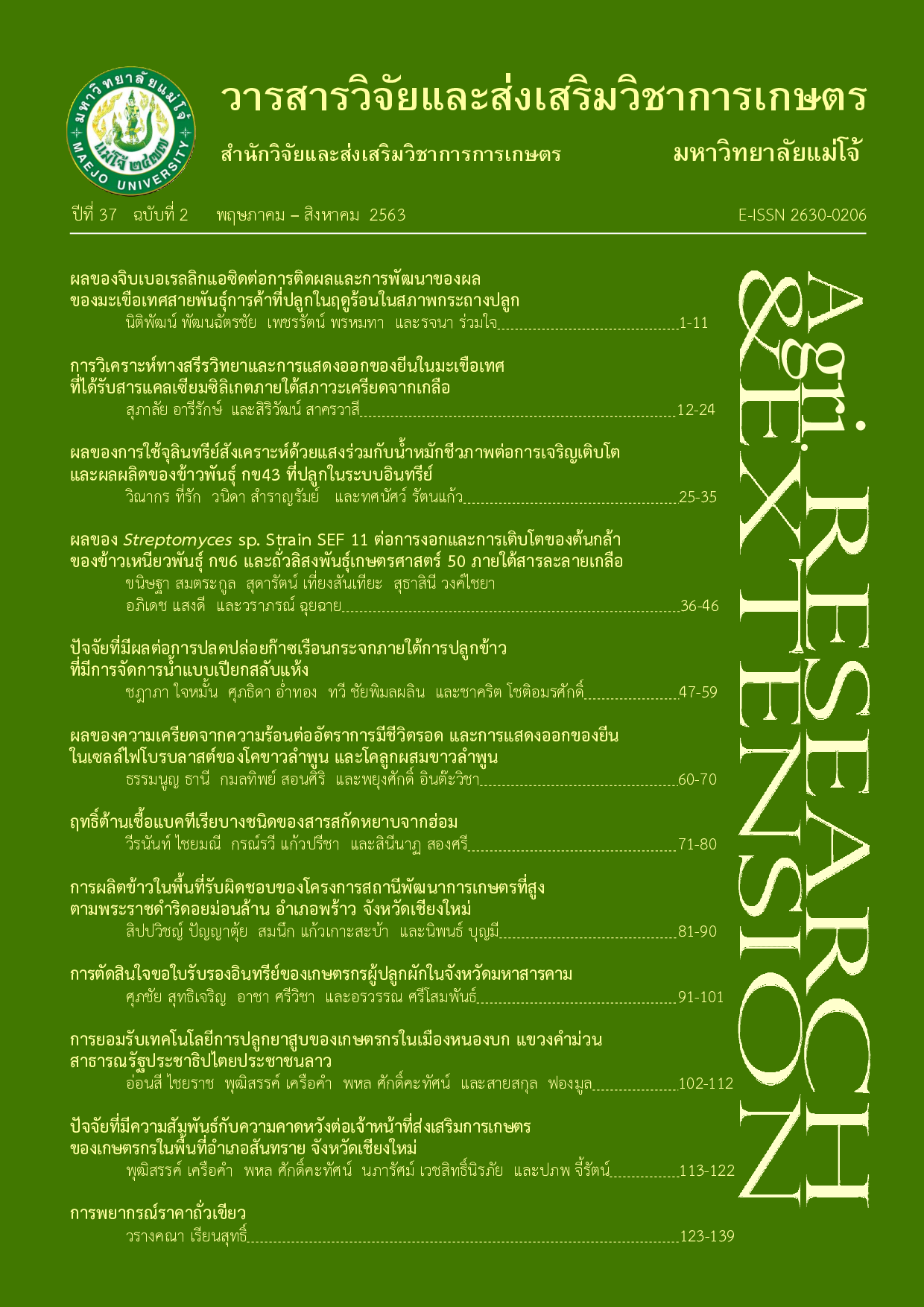
Effect of Streptomyces sp. Strain SEF11 on Germination and Seedling Growth of Glutinous Rice cv. RD 6 and Peanut cv. Kasetsart 50 under Salt Solution
Abstract
This study was performed to investigate the effect of indole-3-acetic acid producing bacteria, Streptomyces sp. strain SEF11 on germination and seedling growth of glutinous rice cv. RD 6 and peanut cv. Kasetsart 50 seedling in 2 concentrations of sterile sodium chloride solution that were slightly (2.37 ds/m) and moderately (7.25 ds/m) salt solution. The results showed that seed of glutinous rice cv. RD6 and peanut cv. Kasetsart 50 germinated well in both slightly and moderately salt solution. Seeds immersion in bacterial suspension increased shoot length of peanut and root length of glutinous rice cv. RD6 and peanut cv. Kasetsart 50 seedling when compared with control in all salt conditions. Seeds immersion in culture filtrate increased shoot length and root length of glutinous rice cv. RD6 seedling but there were no effect on peanut cv. Kasetsart 50 seedling. Thus, Streptomyces sp. strain SEF11 were possible to use for promoting glutinous rice cv. RD6 and peanut cv. Kasetsart 50 growth in saline soil.
References
Annex 1. n.d. Crop salt tolerance data. [Online]. Available http://www.fao.org/3/y4263e/y4263e0e.htm (23 December 2019).
Arunin, S. and P. Pongwichian 2015. Salt-affected soils and management in Thailand. Bull. Soc. Sea Water Sci. 69: 319-325.
Asim, M., M. Aslam, A. Bano, M. Munir, A. Majeed and S.H. Abbas. 2013. Role of phytohormones in root nodulation and yield of peanut under salt stress. Am. J. Res. Commun. 1: 191-208.
Calvelo Pereira, R.C., C. Monterroso and F. Macias. 2010. Phytotoxicity of hexachlorocyclohexane: effect on germination and early growth of different plant species. Chemosphere 79: 326-333.
Chuanren, D., W. Bochu, L. Wanqian, C. Jing, L. Jie and Z. Huan. 2004. Effect of chemical and physical factors to improve the germination rate of Echinaceae angustifolia seeds. Colloids Surfaces B. 37: 101-105.
Gulnaz, A., J. Iqbal, S. Farooq and F. Azam. 1999. Seed treatment with growth regulators and crop productivity I. 2,4-D as an inducer of salinity-tolerance in wheat (Triticum aestivum L.). Plant and Soil 210: 209-217.
Ilangumaran, G. and D.L Smith. 2017. Plant growth promoting rhizobacteria in amelioration of salinity stress: a systems biology perspective. Front. Plant Sci. 8(1768): 1-14.
Li, H.Q. and X.W. Jiang. 2017. Inoculation with plant growth-promoting bacteria (PGPB) improves salt tolerance of maize seedling. Russ. J. Plant Physl. 64: 235-241.
Machado, R.M.A. and R.P. Serralheiro 2017. Soil salinity: effect on vegetable crop growth management practices to prevent and mitigate. Horticulturae 3(30): 1-13.
Mohamed, H.I. and E.Z. Gomaa. 2012. Effect of plant promoting Bacillus subtilis and Pseudomonas fluorescens on growth and pigment composition of radish plants (Raphanus sativus) under NaCl stress. Photosynthetica 50: 263-272.
Mohr, H. and P. Schopfer. 1995. Plant Physiology. Berlin: Springer. 269 p.
Pan, J., F. Peng, X. Xue, Q. You, W. Zhang, T. Wang and C. Huang. 2019. The growth promotion of two salt-tolerant plant groups with PGPR inoculation: a meta-analysis. Sustainability 11(378): 1-14.
Sarkar, A., P.K. Ghosh, K. Pramanik, S. Mitra, T. Soren, S. Pandey, M.H. Mondal and T.K. Maiti. 2018. A halotolerant Enterobacter sp. displaying ACC deaminase activity promotes rice seedling growth under salt stress. Res. Microbiol. 169: 20-32.
Shirokova, Y., I. Forkutsa and N. Sharafutdinova. 2000. Use of electrical conductivity instead of soluble salts for soil salinity monitoring in Central Asia. Irrig. Drain. Sys. 14: 199-205.
Shrivastava, P. and R. Kumar. 2015. Soil salinity: a serious environmental issue and plant growth promoting bacteria as one of the tools for its alleviation. Saudi J. Biol. Sci. 22: 123-131.
Singh, R.P. and P.N. Jha. 2017. Analysis of fatty acid composition of PGPR Klebsiella sp. SBP-8 and its role in ameliorating salt stress in wheat. Symbiosis 73: 213-222.
Somtrakoon, K., N. Sripasa, S. Ladsena, A. Sangdee and W. Chouychai. 2019. Optimum conditions for indole-3-acetic acid production by Streptomyces and its stimulation on seed germination of rice cv. KDML105. Journal of Agricultural Research and Extension 36(3): 12-22. [in Thai]
Tanimoto, E. 2005. Regulation of root growth by plant hormones–roles for auxin and gibberellin. Cri. Rev. Plant Sci. 24: 249-265.
Downloads
Published
How to Cite
Issue
Section
License
Copyright (c) 2020 Journal of Agricultural Research and Extension

This work is licensed under a Creative Commons Attribution-NonCommercial-NoDerivatives 4.0 International License.
This article is published under a Creative Commons Attribution-NonCommercial-NoDerivatives 4.0 International License (CC BY-NC-ND 4.0), which allows others to share the article with proper attribution to the authors and prohibits commercial use or modification. For any other reuse or republication, permission from the journal and the authors is required.