
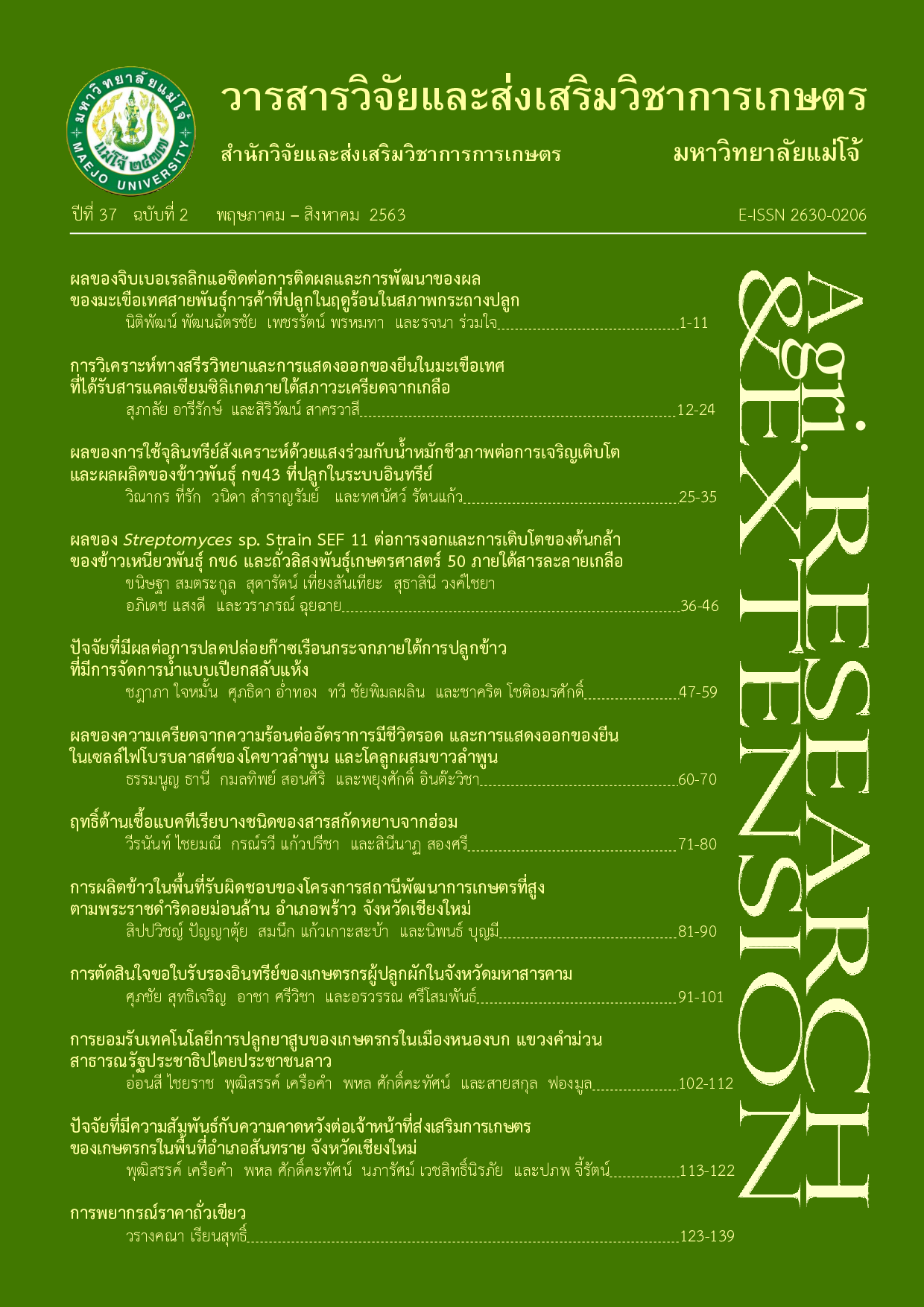
Effect of Gibberellic Acid(GA3) on Fruit Set and Development of Commercial Variety Tomato (Lycopersicon esculentum Mill) Grown in Summer under Pot Condition
Keywords:
Keywords: gibberellic acid, tomato, fruit setting, fruit development, summer, gibberellic acid, tomato, fruit setting, fruit development, summerAbstract
This research aimed to carify the effect of spraying gibberellic acid (GA3) at different concentrations at anthesis stages on fruit setting and fruit development of F1-hybrid tomato cv Ranger grown in pot under summer condition. The experiment was arranged under growing house which was covered by white nylon screen and was replicated 5 times. The first factor was stage of GA3 spraying (0, 2 and 4 day after fullbloom, DAFB) and the second factor was concentration of GA3 (0, 50, 100 and 200 mg/l). It was conducted at the Faculty of Agriculture and Agricultural Industry, Surindra Rajabhat University during February to June, 2017. Results showed that spraying 100 mg/l GA3 at 0 DAFB significantly affected the highest mean of fruit fresh weight per fruit (52.39 g) and pulp thickness (0.67 cm), as spraying of 200 mg/l GA3 at 0 DAFB (0.68 cm), 0 mg/l GA3 (0.73 cm) and 100 mg/l GA3 (0.70 cm) at 4 DAFB showed insignificantly affected pulp thickness. However, spraying of 0 mg/l GA3 at 0 DAFB significantly affected endocarp+placenta+seeds fresh weight (9.37 g). Pulp fresh weight (23.81 g) and fruit fresh weight per inflorescence (32.64 g) were affected by spraying of 100 mg/l GA3 at 4 DAFB. Fruits number per inflorescence showed no interaction between stage of spraying and concentration. Spraying of GA3 at any concentration was significantly enhanced fruit number per inflorescence at 2 DAFB (1.79 fruit). Mooreover, it was found out that spraying of 50 mg/l GA3 (1.79 fruit) and 100 mg/l GA3 (1.72 fruit) showed significantly increased fruit number per inflorescence over the rest concentrations.
References
Abdel-Rahman, M., T.H. Thomas, G.J. Doss and L. Howell. 1975. Changes in endogenous plant hormones in cherry tomato fruit during development and maturation. Physiol. Plantarum. 34(1): 39-43.
Arteca, R.N. 1996. Plant Growth Substances: Principles and Applications. New York: Chapman & Hall. 332 p.
Cutler, H.G. and B.A. Schneider. 1990. Plant Growth Regulator Handbook. 3rd ed. Ithaca, NY: Plant Growth Regulator Society of America. 146 p.
Davies, P.J. 1995. Plant Hormones Physiology, Biochemistry and Molecular Biology. Dordrecht, The Netherlands: Kluwer Academic. 833 p.
de Jong, M., M. Celestina and W.H. Vriezen. 2009. The role of auxin and gibberellin in tomato fruit set. J. Exp. Bot. 60(5): 1523-1532.
Gelmesa, D., B. Abebie and L. Desalegn. 2012. Regulation of tomato (Lycopersicon esculentum Mill.) fruit setting and earliness by gibberellic acid and 2,4-dichlorophenoxy acetic acid application. African J. Biot. 11(51): 11200-11206.
Gillaspy, G., H. Ben-David and W. Gruissem. 1993. Fruits: a developmental perspective. The Plant Cell 5(10): 1439-1451.
Kasetsart University. 2016. Tomato Growing. [Online]. Available http://www.ku.ac.th/e-magazine/nov49/agri/lycopersicon.htm (13 December 2016). [in Thai]
Kazemi, M. 2014. Effect of gibberellic acid and potassium nitrate spray on vegetative growth and reproductive characteristics of tomato. J. Biol. Environ. Sci. 8(22): 1-9.
Khan, J.M., A.C. Gautam, F. Mohammad, M.H. Siddigui, M. Naeem and M.N. Khan. 2006. Effect of gibberellic acid spray on performance of tomato. Turk. J. Biol. 30: 11-16.
Koshioka, M., T. Nishijima, H. Yamazaki, Y. Liu, M. Nonaka and L.N. Mander. 1994. Analysis of gibberellins in growing fruits of Lycopersicon esculentum after pollination or treatment with 4-chlorophenoxyacetic acid. J. Hortic. Sci. 69(1): 171-179.
Kumar, A., T.K. Biswas, N. Singh and E.P Lal. 2014. Effect of gibberellic acid on growth, quality and yield of tomato (Lycopersicon esculentum Mill.). J. Agric. Vet. Sci. 7(7): 28-30.
Kuo, C.G., B.W. Chen, M.H. Chov, C.L. and J.S. Tsay. 1978. Tomato Fruit Set at High Temperature. pp. 94-108. In Proceedings of the 1st International Symposium on Tropical Tomato. Shanhua: Asian Vegetable Research and Development Center.
Mapelli, S., C. Frova, G. Torti and G.P. Soressi. 1978. Relationship between set, development and activities of growth regulators in tomato fruits. Plant and Cell Physiol. 19(7): 1281-1288.
Moore, R., W.D. Clark, K.R. Stern and D. Vodopich. 1995. Botany. Dubugue, IA: Wm. C. Brown Communications. 824 p.
Naeem, N., M. Ishtiaq, P. Khan, N. Mohammad, J. Khan and B. Jamiher. 2001. Effect of gibberellic acid on growth and yield of tomato cv. Roma. J. Biol. Sci. 1(6): 448-450.
Nester, J.E. and J.A.D. Zeevaart. 1988. Flower development in normal tomato and gibberellin deficient (ga-2) mutant. Am. J. Bot. 75(1): 45-55.
Sasaki, H., T. Yano and A. Yamasaki. 2005. Reduction of high temperature inhibition in tomato fruit set by plant growth regulators. JARQ. 39(2): 135-138.
Serrani, J.C., R. Sanjuán, O. Ruiz-Rivero, M. Fos and J.L. Garcia-Martinez. 2007. Gibberellin regulation of fruit set and growth in tomato. Plant Physiol. 145(1): 246-257.
Sritathanee, K. 1997. Cherry Tomato. Advanced Agriculture 12(2): 61-62.
Srivastava, L.M. 2002. Plant Growth and Development: Hormones and Environment. Amsterdam: Academic. 772 p.
Downloads
Published
How to Cite
Issue
Section
License
Copyright (c) 2020 Journal of Agricultural Research and Extension

This work is licensed under a Creative Commons Attribution-NonCommercial-NoDerivatives 4.0 International License.
This article is published under a Creative Commons Attribution-NonCommercial-NoDerivatives 4.0 International License (CC BY-NC-ND 4.0), which allows others to share the article with proper attribution to the authors and prohibits commercial use or modification. For any other reuse or republication, permission from the journal and the authors is required.


