
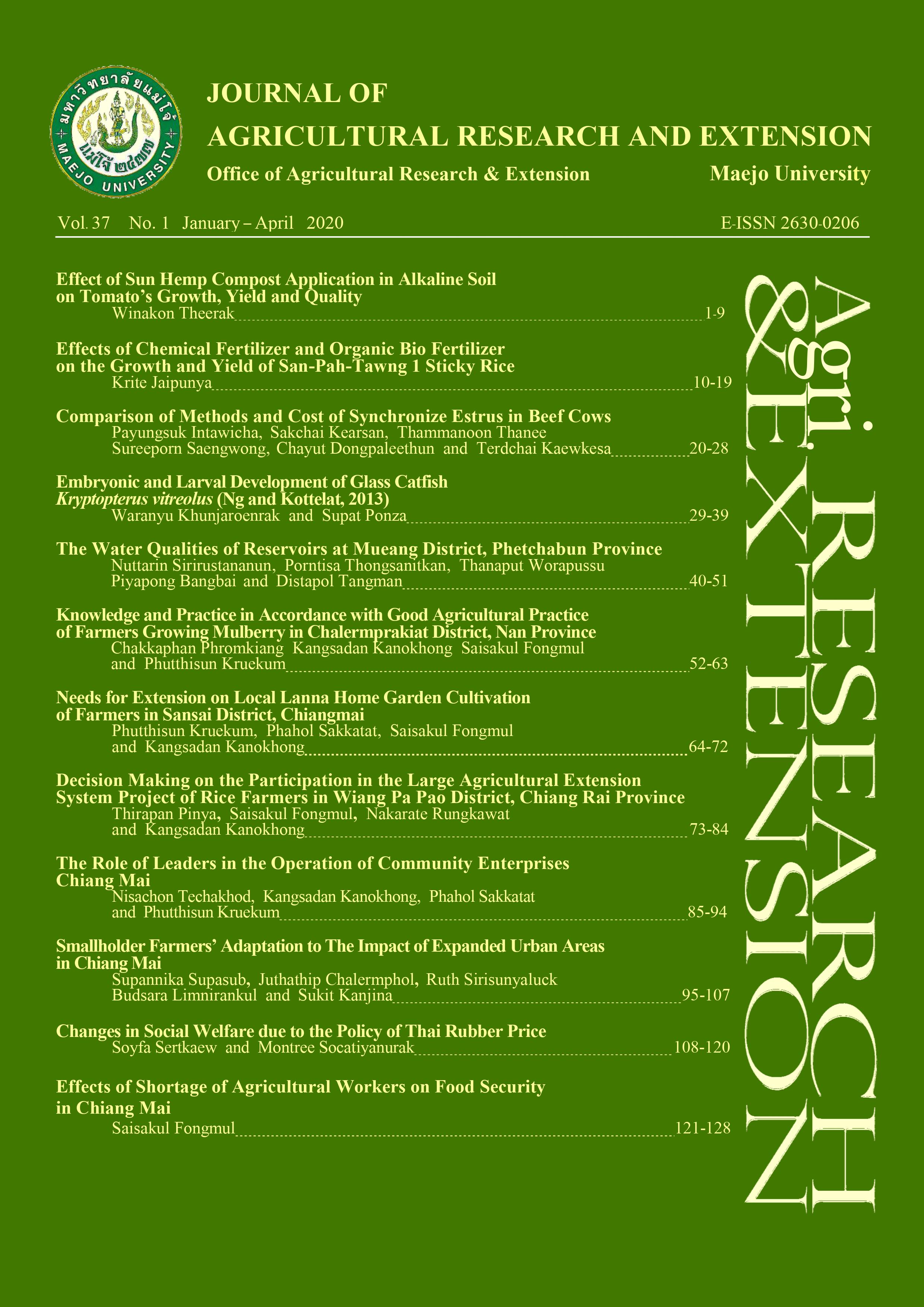
Knowledge and Practice in Accordance with Good Agricultural Practice of Farmers Growing Mulberry in Chalermprakiat District, Nan Province
Keywords:
knowledge, practice, Good Agricultural Practice, chalermprakiat districtAbstract
The objectives of the study were: 1) to study the characteristics and socio-economic of mulberry farmers 2) to study knowledge and practice in accordance with Good Agricultural Practice, and 3) to study the factors affecting of knowledge and practice in accordance with Good Agricultural Practice and to study problems encountered, and suggestions on Good Agricultural Practice of mulberry farmers in Chalermprakiat district, Nan province. The samples were 154 farmers in study areas. The data were collected from questionnaire, statistical techniques used were percentage, mean and standard deviation.
From research findings, it was found that the majority of farmers were male who did not attend formal/non-formal education or did not finish compulsory education. Their average age was 49 years old and had marriage status. They owned plant land for 3.48 rai and earned annual income as 39,038 Baht per year. Each farmer had 2 average workforces. The farmers had 3 years average experience on Good Agricultural Practice of mulberry farming and attended a training average 1 time per year. Mostly of farmers join the Good Agricultural Practice group and received the information about Good Agricultural Practice from neighbor and agricultural extension officers.
The related factor to the knowledge of Good Agricultural Practice which the statistical significance was contact with agricultural extension officer as 0.012 level. In addition, all independent variables shall explain the variation of dependent variables of Good Agricultural Practice knowledge of farmers growing mulberry by 10.1%. The remaining 89.9% were affected by other variables. Whereas, the related factors to the practice of Good Agricultural Practice which the statistical significance were sex and education as 0.026 and 0.012 level, respectively. Moreover, all independent variables shall explain the variation of dependent variables of Good Agricultural Practice knowledge of farmers growing mulberry by 14.2%. The remaining 85.8% were affected by other variables.
There were many the problems encountered on Good Agricultural Practice include: 1) lack of confidence on price and market of the products from Good Agricultural Practice, 2) lack of understanding on detailed data record and monitor, 3) the impact of global climate change which cause of drought and outbreaks of plant pests and diseases. Thereby, the farmers showed the suggestion on those problems as: 1) the sericulture extension officer or related officer should provide the information and build the confidence regarding price and target market, 2) the instruction of Good Agricultural Practice should be revised to easily understood and practical, 3) the training program should be held to teaching about data record by sericulture extension officer and 4) the farmers should be raised awareness and management guideline of global climate change.
References
Boonkapim, P., C. Siriswat and N. Sopa. 2016. A model for development knowledge, attitudes and job performance of organic jasmine rice farmers through the cooperation between the office of farmers council and local government organization in Roi-Et province. Research and Development Journal Loei Rajabhat University. 11(36): 91-102. [in Thai]
Department of Agriculture. 2002. Good Agricultural Practice for Food Plants. Bangkok: Department of Agriculture. 34 p. [in Thai]
Mingsakul, S. 2016. Knowledge and practice in accordance with Good Agricultiral Practice (GAP) of farmers producing vegetables in Mae Rim district, Chiang Mai province. Academic Journal Uttaradit Rajabhat University 11(2): 323-334. [in Thai]
National Commission on the Development of Chemical Management Strategies. 2013. The Eleventh Development of Chemical Management Strategies. Nonthaburi: The Agricultural Cooperative Federation of Thailand. 66 p. [in Thai]
Pettong P. and J. Tanapanyaratchawong. 2009. Adoption of Good Agricultural Practices for rambutan of farmers in Ban Nasan district, Surat Thani province. Suranaree Journal Social Science 3(2): 109-126. [in Thai]
Phengsawat, W. 2010. Applied Statistics for Social Science Research. Bangkok: Suveeriyasarn. 428 p. [in Thai]
Prasitrathasint, S. 2002. Applications of Statistical Methods in Research. Bangkok: Fueang Fa Printing House. 352 p. [in Thai]
Siriwiriyasomboon, N., T. Mekhora and T. Limunggura. 2012. Factors affecting farmers’ adoption of safety vegetable in Bangyai District, Nonthaburi province. King Mongkut's Agricultural Journal 30(2): 59-67. [in Thai]
Yamane, T. 1973. Statistics an Introductory Analysis. 3rd. New York: Harper and Row. 1130 p.
Downloads
Published
How to Cite
Issue
Section
License
This article is published under a Creative Commons Attribution-NonCommercial-NoDerivatives 4.0 International License (CC BY-NC-ND 4.0), which allows others to share the article with proper attribution to the authors and prohibits commercial use or modification. For any other reuse or republication, permission from the journal and the authors is required.