
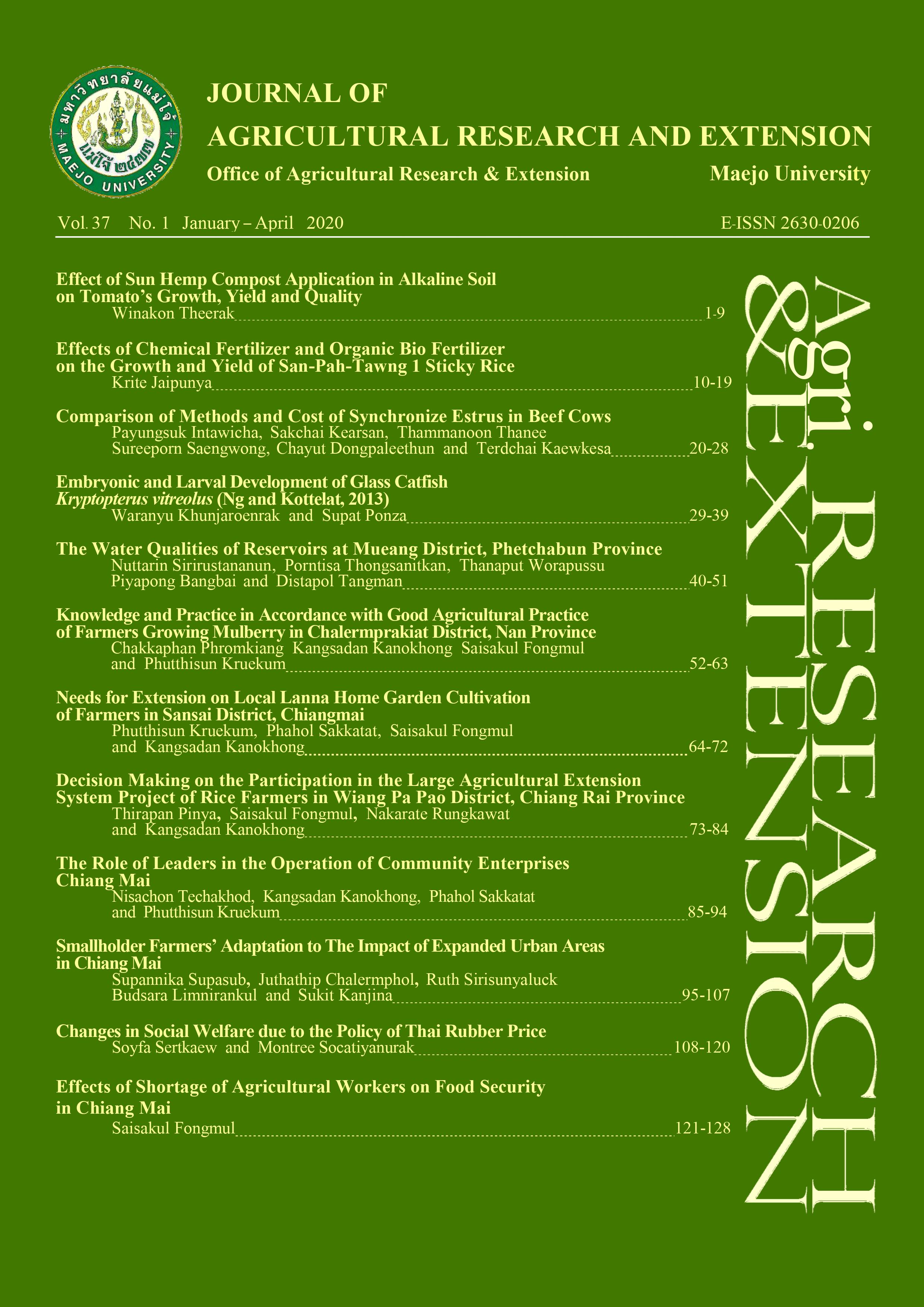
Effects of Shortage of Agricultural Workers on Food Security in Chiang Mai
Keywords:
shortage of agricultural workers, food securityAbstract
This research aimed to study: 1) situation of agricultural workers on food security in Chiang Mai, 2) impact of the shortage of agricultural workers on food security in Chiang Mai, 3) ways and suggestions for enhancing food security in Chiang Mai. This study was conducted in five districts in Chiang Mai as follows: Mae Jaem, Jomthong, Fang, Chiang Dao, and Mae Ai. Data were collected by using a questionnaire, doing in-depth interview, and observing. The samples of this study were 400 agricultural workers in Chiang Mai. The quantitative data was analyzed using descriptive statistics and qualitative data was analyzed using content analysis.
The results of the study on agricultural labor situation in food security in Chiang Mai showed that the proportion of agricultural workers was decreasing. Membership in agricultural households older than 65 years was likely to increase. This population must be a group that the government must provide close and continuous supervision because in addition to being a food producer, it was still a group of people who were living inferior to other people in society. As a result of the increase in the elderly population, the proportion of the elderly in the labor force was likely to increase. This was because in the future working age population was likely to decrease and labor shortage will occur. It was one of the reasons that the elderly who had the potential to work will replace those in working age. So, these aging populations were becoming increasingly important and can impact on the economy and society of the country and the food security of Thailand in the future.
The guideline and suggestions for enhancing food security was mainly by relying upon nature or proximity to water source which was good for sowing and growing crops. And inevitably labor force came from foreign workers. Farmers adapt to this situation by the following: 1) increasing land area for planting field crops or changing main crops, 2) applying integrated farming by planting field crops and raising livestock which required knowledge and skills, less technology, less risks with high chances of success and used of least resources.
References
Chiang Mai Provincial Agricultural Extension Office. 2014. Report of Chiang Mai Agricultural Economic. 13 p. In Annual Report 2014. Chiang Mai: Chiang Mai Provincial Agricultural Extension Office. [in Thai]
Fongmul, S. 2008. The changing of aging population for agricultural labor management: the case of Mae Faek, San Sai district, Chiang Mai province. 11 p. In Research Report. Chiang Mai: Maejo University. [in Thai].
Fongmul, S. 2011. Study on agricultural labor force crises: the case of longan. 96 p. In Research Report. Chiang Mai: Maejo University. [in Thai]
Office of the National Economics and Social Development Board. 2014. Situation and Impact of Foreign Workers in the Thai Economy. 27 p. In Annual Report 2014. Bangkok: Ministry of Labour. [in Thai]
Office of Economic Development and Social North. 2005. Drilling report on the study on labor changes in agricultural sector in upper north of Thailand. [Online]. Available http://www.ftawatch.org/news/view.php?id=2683 (14 March 2012).
Singhapreecha, C.H. 2015. The impact of agricultural demographic structural change on food security in Thai agricultural sector. Journal of the Association of Researchers 20(1): 107-121. [in Thai]
Downloads
Published
How to Cite
Issue
Section
License
Copyright (c) 2020 วารสารวิจัยและส่งเสริมวิชาการเกษตร

This work is licensed under a Creative Commons Attribution-NonCommercial-NoDerivatives 4.0 International License.
This article is published under a Creative Commons Attribution-NonCommercial-NoDerivatives 4.0 International License (CC BY-NC-ND 4.0), which allows others to share the article with proper attribution to the authors and prohibits commercial use or modification. For any other reuse or republication, permission from the journal and the authors is required.