
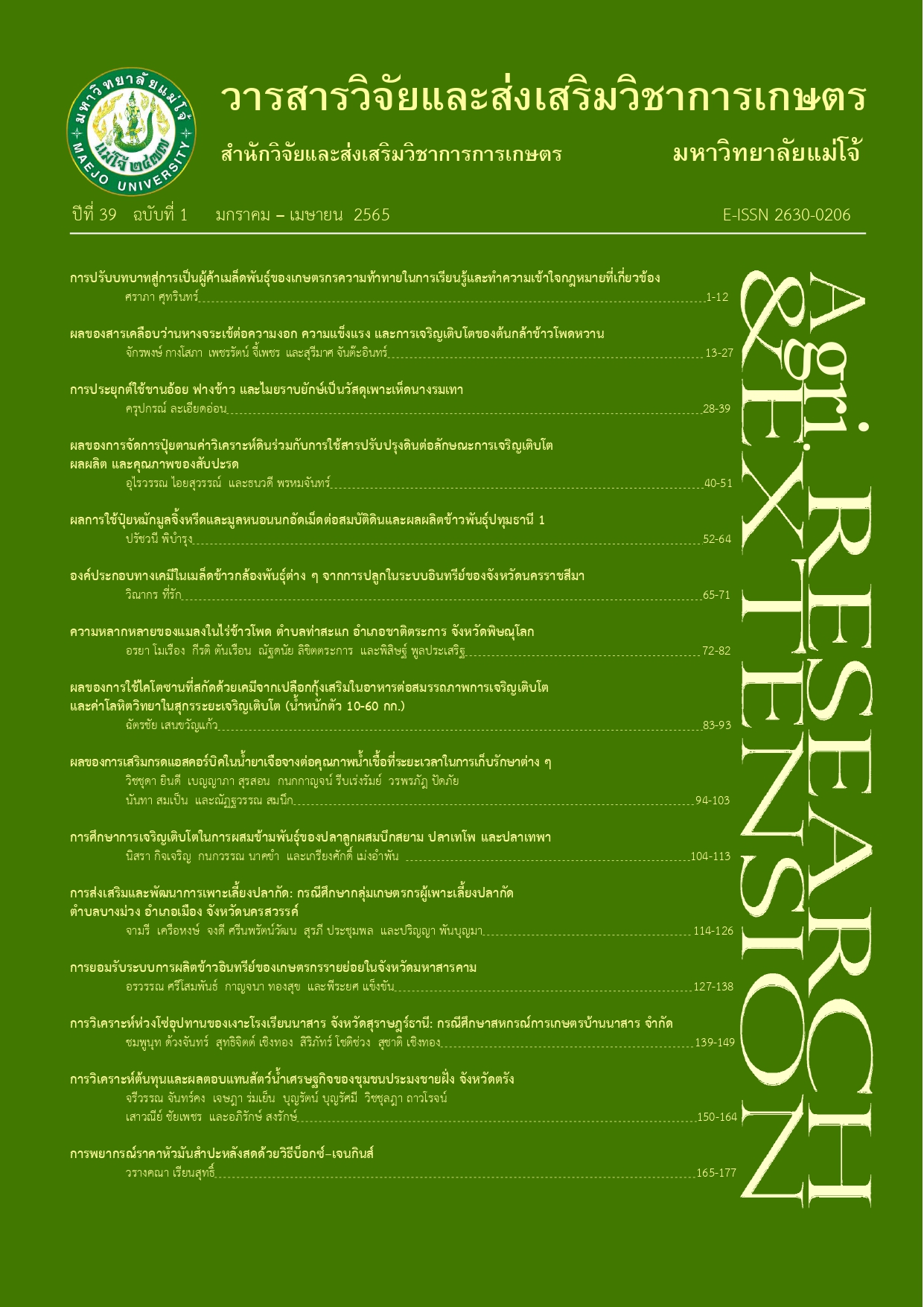
Small-scale Farmers’ Acceptance of Organic Rice Production System in Maha Sarakham Province
Keywords:
acceptance, organic agriculture, small-scale farmers, sustainable livelihoodAbstract
This study analyzed the factors influencing the acceptance of organic rice cultivation by farmers in Maha Sarakham province and provided guidelines for the extension of organic rice production. Data were gathered via interviews, which were administered in 160 farmer households that cultivate organic (80 households) and conventional (80 households) rice in the province during the 2018/2019 crop year. Purposive and random sampling was used to recruit a sample group of farmers, and the data obtained were analyzed by a logistic regression model. The dependent variable was the acceptance of organic rice cultivation, and the independent variables were farm size, distance from farm to home, non-agricultural income, price attitude, age, education level, gender, number of household members, health attitude, membership in agricultural organizations, mobile phones applied, field trips attendance, and extension attitude. The analysis revealed that the following factors had a positive influence on the adoption of organic rice cultivation: health attitude, promotion attitude, education level, number of household members, agricultural organization membership and field trip attendance. Farmers who had a non-agricultural source of income were less likely to adopt organic approaches. To increase organic rice production, future policy recommendations included educating farmers about the use of chemicals that were dangerous to health, focusing on groups whose main source of income came from rice cultivation, and encouraging field trip activity.
References
Ashley, C. and D. Carney. 1999. Sustainable Livelihoods: Lessons from Early Experience. London: DFID. 64 p.
Chanoun, N. 2014. Thailand Food Security. [Online]. Available http://library.senate.go.th/ document/Ext7091/7091777_0002.PDF (16 January 2020).
Chaowagul, M., S. Rungsipathra, O. Sirisompun, and C. Choesawan. 2016. The Adaptation to Drought of Rice Farmers in Irrigated Areas with Evaluation on Integrated Mitigation Project to Farmers Affected by Drought Project. Bangkok: Thailand Research Fund. 306 p. [in Thai]
Chiengkul, P. 2017. The Political Economy of the Agri‐Food System in Thailand—Hegemony, Counter‐Hegemony, and Co‐Optation of Oppositions. Routledge: Oxford Press. 216 p.
Dana, L.P. 2014. Asian Models of Entrepreneurship: from the Indian Union and Nepal to the Japanese Archipelago: Context, Policy and Practice. Second Edition. Singapore: World Scientific. 424 p.
Department of Agricultural Extension. 2016. Farmer map: Maha Sarakham. [Online]. Available https://ssnet.doae.go.th/wpcontent/uploads/2016/05/mahasarakham-24-05-59.pdf (19 January 2021). [in Thai]
Ebers, A., T.T. Nguyen and U. Grota. 2017. Production efficiency of rice farms in Thailand and Cambodia: a comparative analysis of Ubon Ratchathani and Stung Treng provinces. Paddy Water and Environment 15: 79-92.
Janjarean, K. 2011. Identifying Population and Sampling. [Online]. Available https://www.ict.up.ac.th/surinthips/ResearchMethodology_2554/.PDF (19 January 2021). [in Thai]
Jierwiriyapant, P., O. Liangphansakul, W. Chulaphun and T. Pichaya-Satrapongs. 2012. Factors affecting organic rice production adoption of farmers in Northern Thailand. Chiang Mai University Journal of Natural Sciences 11(1): 327-333.
Jiumpanyarach, W. 2017. Sustainable impacts on organic farmers in Thailand: lessons from small-scale farmers. Journal of Social Sciences Srinakharinwirot University 20: 199-215. [in Thai]
Ketpirune, O. 2012. Persuasion in planting organic rice with research. Journal of Community Development Research 5(1): 113-124. [in Thai]
Leklang, S., P. Mankeb and T. Limunggura. 2011. Factors Affecting the Decision Making on Organic Rice Production of Farmers in Surin Province. 157 p. In Proceedings of 49th Kasetsart University Annual Conference: Agricultural Extension and Home Economics. Bangkok: Kasetsart University. [in Thai]
Lukrak, N. and D.A.T. Sindecharak. 2013. Problems and barriers in changing to organic vegetable production of ratchaburi farmers who qualified in the organic farming development project. Thai Journal of Science and Technology 2(2): 125-133.
Panyakul, V. 2006. Organic Rice and Sustainable Trade Economy. Bangkok: Thailand Research Fund. 114 p. [in Thai]
Panyakul, V. 2016. Overview of the organic situation of Thailand in 2016. [Online]. Available http://www.greennet.or.th/article/411/ (16 January 2020).
Pattanapant, A. and G.P. Shivakoti. 2013. Opportunities and constraints of organic agriculture in Chiang Mai province, Thailand. Asia-Pacific Development Journal 5(1): 115-147.
Penvern, S. 2014. Agroecological Crop Protection in Organic Farming: Relevance and Limits. pp. 101-130. In Bellon S., and S. Penvern (eds.). Organic Farming, Prototype for Sustainable Agricultures. Heidelberg: Springer.
Pongsrihadulchai, A. 2020. PGR: roadmap to promote organic agriculture for smallholder in Thailand. [Online]. Available https://ap.fftc.org.tw/ article/1869 (16 March 2021).
Pornpratansombat, P., B. Bauer and H. Boland. 2011. The adoption of organic rice farming in Northeasters Thailand. Journal of Organic Systems 36(3): 4-25.
Ricepedia. 2019. The global staple. [Online]. Available http://ricepedia.org/ rice-as-food/the-global-staple-rice-consumers (15 January 2020).
Rittinon, C. and M. Uruyos. 2017. Effect of leadership on organic farming adoption decision. Applied Economics Journal 24(1): 37-23. [in Thai]
Sangkumchaliang, P. and W.C. Huang. 2012. Consumers’ perceptions and attitudes of organic food products in Northern Thailand. International Food and Agribusiness Management Review 15(1): 87-102.
Sarker, M.A., Y. Itohara and M. Hoque. 2009. Determinants of adoption decisions: The case of organic farming (OF) in Bangladesh. Extension Farming Systems Journal 5(2): 39-46.
Serrat, O. 2017. The sustainable livelihood approach. [Online]. Available http://doi.org/10.1007/978-981-10-0983-9_5 (30 January 2020).
Sierra, L., K. Klonsky, R. Strochlic, S. Brodt and R. Molinar. 2008. Factors Associated with Deregistration among Organic Farmers in California. California: Institute for Rural Studies, Department of Agricultural and Resource Economics, UC Davis University of California Cooperative Extension. 24 p.
Siriwiriyasomboon, N., T. Mekhora and S. Limunggura. 2016. Alternative: factor affecting farmers’ adoption of safety vegetable in Bangyai district, Nonthaburi province. King Mongkut’s Agricultural Journal 30(2): 59-67. [in Thai]
Srisompun, O., S. Simla and S. Boontang. 2019a. Production efficiency and household income of conventional and organic jasmine rice farmer with different farm size. Khon Kaen Agriculture Journal 47(Suppl.1): 857-862.
Srisompun, O., S. Simla and S. Boontang. 2019b. Storage decision of Jasmine rice farmer in Thailand. Journal of the International Society for Southeast Asian Agricultural Sciences
(1): 80-91.
Statista. 2019. World rice acreage from 2008/2009 to 2016/2017 (in million hectares). [Online]. Available https://www.statista.com/statistics/271969/world-rice-acreage-since-2008/ (15 January 2020).
Sujaritturakarn, W. and J. Tanapanyaratchawong. 2010. Factors influencing the adoption of production techniques and applications of organic fertilizer for farmers in Hatyai district, Songkhla province. Suranaree Journal of Social Science 4(1): 29-44. [in Thai]
Suwanmaneepong, S., C. Kerdsriserm, K. Iyapunya and U. Wongtragoon. 2020. Farmers’ adoption of organic rice production in Chachoengsao province, Thailand. Journal of Agricultural Extension 24(4): 71-79.
Thapa, G. and K. Rattanasuteerakul. 2011. Adoption and extent of organic vegetable farming in Mahasarakham province, Thailand. Applied Geography 31(1): 201-209.
Veldstra, M., A. Corinne and M. Maria. 2014.
To certify or not to certify? Separating the organic production and certification decisions. Food Policy 49: 429-426.
Villano, R. and E. Fleming. 2006. Technical inefficiency and production risk in rice farming: evidence from Central Luzon Philippines. Asian Economics Journal 20(1): 29-46.
Xiong Y., X. Li and P. He. 2016. Farmers’ adoption of pollution-free vegetable farming in China: economic, informational, or moral motivation? Cogent Food & Agriculture 2(1): 1-16.
Downloads
Published
How to Cite
Issue
Section
License
Copyright (c) 2022 Journal of Agricultural Research and Extension

This work is licensed under a Creative Commons Attribution-NonCommercial-NoDerivatives 4.0 International License.
This article is published under a Creative Commons Attribution-NonCommercial-NoDerivatives 4.0 International License (CC BY-NC-ND 4.0), which allows others to share the article with proper attribution to the authors and prohibits commercial use or modification. For any other reuse or republication, permission from the journal and the authors is required.


