
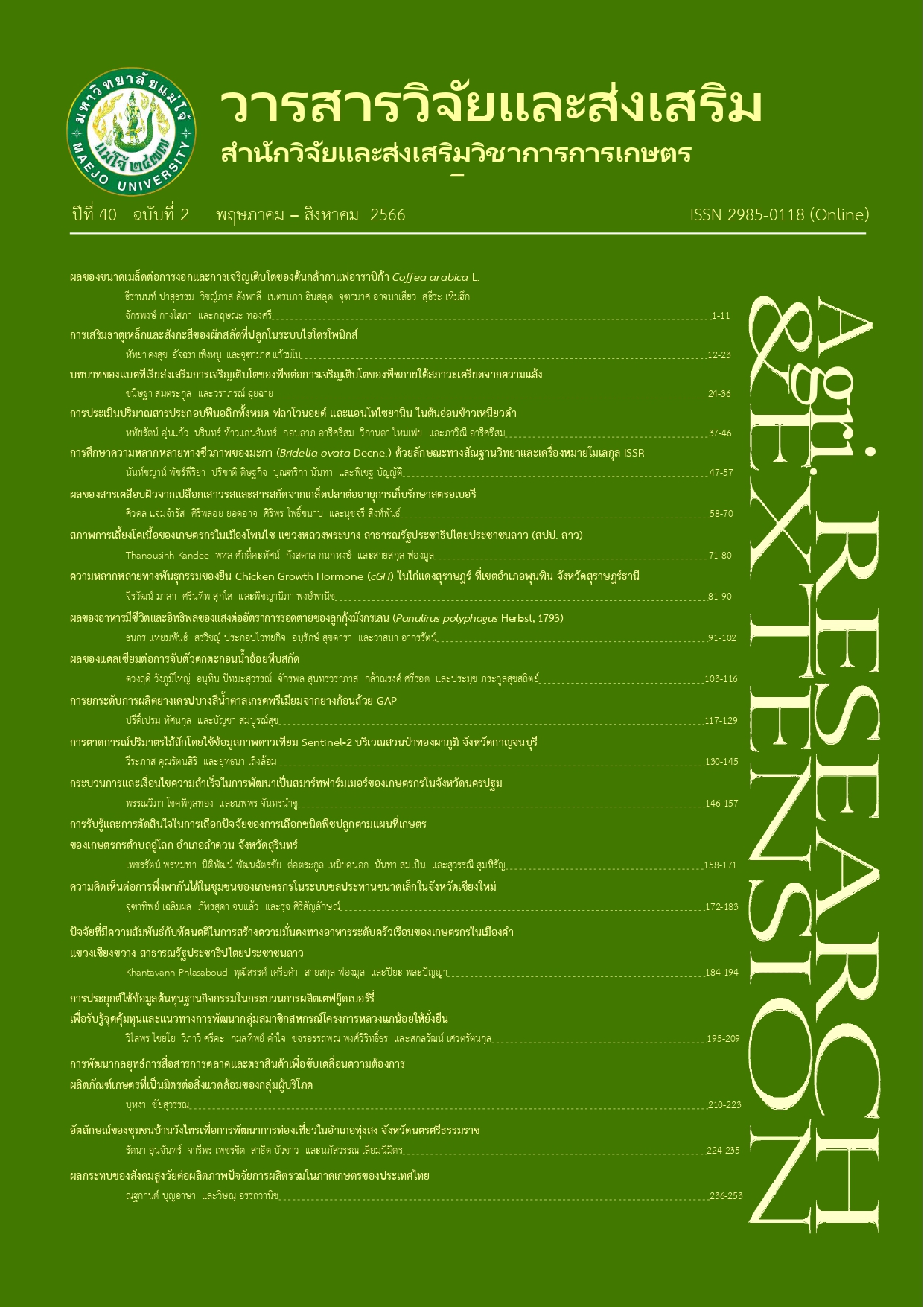
Enhancing the Production of Premium Thin Brown Crepe Rubber from GAP Cup Lumps
Keywords:
cup lump, GAP, premium grade, sustainability, thin brown crepeAbstract
The major objective for studying the production of premium grade thin brown crepe (TBC-P) from GAP standard cup lumps was to encourage farmer groups to produce high-quality crepe rubber. This study selected a specific sample group to investigate the working results of GAP-cup lumps producing farmer groups. By analyzing economic value, establishing a scientific standard of TBC-P for reducing controversy from visual assessment, and connecting the market linkage, the study found that farmer groups producing GAP cup lumps were able to increase the average annual yield by 20.28%. For analyzing the economic situation, the study found that the investment of TBC-P had values of NPV greater than zero, and those of BCR and IRR were more than 1 and 7%, respectively. These indicated the worth of investment. The standardization had set the values of maximum contaminants or dirt at 0.05%, the minimum initial plasticity at 35 unit, and the minimum plasticity retention Index at 65 unit allowing tire manufacturers to accept and trust in the quality of raw materials. These creates added value and enhances the production of TBC-P toward sustainability for the rubber farmer groups in the future.
References
Juntuma, P. 2020. Increase productivity and income of farmers in Trang province from GAP rubber farming. Rubber Journal 41(2): 2-12. [in Thai]
Rubber Research Institute of Thailand. 2011. The Testing of Block Rubber According to STR Standards. Bangkok: Department of Agriculture. 34 p. [in Thai]
Rubber Research Institute of Thailand. . 2018. Para Rubber Academic Data 2018. Bangkok: Rubber Authority of Thailand. 179 p. [in Thai]
Rubber Authority of Thailand. 2021. Thai Rubber Statistics and Forecasts. 356 p. In Monthly Report of Rubber Economy Division 26 April 2021. Bangkok: Rubber Authority of Thailand. [in Thai]
Sadudee, S., I. Yeedum and J. Petnongchum. 2009. Irrigation Management for Rubber (Hevea brasiliensis) to Maintain Tapping during the Period of Dry season. 105 p. In The Complete Research Report. Songkhla: Prince of Songkhla University. [in Thai]
SRAOT 3–2021. Thin Brown Crepe–premium Grade; Specifications. Standards of the Rubber Authority of Thailand. Bangkok: Rubber Authority of Thailand. 9 p. [in Thai]
Sriwarin, P., T. Petsungnoen, M. Ananta and A. Kunalasira. 2014. The cost of processing primary rubber at the factory level. Rubber Journal 35(3): 20-29. [in Thai]
TAS 5907-2018. Good Manufacturing Practices for Crepe Rubber. Bangkok: National Bureau of Agricultural Commodity and Food Standards. 12 p. [in Thai]
TAS 5910-2020. Good Agricultural Practices for Rubber Volume 2: Production of Cup Lump. Bangkok: National Bureau of Agricultural Commodity and Food Standards. 12 p. [in Thai]
Tassanakul, P. 2013. A Handbook for the Production of a Good-quality Cup Lump. pp. 2-10. In The Guidance Document for Rubber Farmers. Bangkok: Rubber Technology Research and Development Division, Rubber Authority of Thailand. [in Thai]
Tassanakul, P. 2015. Stop using sulfuric acid for latex coagulation. Rubber Journal 36(4): 26-30. [in Thai]
Tassanakul, P. 2020. Upgrading GAP Cup Crumbs Toward GMP Crepe Rubber Production. pp. 10-17. In Meeting Academic Thailand Quality Conference & The 21st Symposium on TQM-Best Practices in Thailand. Bangkok: TQM Promotion Foundation in Thailand. [in Thai]
Tassanakul, P. 2021a. The Establishment of Premium Grade Thin Brown Crepe Standards of the Rubber Authority of Thailand. pp. 3-36. In The full Report. Bangkok: Rubber Authority of Thailand. [in Thai]
Tassanakul, P. 2021b. Production of premium grade thin brown crepe from good quality cup lumps. Journal of Science Innovation for Sustainable Development 3(1): 1-14. [in Thai]
Thai Rubber Association. 2021. The Problem of Adulterated Coagulation Added in Latex, Cup Lumps or Natural Rubber Raw Materials. pp. 1-3 In The Message Memo 24 December 2021. Songkhla: Thai Rubber Association. [in Thai]
The Rubber Manufacturers Association. 1979. International Standards of Quality and Packing for Natural Rubber Grades. (The Green Book). Washington, D.C.: Rubber Manufacturers Association, Incorporated. 19 p.
Yunyongwattanakorn, J., Y. Tanaka, S. Kawahara, W. Klinklai and J. Sakdapipanich. 2003. Study the effect of proteins and fatty acids on storage hardening and gel formation under various conditions during accelerated storage of various kinds of natural rubber. Rubber Chemistry Technology Journal 76: 1228-1240.
Downloads
Published
How to Cite
Issue
Section
License
Copyright (c) 2023 Journal of Agricultural Research and Extension

This work is licensed under a Creative Commons Attribution-NonCommercial-NoDerivatives 4.0 International License.
This article is published under a Creative Commons Attribution-NonCommercial-NoDerivatives 4.0 International License (CC BY-NC-ND 4.0), which allows others to share the article with proper attribution to the authors and prohibits commercial use or modification. For any other reuse or republication, permission from the journal and the authors is required.