
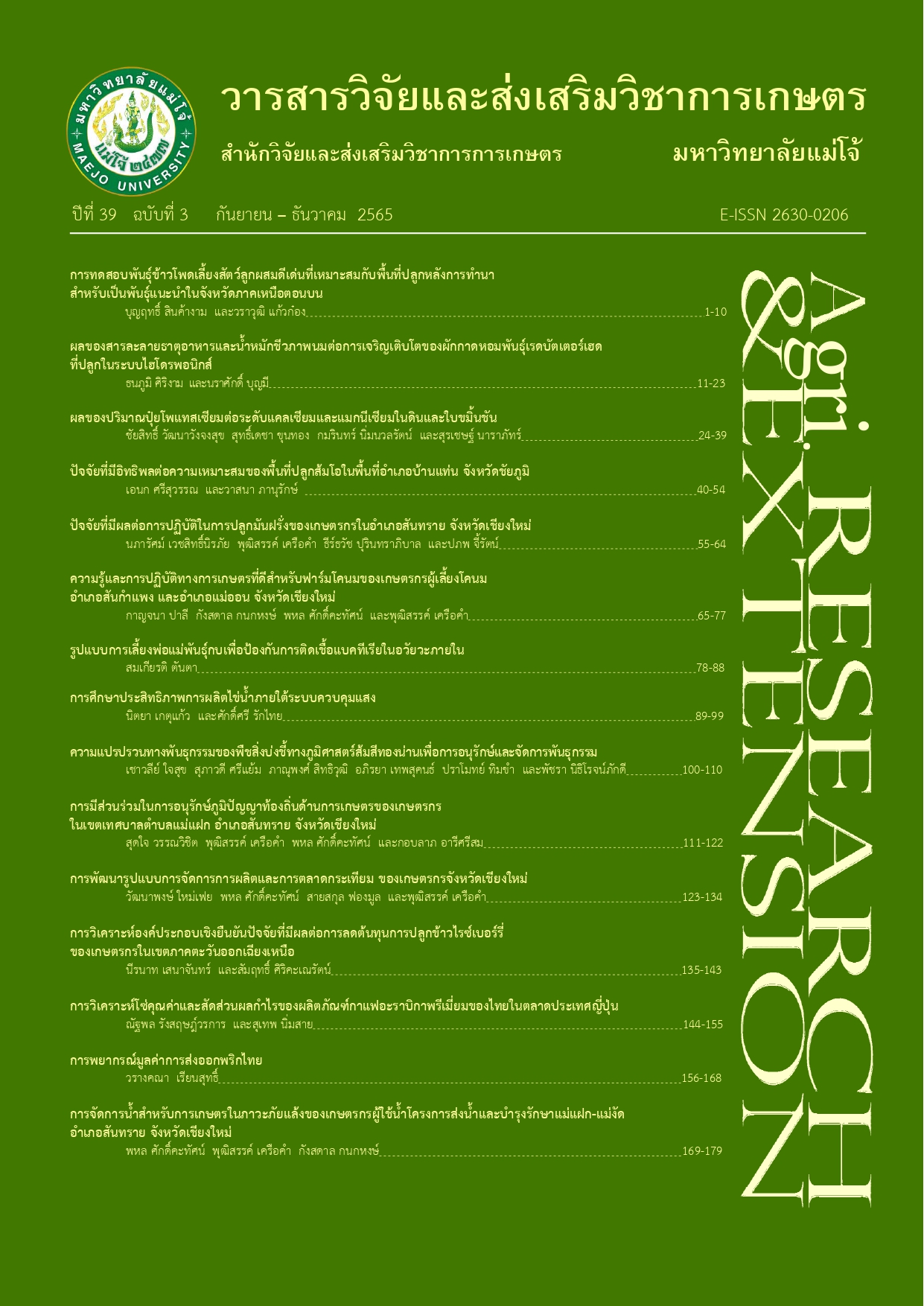
ความแปรปรวนทางพันธุกรรมของพืชสิ่งบ่งชี้ทางภูมิศาสตร์ส้มสีทองน่าน เพื่อการอนุรักษ์และจัดการพันธุกรรม
คำสำคัญ:
ความแปรปรวนทางพันธุกรรม , สิ่งบ่งชี้ทาง ภูมิศาสตร์ , ส้มสีทองน่านบทคัดย่อ
ส้มสีทองน่าน เป็นสิ่งบ่งชี้ทางภูมิศาสตร์และเป็นพืชเศรษฐกิจที่สำคัญของจังหวัดน่าน การศึกษาความแปรปรวนทางพันธุกรรมของส้มสีทองน่านเป็นประโยชน์ต่อการอนุรักษ์และการจัดการพันธุกรรม จากการรวบรวมตัวอย่างยอดอ่อนส้มสีทองน่านจากพื้นที่ปลูกส้มในจังหวัดน่าน 5 กลุ่มตัวอย่าง (30 ตัวอย่างต่อกลุ่ม) ได้แก่ 1. ส้มกิ่งตอนน่านดั้งเดิม (G1) 2. ส้มที่เกิดจากเพาะเมล็ดส้มน่านดั้งเดิม (G2) 3. สวนส้มสีทอง (A) 4. สวนส้มสีทอง (B) 5. สวนส้มสีทอง (C) พบความหลากรูปแบบของไมโครแซทเทลไลท์ 5 ตำแหน่ง กลุ่มตัวอย่างมีความหลากหลายทางพันธุกรรมโดยมีจำนวนแอลลีลต่อตำแหน่ง (A) อยู่ระหว่าง 5.00-5.40 แอลลีล ค่า allelic richness (Ar) 4.79-5.07 แอลลีล และค่าเฮเทอโรไซโกซิตีจากการสังเกต (Ho) 0.92-0.97 จำนวน effective population size (Ne) มีน้อยในกลุ่มตัวอย่าง B สภาวะคอขวดพบได้ในกลุ่มตัวอย่าง G2 พบความต่างทางพันธุกรรม (pairwise FST) ระหว่างกลุ่มตัวอย่าง G1 กับ G2, B และ C แผนผังความสัมพันธ์ทางพันธุกรรมกลุ่มตัวอย่าง G1 ถูกจัดเป็นกลุ่มที่มีความแตกต่างทางพันธุกรรมจากกลุ่มอื่น ระยะห่างทางพันธุกรรมมีค่ามากที่สุดระหว่าง G1 กับ B (0.166) การพบความแปรปรวนทางพันธุกรรม จำนวน Ne ที่น้อยและพบสภาวะคอขวดในบางกลุ่มตัวอย่างเป็นผลมาจากการจัดการพันธุกรรม ซึ่งแสดงให้เห็นถึงความสำคัญของการมีแหล่งอนุรักษ์พันธุกรรมและการสร้างความเข้าใจถึงแนวทางการขยายพันธุ์ที่ดีเพื่อการรักษาความหลากหลายทางพันธุกรรมที่จะช่วยคงคุณภาพส้มสีทองน่านให้เป็นไปตามคุณลักษณะที่ดีของการเป็นสิ่งบ่งชี้ทางภูมิศาสตร์
เอกสารอ้างอิง
Allendorf, W.F. and G. Luikart. 2007. Conservation and the Genetics of Population. New York City: John Wiley & Sons, Inc. 642 p.
Barkley, A.N., L.M. Roose, R.R. Krueger and T.C. Federici. 2006. Assessing genetic diversity and population structure in a citrus germplasm collection utilizing simple sequence repeat markers (SSRs). Theoretical and Applied Genetics 112: 1519-1531.
Do, C., R.S. Waples, D. Peel, G.M. Macbeth B.J. Tillett and J.R. Ovenden. 2014. NeEstimator v2: reimplementation of software for the estimation of contemporary effective population size (Ne) from genetic data. Molecular Ecology Resources 14: 209-214.
Elcy, G.P.S., M.C. Mahani, Y.J. Park and N.M. Noor. 2012. Simple Sequence Repeat (SSR) profiling of cultivated Limau Madu (Citrus reticulata Blanco) in Malaysia. Fruits 67: 67-76.
Excoffier, L. and H.E.L. Lischer. 2010. Arlequin suite ver 3.5: A new series of programs to perform population genetics analyses under Linux and Windows. Molecular Ecology Resources 10: 564-567.
Goudet, J. 2001. FSTAT, a program to estimate and test gene diversities and fixation indice Version2.9.3. [Online]. Available https://www.scienceopen.com/document?vid=79097bb4-ec3c-47c3-94a1-47085d721e6b (15 January 2021).
Guo, S.W. and E.A. Thompson. 1992. Performing the exact test of Hardy-Weinberg proportions for multiple alleles. Biometrics 48: 361-372.
Intellectual Property Department. 2013. Nan Golden Orange. ECAP 3 geographical indication Fiche. [Online]. Available http://www.aseangidatabase.org/gidatabase/sites/default/files/gidocs/THGI0000053100065-en.pdf (15 January 2021).
Kongpun B. 2009. Genetic Diversity of Citrus spp. in Southern Thailand Based on RAPD (Random Amplified Polymorphic DNA) and Microsatellite Techniques. Master Thesis. Prince of Songkla University. 88 p. [in Thai]
Novelli, V.M., M. Cristofani, A.A. Souza and M.A. Machado. 2006. Development and characterization of polymorphic microsatellite markers for the sweet orange (Citrus sinensis L. Osbeck). Genetics and Molecular Biology 29: 90-96.
Office of Agricultural Economics. 2018. Mandarin. [Online]. Available http://oae.go.th//assets/portals/1/fileups/prcaidata/files/lime61.pdf (8 July 2021).
Peakall, R. and P.E. Smouse. 2006. GENALEX 6: genetic analysis in excel. population genetic software for teaching and research. Molecular Ecology Notes 6: 288-295.
Piry, S., G. Luikart and J.M. Cornuet. 1999. BOTTLENECK: a computer program for detecting recent reductions in the effective population size using allele frequency data. Journal of Heredity 90: 502-503.
Rice, W.R. 1989. Analyzing tables of statistical test. Evolution 43(1): 223-225.
Rousset, F. 2008. GENEPOP’007: a complete re-implementation of the GENEPOP software for Windows and Linux. Molecular Ecology Resources 8: 103-106.
Spiegel-Roy, P. and E.E. Goldschmidt. 1996. Biology of Citrus. New York: Cambridge University Press. 230 p.
Yeh, F.C, R.C. Yang and T. Boyle. 1999. POPGENE VERSION 1.31 Microsoft Window-based freeware for population genetic analysis. [Online]. Available http://ftp.microsoft.com/softlib/Mslfiles/hpgl.exe (25 January 2021).
ดาวน์โหลด
เผยแพร่แล้ว
รูปแบบการอ้างอิง
ฉบับ
ประเภทบทความ
สัญญาอนุญาต
ลิขสิทธิ์ (c) 2022 วารสารวิจัยและส่งเสริมวิชาการเกษตร

อนุญาตภายใต้เงื่อนไข Creative Commons Attribution-NonCommercial-NoDerivatives 4.0 International License.
บทความนี้ได้รับการเผยแพร่ภายใต้สัญญาอนุญาต Creative Commons Attribution-NonCommercial-NoDerivatives 4.0 International (CC BY-NC-ND 4.0) ซึ่งอนุญาตให้ผู้อื่นสามารถแชร์บทความได้โดยให้เครดิตผู้เขียนและห้ามนำไปใช้เพื่อการค้าหรือดัดแปลง หากต้องการใช้งานซ้ำในลักษณะอื่น ๆ หรือการเผยแพร่ซ้ำ จำเป็นต้องได้รับอนุญาตจากวารสาร