
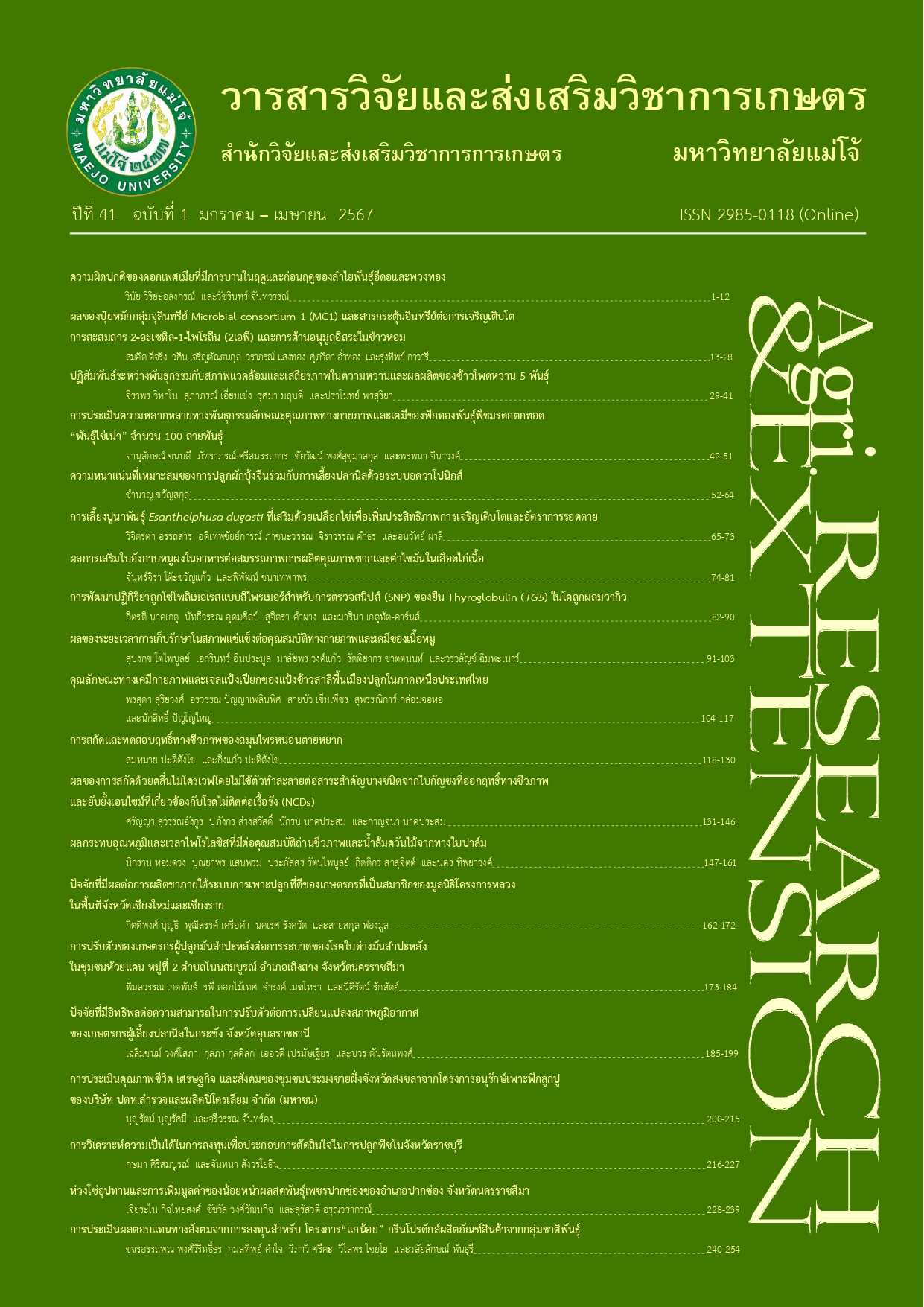
Effects of Microbial Consortium 1 (MC1) Fertilizer and Organic Stimulants on Growth, 2-Acetyl-1-Pyrroline (2AP) Accumulation and Antioxidant Activity of Fragrant Rice
DOI:
https://doi.org/10.14456/jare-mju.2024.2Keywords:
2AP, fragrant rice, microbial consortium, antioxidant, organic stimulantsAbstract
Fragrant rice with antioxidants produced by organic farming systems is high quality rice and preferable. This research studied the effects of compost in combination with microbial consortium MC1, alternative wetting and drying water management and organic stimulants (bioextract and egg-derived hormone) on antioxidant activity and accumulation of 2-acetyl-1-pyrroline (2AP) in 3 cultivars of fragrant rice, i.e. Maejo 1A, Maejo 2, and Mali Daeng. Supplementation with MC1 tentatively increased height, tillering, and panicle number of all 3 cultivars as compared with control group while supplementation with MC1 and bioextract added with egg-derived hormone tentatively increased height, tillering, and panicle number, and number of filled spikelet of all 3 cultivars as compared with application of MC1 alone. At the same time, supplementation with MC1 and bioextract added with egg-derived hormone tentatively increased total phenolic compounds and antioxidative activity in only Mali Daeng. Meanwhile, the increased 2AP was not detected in rice supplemented with MC1 and bioextract with egg-derived hormone.
References
Agricultural Production Sciences Research and Development Division. 2010. Handbook of Soil Analysis (Chemical and Physical Methods). Vol. 1. Bangkok: Quick Print Offset Press. 174 p. [in Thai]
Aishwarya, D., P. Prashanth, N. Seenivasan and D.S. Naik. 2022. Coconut water as a root hormone: biological and chemical composition and applications. Journal of Pharmaceutical Innovation 11(12): 1678-1681.
Baradi, U.M.A. and A.R. Elepano. 2012. Aroma loss in rice as affected by various conditions during postharvest operations. Philippine Agricultural Scientist 95(3): 260-266.
Changsri, R. 2014. Factors Affecting the Quality of Thai Hom Mali Rice Factors Affecting the Quality of Thai Hom Mali Rice. 47 p. In Research Report. Bangkok: Rice Department. [in Thai]
Chinachanta, K., A. Shutsrirung, L. Herrmann D. Lesueur and W. Pathom-aree. 2021. Enhancement of the aroma compound 2-acetyl-1-pyrroline in Thai jasmine rice (Oryza sativa) by rhizobacteria under salt stress. Biology 10(10): 1-16.
Daiponmak, W., P. Theerakulpisut, P. Thanonkao, A. Vanavichit and P. Prathepha. 2010. Changes of anthocyanin cyanidin-3-glucoside content and antioxidant activity in Thai rice varieties under salinity stress. ScienceAsia 36: 286-291.
Davari, M.R., S.N. Sharma and M. Mirzakhani. 2012. The effect of combinations of organic materials and biofertilisers on productivity, grain quality, nutrient uptake and economics in organic farming of wheat. Journal of Organic Systems 7(2): 26-35.
Deejing, S. and V. Sanguanpong. 2015. Evaluation of Soil quality in Organic Rice Fields. pp. 150-156. In Proceedings of the 11th Research & Innovation 22-23 July 2015. Phitsanulok: Naresuan University. [in Thai]
Gay, F., I. Maraval, S. Roques, Z. Gunata, R. Boulanger, A. Audebert and C. Mestres. 2010. Effect of salinity on yield and 2-acetyl-1-pyrroline content in the grains of three fragrant rice cultivars (Oryza sativa L.) in Camargue (France). Field Crops Research 117: 154-160.
Goufo, P., M. Duan, S. Wongpornchai and X. Tang. 2010. Some factors affecting the concentration of the aroma compound 2-acetyl-1-pyrroline in two fragrant rice cultivars grown in South China. Frontiers of Agriculture in China. 4(1): 1-9.
Gui, R.F., H.L. Jing, U. Ashraf, S.Y. Li, M.Y. Duan, S.G. Pan, H. Tian, X.R. Tang and Z.W. Mo. 2022. Drought stress at flowering stage regulates photosynthesis, aroma and grain yield in fragrant rice. Applied Ecology and Environmental Research 20(3): 2425-2438.
Harakotr B. and A. Thongoon. 2018. Effects of water management and plant spacing on the growth and yield of purple riceberry rice with the system of rice intensification (SRI). Thai Science and Technology Journal 24(6): 986-997.
Hussain, S., J.H. Zhang, C. Zhong, L.F. Zhu, X.C. Cao, S.M. Yu, A.B. James, J.J. Hu and Q.Y. Jin. 2017. Effect of salt stress on rice growth, development characteristics, and the regulating ways: a review. Journal of Integrative Agriculture 16: 2357-2374.
Joseph, E.A., V.V. Radhakrishnan and K.V. Mohanan. 2015. A study on the accumulation of proline an osmoprotectant amino acid under salt stress in some native rice cultivars of north Kerala, India. Universal Journal of Agricultural Research 3(1): 15–22.
Kasikumpaiboon, J. and N. Boonman. 2020. Antioxidant Activities of Red Jasmine Rice Extracts. pp. 1382-1394. In Proceedings of the 10th STOU National Research Conference. Nontaburi: Sukhothai Thammathirat Open University. [in Thai]
Lia, M., U. Ashraf, H. Tian, Z. Mob, S. Pan, A. Anjumd, M. Duan and X. Tang. 2016. Manganese-induced regulations in growth, yield formation, quality characters, rice aroma and enzyme involved in 2-acetyl-1-pyrroline biosynthesis in fragrant rice. Plant Physiology and Biochemistry 103: 167-175.
Maraval, I., K. Sen and A. Agrebi. 2010. Quantification of 2-acetyl-1-pyrroline in rice by stable isotope dilution assay through headspace solid–phase microextraction coupled to gas chromatography tandem mass spectrometry. Analytica Chimica Acta 675: 148-155.
Matsumiya, Y. and M. Kubo. 2011. Soybean peptide: novel plant growth promoting peptide from soybean. Agricultural and Biological Sciences Journal 1: 215-230.
Mo, Z., J. Huang and D. Xiao. 2016. Supplementation of 2-Ap, Zn and La improves 2-acetyl-1-pyrroline concentrations in detached aromatic rice panicles In Vitro. PLoS One 11(2): e0149523.
Mo, Z., U. Ashraf, Y. Tang, W. Li, S. Pan, M. Duan, H. Tian and X. Tang. 2018. Nitrogen application at the booting stage affects 2-acetyl-1-pyrroline, proline, and total nitrogen contents in aromatic rice. Chilean Journal of Agricultural Research 78(2): 165-172.
Monggoot, S., P. Sookwong, S. Mahatheeranont and S. Meechoui. 2014. Influence of single nutrient element on 2-Acetyl-1-pyrroline contents in Thai fragrant rice (Oryza sativa L.) cv. Khao Dawk Mali 105 grown under soilless conditions. pp. 642-647. The 26th Annual Meeting of the Thai Society for Biotechnology and International Conferences. Chiang Rai: Mae Fah Luang University.
Nawara, W.C., O. Bennett, O. Norkaew P. Sookwong, S. Moolkam, S. Narueba and S. Mahatheeranont. 2020. Variation of the impact aroma compound, 2-acetyl-1-pyrroline, content in Thai fragrant rice plants and its enhanced accumulation by soil nutritional elements. Journal of Agricultural Science 2(6): 36-45.
Office of Science for Land Development. 2005. Handbook for the Analysis of Soil Samples, Water, Fertilizers, Plants, Soil Improvement Materials and Analyze to Inspect and Certify Product Standards Vol. 1. Bangkok: Kasetsart University Press. 46 p. [in Thai]
Pabby, A., R. Prasanna and P.K. Singh. 2003. Azolla-anabaena symbiosis from traditional agriculture biotechnology. Indian Journal of Biotechnology 2(1): 26-37.
Palungwachira, P., S. Tancharoen, C. Phruksaniyom, S. Klungsaeng, R. Srichan, K. Kikuchi and T. Nararatwanchai. 2019. Antioxidant and anti-inflammatory properties of anthocyanins extracted from Oryza sativa L. in primary dermal fibroblasts. Oxidative Medicine and Cellular Longevity 2019: 1-18.
Prodhan, Z.H. and S. Qingyao. 2020. Rice aroma: a natural gift comes with price and the way forward. Rice Science 27(2): 86-100.
Sakulsingharoj, C., L. Na Rachasima, A. Richinda, P. Wongputtisin, R. Kawaree, S. Pongjaroenkit and V. Sangtong. 2019. Evaluation of Total Anthocyanins and Antioxidant Activity of Thai Rice Cultivars for Phenotypic Selection in Rice Breeding. pp. 227-235. Proceedings of the 2019 International Joint Conference on JSAM and SASJ, and 13th CIGR VI Technical Symposium joining FWFNWG and FSWG Workshops. Hokkaido: Hokkaido University – Sapporo Campus
Sangchhen, V. 2011. A Study on Bioextract Production Process and Its Effectiveness on Rice Production of Farmers in Bangpakong District. Master Thesis. Rajamangala University of Technology. 114 p. [in Thai]
Thammapat, P. and S. Sirimornpun. 2015. Effects of NaCl and soaking temperature on the phenolic compounds, α-tocopherol, γ-oryzanol and fatty acids of glutinous rice. Food Chemistry 175(21): 218-224.
Umesha, S. and B. Narayanaswamy. 2017. Pivotal role of residual coconut water and spent wash on phyllosphere and rhizosphere microflora of Gherkin (Cucumis sativus L.) under glass house condition. International Journal of Current Microbiology and Applied Sciences 6(7): 3956-3963.
Umnajkitikorn, K., B. Faiyue and K. Saengnil. 2013. Enhancing antioxidant properties of germinated Thai rice (Oryza sativa L.) cv. Kum Doi Saket with salinity. Journal of Rice Research 1: 103.
Wongtay, P., D. Maneejan, R. Jansasithorn, A. Juttupornpong, N. Sueadang, P. Saiyued, S. Kongsomjit, W. Sukviwat, P. Maneenin and K. Parngrussamee. 2020. Phenolic content in Thai rice varieties and the effects of storage temperature on rice quality. Thai Rice Research Journal 11(2): 103-113.
Yi, D.W., X. Yu, X. Zhang, X.D. Qin, X.L. Fu, F.T. Yang, X.Y. Liu, X.S. Min, X.W. Fa and S. Schaeffer. 2014. Changes in soil microbial community composition in response to fertilization of paddy soils in subtropical China. Applied Soil Ecology 84: 140-147.
Downloads
Published
How to Cite
Issue
Section
License
Copyright (c) 2024 Journal of Agricultural Research and Extension

This work is licensed under a Creative Commons Attribution-NonCommercial-NoDerivatives 4.0 International License.
This article is published under a Creative Commons Attribution-NonCommercial-NoDerivatives 4.0 International License (CC BY-NC-ND 4.0), which allows others to share the article with proper attribution to the authors and prohibits commercial use or modification. For any other reuse or republication, permission from the journal and the authors is required.


