
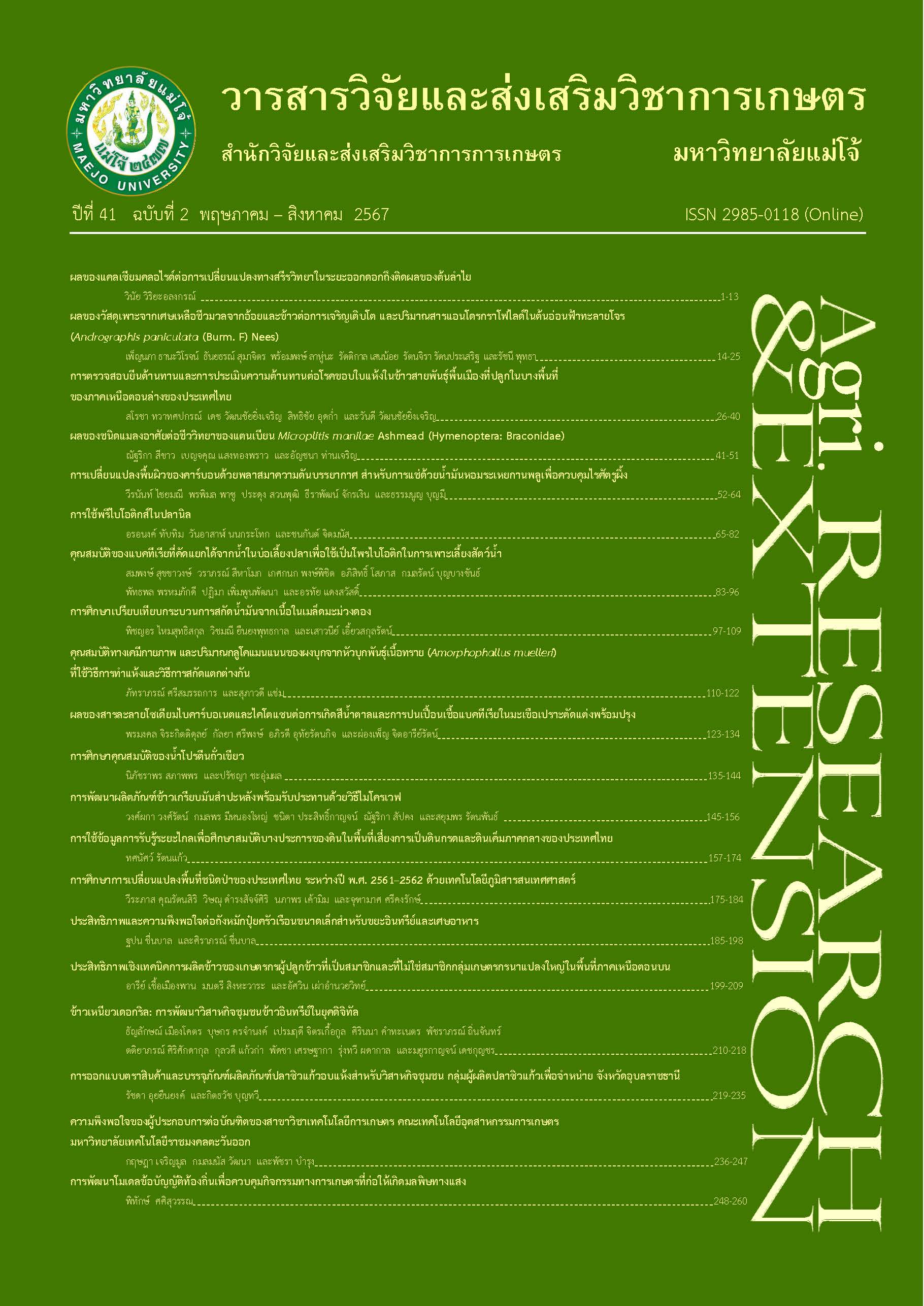
Properties of Bacteria Isolated from Fish Pond Water for Use as Probiotic in Aquaculture
DOI:
https://doi.org/10.14456/jare-mju.2024.27Keywords:
potential, fish pond water, probiotic, aquacultureAbstract
This study aimed to isolate potential probiotic bacteria from fish pond water for the application in aquaculture. The isolates showed that three isolates namely KP1, KP4 and KP5 which had similarly to Bacillus sp. All isolates showed that the efficient spores on DSM 98.98, 94.99 and 94.45% respectively. The efficient spores in LB showed 98.92, 97.79 and 99.30%, respectively. Three isolates were tolerated to stomach acid at pH 1.0-3.0 and tolerant to bile salt at 0.5-5.0% concentration for 3 hours were extracted with over 72% of the survival and antibiotic susceptibility. KP1 and KP4 showed that anti-biofilm producing activity against Staphylococcus aureus, Escherichia coli and Vibrio parahaemolyticus. KP5 was inhibited biofilm formation by Staphylococcus aureus and Escherichia coli. All isolates showed that tolerance to salinity was similar to the condition of the water used in aquaculture. Our results demonstrate that three isolates KP1, KP4 and KP5 could have the potential of consideration as probiotics for sustainable development in aquaculture.
References
Abarike, E.D., J. Cai, Y. Lu, H. Yu, L. Chen, J. Jian, J. Tang, L. Jun and F.K.A. Kuebutornye. 2018. Effects of a commercial probiotic bs containing Bacillus subtilis and Bacillus licheniformis on growth, immune response and disease resistance in Nile tilapia, Oreochromis niloticus. Fish and Shellfish Immunology 82: 229-238. DOI: 10.1016/j.fsi.2018.08.037
Adilah, R.N., S.T. Chiu, S.Y. Hu, R. Ballantyne, N. Happy, A.C. Cheng and C.H. Liu. 2022. Improvement in the probiotic efficacy of Bacillus subtilis E20-stimulates growth and health status of white shrimp, Litopenaeus vannamei via encapsulation in alginate and coated with chitosan. Fish and Shellfish Immunology 125: 74-83. DOI: 10.1016/j.fsi. 2022.05.002
Almanaa, T.N., P. Vijayaraghavan, N.S. Alharbi S. Kadaikunnan, J.M. Khaled and S.A. Alyahya. 2020. Solid state fermentation of amylase production from Bacillus subtilis D19 using agro-residues. Journal of King Saud University – Science 32(2): 1555-1561 DOI: 10.1016/j.jksus.2019.12.011.
Arai, S., C. Limsuwan and P. Wilapun. 2011. The antimicrobial effects of Bacillus subtilis B-1 isolated from a fish culture pond. Asian Fisheries Science 24(3). 343-353. DOI: 10.33997/ j.afs.2011.24.3.007
Bhandary, T., L.R. Ali and K. Alagesan Paari. 2021. Probiotic properties of Bacillus subtilis isolated from dried anchovies (Stolephorus indicus) and evaluating its antimicrobial, antibiofilm and growth-enhancing potential in danio rerio. Journal of Animal Health and Production 9(3). 205-212. DOI : 10.17582/journal.jahp/2021/ 9.3.205.212
Dangsawat, O., W. Appamano, B. Chaipech, P. Srisawang and P. Permpoonpattana. 2022. Evaluation of potential probiotics isolated from the intestinal tract of Nile tilapia (Oreochromis niloticus) against bacterial pathogens in aquaculture. Khon Kaen Agriculture Journal Suppl.(1): 55-62. [in Thai]
Department of Fisheries. 2022. Thailand fishery and fisheries statistics 2021. [Online]. Available https://www4.fisheries.go.th/local/file_document/20221129154933_1_file.pdf (December 22, 2022).
Ghanei, M.R., T. Mohammadian, D. Gharibi, S.L. Menanteau, E. Mahmoudi, M. Khosravi, M. Zarea and M. El-Matbouli. 2019. Quorum quenching properties and probiotic potentials of intestinal associated bacteria in Asian sea bass lates Calcarifer. Marine Drugs 18(1): 23. DOI: 10.3390/md18010023
Haenen, O.L., H.T. Dong, T.D. Hoai, M. Crumlish, I. Karunasagar, T. Barkham, S.L. Chen, R. Zadoks, A. Kiermeier, B. Wang, E.G. Gamarro, M. Takeuchi, M.N. Azmai, B. Fouz, R. Pakingking, Z.W. Wei and M.G. Bondad‐Reantaso. 2023. Bacterial diseases of tilapia, their zoonotic potential and risk of antimicrobial resistance. Reviews in Aquaculture 15(S1): 154-185. DOI: 10.1111/raq.12743
Huovinen, P. and G.M. Eliopoulos. 2001. Resistance to trimethoprim-sulfamethoxazole. Clinical Infectious Diseases 32(11): 1608-1614. DOI: 10.1086/320532
Hong, H. A., L.H. Duc and S.M Cutting. 2005. The use of bacterial spore formers as probiotics. FEMS Microbiology Reviews 29(4): 813-835. DOI: 10.1016/j.femsre.2004.12.001
Karava, M., F. Bracharz and J. Kabisch. 2019. Quantification and isolation of Bacillus subtilis spores using cell sorting and automated gating. PLOS ONE 14(7): 1-15. DOI: 10.1371/journal.pone.0219892
Kewcharoen, W. and P. Srisapoome. 2019. Probiotic effects of Bacillus spp. from Pacific white shrimp (Litopenaeus Vannamei) on water quality and shrimp growth, immune responses, and resistance to Vibrio Parahaemolyticus (AHPND strains). Fish and Shellfish Immunology 94: 175-189. DOI: 10.1016 /j.fsi.2019.09.013
Khan, Md. I., T.G. Choudhury, D. Kamilya, S.J Monsang and J. Parhi. 2020. Characterization of Bacillus spp. isolated from intestine of labeo rohita towards identifying novel probiotics for aquaculture. Aquaculture Research 52(2): 822-830. DOI: 10.1111/ are.14937
Meidong, R., K. Khotchanalekha, S. Doolgindachbaporn, T. Nagasawa, M. Nakao, K. Sakai and S. Tongpim. 2018. Evaluation of probiotic Bacillus aerius B81e isolated from healthy hybrid catfish on growth, disease resistance and innate immunity of Pla-mong Pangasius bocourti. Fish and Shellfish Immunology 73: 1-10. DOI: 10.1016/j.fsi.2017.11.032
Nimkande, V.D., S. Sivanesan and A. Bafana. 2023. Screening, identification, and characterization of lipase-producing halotolerant Bacillus altitudinis ant19 from Antarctic soil. Archives of Microbiology 205(4): 1-13. DOI: 10.1007/s00203-023-03453-8
Nwagu, T.N., C.J. Ugwuodo, C.O. Onwosi, O. Inyima, O.C. Uchendu and C. Akpuru. 2020. Evaluation of the probiotic attributes of Bacillus strains isolated from traditional fermented African locust bean seeds (Parkia Biglobosa), “Daddawa.” Annals of Microbiology 70(1). 1-15 DOI: 10.1186/s13213-020-01564-x
Pungpang S., C. Limsuwan and W. Purivirojkul. 2011. Bacillus sp. strain B-1 isolated from a fish culture pond produces antimicrobial substances. Agricultural Science Journal 42(2): 265-272. [in Thai]
Romanova, E., E. Spirina, V. Romanov, V. Lyubomirova and L. Shadyeva. 2020. Effects of Bacillus subtilis and Bacillus licheniformis on catfish in industrial aquaculture. Fish and Shellfish Immunology 175: 2013-2020. DOI: 10.1051/e3sconf/202017502013
Rusmana, I., R.A. ISRAMILDA and A. Akhdiya. 2021. Characteristics of anti-Vibrio harveyi compounds produced by Bacillus spp. isolated from shrimp ponds. Biodiversitas Journal of Biological Diversity 22(11): 4872-4879. DOI: 10.13057/biodiv/d221120
Samat, N.A., F.M. Yusoff, N.W. Rasdi and M. Karim. 2021. The efficacy of Moina micrura enriched with probiotic Bacillus pocheonensis in enhancing survival and disease resistance of red hybrid tilapia (Oreochromis spp.) larvae. Antibiotics 10(8): 989. DOI: 10.3390/antibiotics10080989
Sam-on, M.F., S. Mustafa, M.T. Yusof, A.M. Hashim, S. Abbasiliasi, S. Zulkifly, M.A. Jahari and M.A. Roslan. 2022. Evaluation of three Bacillus spp. isolated from the gut of giant freshwater prawn as potential probiotics against pathogens causing Vibriosis and Aeromonosis. Microbial Pathogenesis 164: 105417. DOI: 10.1016/j.micpath.2022.105417
Sookchaiyaporn, N., P. Srisapoome, S. Unajak and N. Areechon. 2020. Efficacy of Bacillus spp. isolated from Nile tilapia Oreochromis niloticus Linn. on its growth and immunity, and control of pathogenic bacteria. Fisheries Science 86(2): 353-365. DOI: 10.1007/s12562-019-01394-0
Zhao, M., D. Liu, Z. Liang, K. Huang and X. Wu. 2022. Antagonistic activity of Bacillus subtilis CW14 and its β-glucanase against Aspergillus ochraceus. Food Control 131: 108475. DOI: 10.1016/j.foodcont.2021.108475
Downloads
Published
How to Cite
Issue
Section
License
Copyright (c) 2024 Journal of Agricultural Research and Extension

This work is licensed under a Creative Commons Attribution-NonCommercial-NoDerivatives 4.0 International License.
This article is published under a Creative Commons Attribution-NonCommercial-NoDerivatives 4.0 International License (CC BY-NC-ND 4.0), which allows others to share the article with proper attribution to the authors and prohibits commercial use or modification. For any other reuse or republication, permission from the journal and the authors is required.