
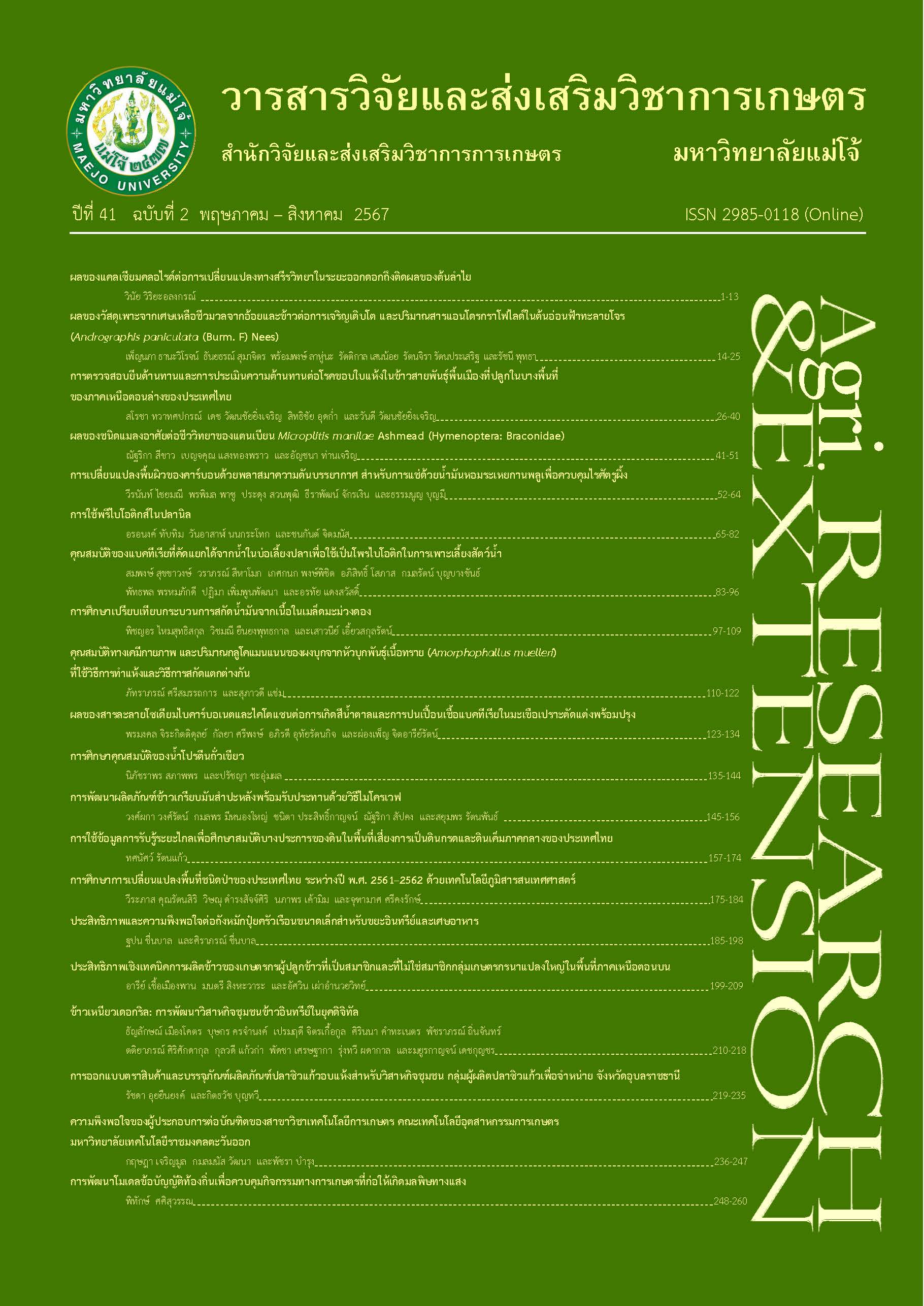
Effect of Host Species on Biology of Parasitoid, Microplitis manilae Ashmead (Hymenoptera: Braconidae)
DOI:
https://doi.org/10.14456/jare-mju.2024.24Keywords:
biological control, parasitization, fall armyworm, insect natural enemyAbstract
Microplitis manilae is an endoparasitoid that parasitizes larvae in the genus Spodoptera. In Thailand, three species of spodoptera, namely the fall armyworm (Spodoptera frugiperda), common cutworm (S. litura) and beet armyworm (S. exigua), are found in high numbers. The biological control method using parasitoids is an alternative method for reducing insecticide applications. This research investigated the biological aspects of M. manilae, focusing on its developmental period, percentage parasitism, sex ratio of offspring, longevity and fecundity when parasitizing three hosts (fall armyworm, common cutworm, and beet armyworm). Our findings revealed a significant influence of the host species on M. manilae is biology. S exigua caused the highest percentage parasitism (41.66%), a higher female to male ratio (1:0.9) and the most fecundity rate (16.70 eggs per female). While S. exigua emerged as the most suitable host for mass rearing M. manilae for augmentative biological control and followed by S. frugiperda and S. litura proved to be unsuitable.
References
Baudron, F., M.A. Zaman-Allah, I. Chaipa, N. Chari and P. Chinwada. 2019. Understanding the factors influencing fall armyworm (Spodoptera frugiperda J.E. Smith) damage in African smallholder maize fields and quantifying its impact on yield. A case study in Eastern Zimbabwe. Crop Protection 120: 141-150.
Bertschy, C., T.C.J. Turlings, A. Bellotti and S. Dorn. 2000. Host stage preference and sex allocation in Aenasius vexans, an encyrtid parasitoid of the cassava mealybug. Entomologia Experimentalis et Applicata. 95(3): 283-291.
Capinera, J.L. 2020. Common name: beet armyworm scientific name: Spodoptera exigua (Hübner) (Insecta: Lepidoptera: Noctuidae). [Online]. Available https://entnemdept.ufl.edu/creatures/veg/leaf/beet_armyworm.htm (January 25, 2022).
Day, R., P. Abrahams, M. Bateman, T. Beale, V. Clottey, M. Cock, Y. Colmenarez, N. Corniani, R. Early, J. Godwin, J. Gomez, P.G. Moreno, S.T. Murphy, B. Oppong-Mensah, N. Phiri, C. Pratt, S. Silvestri and A. Witt. 2017. Fall Armyworm: Impacts and Implications for Africa. Outlooks on Pest Management 28(5): 196-201.
Godfray, H.C.J. 1994. Parasitoids: Behavioral and Evolutionary Ecology. Princeton: Princeton University Press. 473 p.
Häckermann, J., A.S. Rott and S. Dorn. 2007. How two different host species influence the performance of a gregarious parasitoid: host size is not equal to host quality. Journal of Animal Ecology 76(2): 376-383.
King, B.H. 1987. Offspring sex-ratios in parasitoid wasps. Quarterly Review of Biology 62(4): 367-396.
King, B.H. 1993. Sex Ratio Manipulation by Parasitoid Wasps. pp. 418-441. In Wrench, D.L. and M.A. Ebbert (eds.). Evolution and Diversity of Sex Ratio in Insects and Mites. New York: Chapman and Hall.
Maes, K. 2014. Spodoptera litura (taro caterpillar): invasive species compendium. [Online]. Available https://doi.org/10.1079/cabicompendium.44520 (January 25, 2022).
Qiu, B., Z.S. Zhou, S.P. Luo and Z.F. Xu. 2012. Effect of temperature on development, survival, and fecundity of Microplitis manilae (Hymenoptera: Braconidae). Environmental Entomology 41(3): 657-664.
Qiu, B., Z. Zhou and Z. Xu. 2013. Age preference and fitness of Microplitis manilae (Hymenoptera: Braconidae) reared on Spodoptera exigua (Lepidoptera: Noctuidae). Florida Entomologist 96(2): 602-609.
Rajapakse, Rohan H.S., T.R. Ashley and V.H. Waddill. 1985. Biology and host acceptance of Microplitis manilae (Hymenoptera: Braconidae) raised on fall armyworm larvae Spodoptera frugiperda (Lepidoptera: Noctuidae). Florida Entomologist 68(4): 653-657.
Rwomushana, I. 2019. Spodoptera frugiperda (fall armyworm): invasive species compendium. [Online]. Available https://doi.org/10.1079/cabicompendium.29810 (January 25, 2022).
Srivastava, M.J. and R. Singh. 1995. Sex ratio adjustment by a koino-biotic parasitoid Lysiphlebus delhiensis (Subba Rao & Sharma) (Hymenoptera: Aphidiidae) in response to host size. Biological Agriculture and Horticulture 12(1): 15-28.
Strand, M.R. and L.L. Pech. 1995. Immunological basis for compatibility in parasitoid-host relationships. Annual Review of Entomology 40: 31-56.
Sun, J.S. and S.S. Huang. 2010. Evaluation of potential control ability of Snellenius manilae (Ashmead) against Spodoptera exigua (Hübner). Acta Ecologica Sinica 30: 1494-1499.
Taylor, J.E. and D.G. Riley. 2008. Artificial infestations of beet armyworm, Spodoptera exigua (Lepidoptera: Noctuidae), used to estimate an economic injury level in tomato. Crop Protection 27: 268-274.
Xing, B., L. Yang, A. Gulinuer, F. Li and S. Wu. 2022. Effect of pupal cold storage on reproductive performance of Microplitis manilae (Hymenoptera: Braconidae), a larval parasitoid of Spodoptera frugiperda (Lepidoptera: Noctuidae) Insects 449(13): 1-13.
Downloads
Published
How to Cite
Issue
Section
License
Copyright (c) 2024 Journal of Agricultural Research and Extension

This work is licensed under a Creative Commons Attribution-NonCommercial-NoDerivatives 4.0 International License.
This article is published under a Creative Commons Attribution-NonCommercial-NoDerivatives 4.0 International License (CC BY-NC-ND 4.0), which allows others to share the article with proper attribution to the authors and prohibits commercial use or modification. For any other reuse or republication, permission from the journal and the authors is required.