
Unravelling Climate Change's Impact and Risk on Wet Season Rice Production in Irrigated Areas: An Econometric Case Study from Northeastern Thailand
DOI:
https://doi.org/10.14456/jare-mju.2025.56Keywords:
wet season rice production, climate change, impact and risk , feasible generalized least squares, econometric panel analysisAbstract
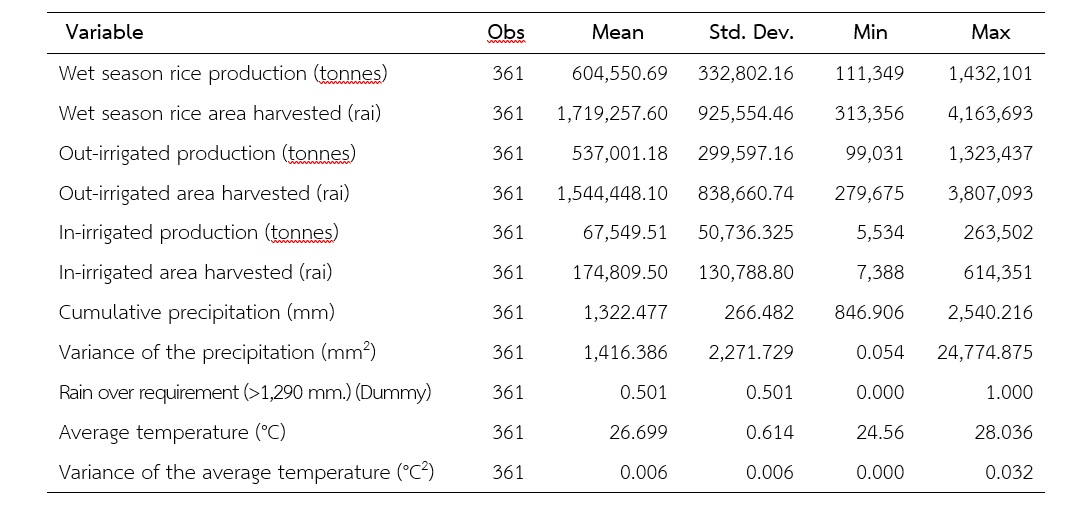
This study aimed to analyze the impact and risk of climate change on wet season rice production in irrigated areas of Northeastern Thailand. The Feasible Generalized Least Squares (FGLS) was applied to estimate the rice production function. By using the panel data on rice production from 19 provinces in the northeast classified by irrigation area of wet season rice (2002–2020), the results of the study showed that Area harvested, Trend Time, Cumulative Precipitation, and Average Temperature had a positive effect on the yield of wet season rice. At the same time, they were risk factors for rice production variance. On the other hand, rice production in the irrigated area depended on accumulated rainfall and average temperature, which had a negative impact on the wet season rice production and there was a statistically significant increase in the risk of variation in rice production. When considering dummy variables representing cumulative rainfall events exceeding requirement, there was a negative effect on rice yield. At the same time, there was a statistically significant increase in the risk of variance in rice production in all three cases. This study suggests that the characteristics of areas receiving water from irrigation have differentially influenced rice crop yield.
References
Antle, J.M. 1983. Testing the stochastic structure of production: a flexible moment-based approach. Journal of Business & Economic Statistics 1(3): 192–201.
Antle, J. M. and A. Havenner. 1983. Formulating and Estimating Dynamic Stochastic Production Models. Minneapolis, MN: AgEcon Search, University of Minnesota. 36 p.
Baethgen, W., J. Hansen, A. Ines, J. Jones, H. Meinke and P. Steduto. 2010. Contributions of Agricultural Systems Modeling to Weather Index Insurance. New York: International Research Institute for Climate and Society (IRI). 7 p.
Battese, G.E., A.N. Rambaldi and G.H. Wan. 1997. A stochastic frontier production function with flexible risk properties. Journal of Productivity Analysis 8(3): 269–280.
Farrell, T., K. Fox, R. Williams, S. Fukai and L. Lewin. 2006. Minimising cold damage during reproductive development among temperate rice genotypes; II. genotypic variation and flowering traits related to cold tolerance screening. Australian Journal of Agricultural Research 57(1): 89–100.
Greene, W.H. 2000. Econometric Analysis. 4th ed. Englewood Cliffs, NJ: Prentice Hall. 1004 p.
Im, K.S., M.H. Pesaran and Y. Shin. 2003. Testing for unit roots in heterogeneous panels. Journal of Econometrics 115(1): 53–74.
Jatuporn, C. and K. Takeuchi. 2022. Assessing the impact of climate change on the agricultural economy in Thailand: an empirical study using panel data analysis. Environmental Science and Pollution Research 30(1): 8123–8132.
Just, R.E. and R.D. Pope. 1978. Stochastic specification of production functions and economic implications. Journal of Econometrics 7(1): 67–86.
Just, R.E. and R.D. Pope. 1979. Production function estimation and related risk considerations. American Journal of Agricultural Economics 61(2): 276–284.
Komarek, A.M., A. De Pinto and V.H. Smith. 2020. A review of types of risks in agriculture: what we know and what we need to know. Agricultural Systems 178(1): 102738.
Maiti, A., M.K. Hasan, S. Sannigrahi, S. Bar, S. Chakraborti, S.S. Mahto, S. Chatterjee, S. Pramanik, F. Pilla, J. Auerbach, O. Sonnentag, C. Song and Q. Zhang. 2024. Optimal rainfall threshold for monsoon rice production in India varies across space and time. Communications Earth & Environment 5(1): 302.
National Centers for Environmental Information (NOAA). 2023. Climate at a glance: global time series. [Online]. Available https://www.ncei.noaa.gov/access/monitoring/climate-at-a-glance/global/time-series (January 24, 2023).
Pakeechai, K., N. Sinnarong, K. Autchariyapanitkul and P. Supapunt. 2020. The impacts of climate change factors on rice production and climate-smart agriculture in the watershed areas of central Thailand. RMUTSB Academic Journal (Humanities and Social Sciences) 5(2): 196–218. [in Thai]
Phitsanulok Rice Research Center. 2017. Irrigation Rice Production Technology in Lower Region. Phitsanulok: Phitsanulok Rice Research Center. 313 p. [in Thai]
Puphoung, S., N. Sinnarong, K. Autchariyapanitkul and K. Satienpirakul. 2019. Impacts of climate change on rice yield in the north region. Graduate School Journal CRRU. 12(2): 119–132. [in Thai]
Sinnarong, N., C.-C. Chen, B. McCarl and B.-L. Tran. 2019. Estimating the potential effects of climate change on rice production in Thailand. Paddy and Water Environment 17(1): 1–9.
Sinnarong, N., S. Kuson, W. Nunthasen, S. Puphoung and V. Souvannasouk. 2022. The potential risks of climate change and weather index insurance scheme for Thailand’s economic crop production. Environmental Challenges 8(1): 100575.
Song, Y., C. Wang, H.W. Linderholm, Y. Fu, W. Cai J. Xu, L. Zhuang, M. Wu, Y. Shi, G. Wang and D. Chen. 2022. The negative impact of increasing temperatures on rice yields in southern China. Science of the Total Environment 820: 153262.
Studenmund, A. 2011. Using Econometrics: A Practical Guide. 6th ed. New York: Pearson. 648 p.
Welch, J.R., J.R. Vincent, M. Auffhammer, P.F. Moya, A. Dobermann and D. Dawe. 2010. Rice yields in tropical/subtropical Asia exhibit large but opposing sensitivities to minimum and maximum temperatures. Proceedings of the National Academy of Sciences 107(33): 14562–14567.
Wooldridge, J.M. 2002. Econometric analysis of cross section and panel data MIT press. Cambridge, MA: MIT Press 108(2): 245–254.
World Bank. 2022. Climate change knowledge portal. [Online]. Available https://climateknowledgeportal.worldbank.org/ (April 21, 2023).
Yu, Y., J.S. Clark, Q. Tian and F. Yan. 2022. Rice yield response to climate and price policy in high-latitude regions of China. Food Security 14(5): 1143–1157.
Downloads
Published
How to Cite
Issue
Section
License
Copyright (c) 2025 Journal of Agricultural Research and Extension

This work is licensed under a Creative Commons Attribution-NonCommercial-NoDerivatives 4.0 International License.
This article is published under a Creative Commons Attribution-NonCommercial-NoDerivatives 4.0 International License (CC BY-NC-ND 4.0), which allows others to share the article with proper attribution to the authors and prohibits commercial use or modification. For any other reuse or republication, permission from the journal and the authors is required.