การทดสอบฟักทองพันธุ์ไข่เน่าน่านใน 2 ฤดูปลูก
DOI:
https://doi.org/10.14456/jare-mju.2025.42คำสำคัญ:
ฟักทอง, พันธุ์ไข่เน่าน่าน , ผลผลิต, คุณภาพ , ฤดูปลูกบทคัดย่อ
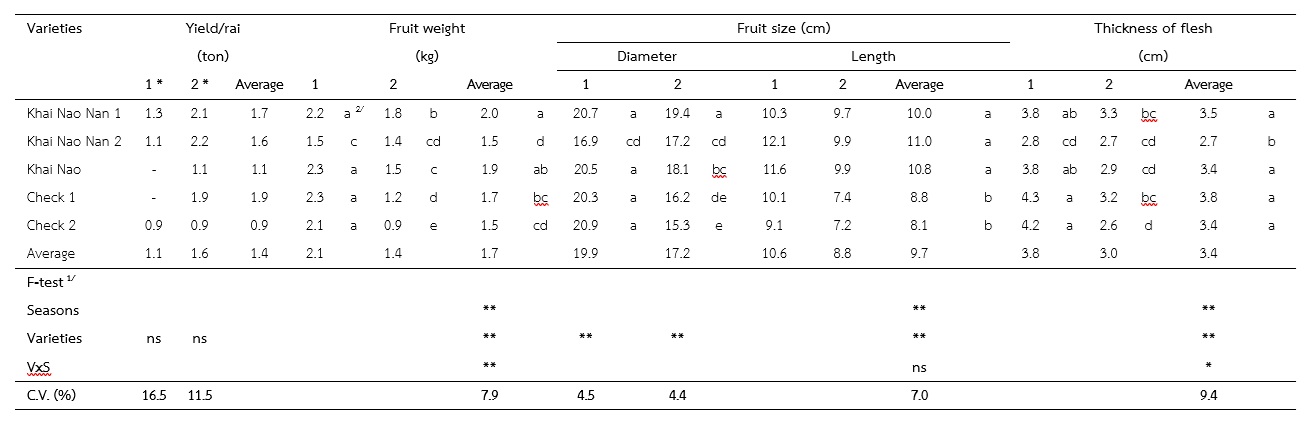
ฟักทองไข่เน่าน่าน 1 และไข่เน่าน่าน 2 เป็นพันธุ์ที่กำลังจดทะเบียนพันธุ์พืชพื้นเมืองเฉพาะถิ่น ตามพระราชบัญญัติคุ้มครองพันธุ์พืช พ.ศ. 2542 การทดลองนี้จึงมีวัตถุประสงค์เพื่อประเมินพันธุ์ไข่เน่าน่าน 2 พันธุ์ ร่วมกับพันธุ์ไข่เน่า และพันธุ์มาตรฐาน 2 พันธุ์ การศึกษาครั้งนี้ทำการวางแผนการทดลองแบบสุ่มในบล็อกสมบูรณ์ (RCB) จำนวน 3 ซ้ำ ระหว่าง 2 ฤดูปลูก คือ ฤดูฝน ระหว่างกรกฎาคม ถึง ตุลาคม พ.ศ. 2565 และฤดูแล้ง ระหว่างธันวาคม พ.ศ. 2565 ถึง เมษายน พ.ศ. 2566 ในพื้นที่จังหวัดน่าน ในแปลงทดลองเดิม และทำการวิเคราะห์ความแปรปรวนรวม (combined analysis in RCB) ของ 2 ฤดูปลูก การทดสอบความเป็นเอกภาพของความแปรปรวนของ 2 ฤดูปลูก พบว่าทุกลักษณะที่ศึกษามีความเป็นเอกพันธุ์ ยกเว้นเส้นผ่านศูนย์กลางของผล ปริมาณของแข็งทั้งหมด ปริมาณของแข็งทั้งหมดที่ละลายน้ำของเนื้อสุก ความแน่นของเนื้อดิบ และค่าสี L*, a* และ b* ของเนื้อดิบและสุก ค่าเฉลี่ยผลผลิตต่อไร่ของ ฤดูแล้งมีแนวโน้มมากกว่าฤดูฝน เท่ากับ 1.6 และ 1.1 ตัน เนื่องจากในฤดูฝนพบการระบาดของโรคไวรัส พันธุ์ไข่เน่าน่าน 1 และพันธุ์ไข่เน่าน่าน 2 ให้ผลผลิตต่อไร่ในฤดูฝน สูงกว่าพันธุ์อื่น ๆ มากกว่าหรือเท่ากับ 1.1 ตัน และ ฤดูแล้งมากกว่าหรือเท่ากับ 2.1 ตัน องค์ประกอบของผลผลิตและคุณภาพทุกลักษณะ พบว่าฤดูแล้งให้ค่ามากกว่าฤดูฝน ยกเว้น ลักษณะค่าสี L* และ a* ของ เนื้อดิบและนึ่งสุก พันธุ์ไข่เน่าน่าน 2 และพันธุ์ไข่เน่า ให้ค่าปริมาณของแข็งในฤดูฝนและฤดูแล้งมากกว่าหรือเท่ากับ ร้อยละ 18.9 และ 20.0 ตามลำดับ พันธุ์ไข่เน่าน่าน 1 และพันธุ์ไข่เน่าน่าน 2 มีค่าปริมาณของแข็งทั้งหมดที่ละลายน้ำได้ของเนื้อดิบในฤดูแล้งมากกว่าหรือเท่ากับ ร้อยละ 16.0 พันธุ์ไข่เน่าน่าน 1 ไข่เน่าน่าน 2 และไข่เน่า มีความสว่างของสีเนื้อดิบ L* น้อยกว่าพันธุ์อื่น ๆ ค่าสี a* พบว่า พันธุ์ไข่เน่าน่าน 1 ไข่เน่าน่าน 2 และไข่เน่า ให้ค่าสีแดงมากกว่าพันธุ์อื่น ๆ ค่าสี b* พบว่าในฤดูฝน พันธุ์ไข่เน่าน่าน 1 และไข่เน่าน่าน 2 มีแนวโน้มให้สีเหลืองน้อยกว่าพันธุ์อื่น ๆ ส่วนในฤดูแล้งมีค่าใกล้เคียงกัน
เอกสารอ้างอิง
AOAC. 2000. The Official Methods of Analysis of the Association of Analytical Chemists. 17th Edition. Washington D.C.: AOAC International. 2200 p.
Etty, T. and L. Harrison. 2016. Heirloom Plants: a Complete Compendium of Heritage Vegetables, Fruits, Herbs & Flowers. Chicago, Illinois: Ball Publishing. 224 p.
Kaiser, C. and M. Ernst. 2017. Heirloom Vegetables (CCD-CP-100). Lexingto, KY: Center for Crop Diversification, University of Kentucky. 8 p.
Khanobdee, C. 2020. Cucurbits Breeding and Seed Production. Bangkok: O.S. Printing House Co., Ltd. 186 p. [in Thai]
Khanobdee, C. 2021. Khai Nao pumpkin: potential heirloom plants of Nan province. Kehakaset Magazine 45(7): 86–89. [in Thai]
Khanobdee, C., P. Srisamatthakarn, C. Pongsukhumalkul and P. Jinawong. 2022. Inbred Line Selection and Evaulation of “Khai-Nao Nan” Pumpkin Varieties. pp. 214–223. In Proceedings of the 1st Agricultural Innovation and Natural Resources Conference 2022. Songkhla: Prince of Songkla University [in Thai]
Khanobdee, C., P. Srisamatthakarn, C. Pongsukhumalkul and P. Jinawong. 2024. Genetic diversity assessment of physical and chemical traits of 100 heirloom “Khai Nao” pumpkin varieties. Journal of Agricultural Research and Extension 41(1): 42–51. [in Thai]
Little, T.M. and F.J Hills. 1978. Agricultural Experimentation Design and Analysis. New York: John Wiley & Sons, Inc. 350 p.
Loy, J.B. 2012. Breeding Squash and Pumpkins. pp. 93-139. In Y-Hong W., T.K. Behera, and K. Chittaranjan (Eds.). Genetics, Genomics and Breeding of Cucurbits. Boca Raton: CRC Press.
Paris, H.S. 1994. Genetic Analysis and Breeding of Pumpkins and Squash for High Carotene Content. pp 93–115. In Linskens H.F. and J.F. Jackson (Eds.). Vegetables and Vegetable Products. Berlin: Springer.
Thai Meteorological Department. 2024. Temperature and rainfall data for the Northern region. [Online]. Available http://www.cmmet.tmd.go.th/forecast/pt/Max_Min_Rainfall.php (December 29, 2024).
ดาวน์โหลด
เผยแพร่แล้ว
รูปแบบการอ้างอิง
ฉบับ
ประเภทบทความ
สัญญาอนุญาต
ลิขสิทธิ์ (c) 2025 วารสารวิจัยและส่งเสริมวิชาการเกษตร

อนุญาตภายใต้เงื่อนไข Creative Commons Attribution-NonCommercial-NoDerivatives 4.0 International License.
บทความนี้ได้รับการเผยแพร่ภายใต้สัญญาอนุญาต Creative Commons Attribution-NonCommercial-NoDerivatives 4.0 International (CC BY-NC-ND 4.0) ซึ่งอนุญาตให้ผู้อื่นสามารถแชร์บทความได้โดยให้เครดิตผู้เขียนและห้ามนำไปใช้เพื่อการค้าหรือดัดแปลง หากต้องการใช้งานซ้ำในลักษณะอื่น ๆ หรือการเผยแพร่ซ้ำ จำเป็นต้องได้รับอนุญาตจากวารสาร