
Application of Geographic Information System for Assessing Suitable Areas for Sanitary Landfill According to Sanitary Standards Sites in Lop Buri Province
DOI:
https://doi.org/10.14456/jare-mju.2025.60Keywords:
suitable sanitary landfill area, geographic information system, overlay techniqueAbstract
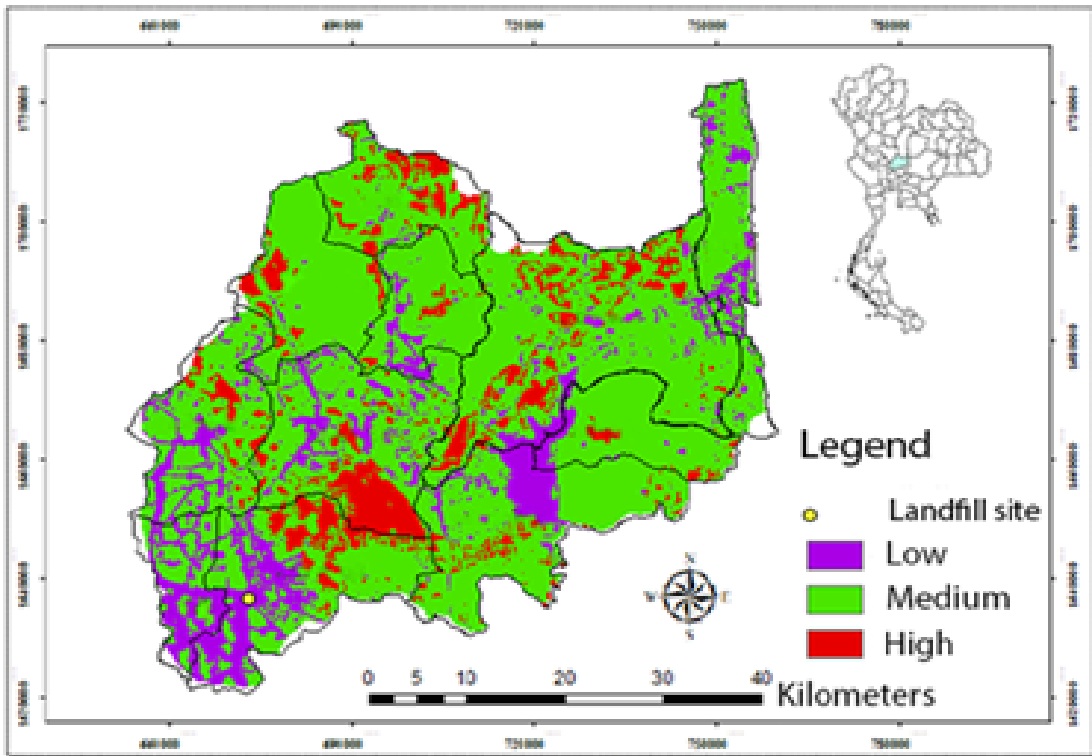
This research used a geographic information system for sanitary landfill site selection. Based on 11 criteria influencing sanitary landfill site selection and spatial data, suitable areas for landfill sites were determined using the weighted overlay technique with ArcGIS 10.2.
The results showed that the most influential factor is the distance from water sources and wetlands, with a weight of 11.03%. This is followed by proximity to water supply, groundwater levels, distance from communities, slope, geological conditions, historical sites, flood risk areas, soil type, land use, and transportation routes, with weights of 10.66, 10.29, 9.56, 9.56, 9.19, 8.82, 8.46, 8.09, 7.72 and 6.62%, respectively. The most suitable areas for sanitary landfills are mainly located in Khok Samrong district, covering 224.64 square kilometers (3.62% of the province's total area). This is followed by Chai Badan District (182.05 sq. km., 2.93%), Tha Luang District (81.21 sq. km., 1.30%), and the least suitable area is in Sa Bot District (0.86 sq. km., 0.01%). It is recommended that public participation should be promoted and taken into account when evaluating suitable landfill sites. Additionally, long-term waste reduction is required for sustainable waste management.
References
Al-Anbari, M.A., M.Y. Thameer and N. Al-Ansari. 2018. Landfill site selection by weighted overlay technique: case study of Al-Kufa, Iraq. Sustainability 10(4): 999. https://doi.org/10.3390/su10040999
Chabuk, A., N. Al-Ansari, H.M. Hussain, S. Knutsson and R. Pusch. 2016. Landfill site selection using geographic information system and analytical hierarchy process: a case study Al-Hillah Qadhaa, Babylon, Iraq. Waste Management and Research 34(5): 427–437. https://doi.org/10.1177/0734242X16633778
Chinda, T., N. Leewattana and N. Leeamnuayjaroen. 2012. The Study of Landfill Situations in Thailand. pp. 1–8. In Proceedings of the 1st Mae Fah Luang University International Conference 2012. Chiang rai: Mae Fah Luang University.
Ghobadi, M. 2024. Environmental capability assessment for MSW landfill site using geographic information system and multi criteria evaluation. Advances in Environmental Technology 10(1): 29–40. https://doi.org/10.22104/aet.2023.6210.1712
Iamchuen, N., B. Sukopromsun, N. Chaikaew and T. Anucharn. 2023. Network analysis of waste collection systems and guidelines for finding landfill areas: a case study of Songkhla municipality, Songkhla province. Burapha Science Journal 28(1): 364–383. [in Thai]
Mallick, J. 2021. Municipal solid waste landfill site selection based on fuzzy-AHP and geoinformation techniques in Asir region, Saudi Arabia. Sustainability 13(3): 1538. https://doi.org/10.3390/su13031538
Narongrit, C. 2005. Geographic Information Systems for Environmental Management. Phitsanulok: Department of Natural Resources and Environment, Faculty of Agriculture, Natural Resources and Environment, Naresuan University. 329 p. [in Thai]
Noinamsai, S. and P. Wachirawongsakorn. 2017. Assessment of suitable areas for sanitary landfill sites in uttaradit province using geographic information systems. Phibunsongkhram Journal of Science, Technology and Environmental Research 3(25): 77–85. [in Thai]
Pollution Control Department. 2024. Information system for municipal waste management. [Online]. Available https://thaimsw.pcd.go.th/report_country.php (September 12, 2024).
Pollution Control Department. 2024. Guidelines for assessing site suitability, design, construction and management of sanitary landfill sites. [Online]. Available https://www.pcd.go.th/publication/5065/(September 20, 2024).
Provincial Office of Natural Resources and Environment Lop Buri. 2024. Provincial natural resources and environmental management plan (5-year period 2023–2027). [Online]. Available https://lopburi.mnre.go.th/th/information/more/69 (September 12, 2024).
Rezaeisabzevar, Y., A. Bazargan and B. Zohourian. 2020. Landfill site selection using multi criteria decision making: Influential factors for comparing locations. Journal of Environmental Sciences 93: 170–184. https://doi.org/10.3390/rs15153754
Vichiansinpa, J., N. Wongram and C. Wantong. 2015. Application of geographic information system on sanitary landfill site selection: a case study of Lam Plai Mat district, Buriram province. Rommayasan 13(2): 19–32. [in Thai]
Downloads
Published
How to Cite
Issue
Section
License
Copyright (c) 2025 Journal of Agricultural Research and Extension

This work is licensed under a Creative Commons Attribution-NonCommercial-NoDerivatives 4.0 International License.
This article is published under a Creative Commons Attribution-NonCommercial-NoDerivatives 4.0 International License (CC BY-NC-ND 4.0), which allows others to share the article with proper attribution to the authors and prohibits commercial use or modification. For any other reuse or republication, permission from the journal and the authors is required.


