
The Evaluation of Potential Agriculturally Beneficial Bacteria from Rhizosphere Soil of Sangyod Rice
DOI:
https://doi.org/10.14456/jare-mju.2025.47Keywords:
plant growth promoting bacteria, soil, rhizosphere, Sangyod riceAbstract
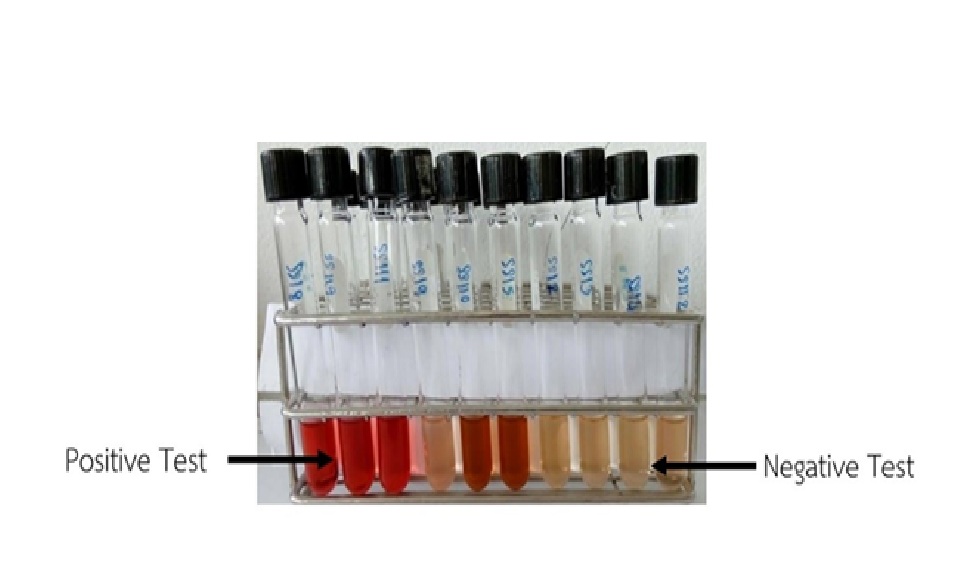
Sangyod rice is the most popular native rice variety in Phatthalung province. However, its low productivity is due to soil quality. Farmers often use chemical fertilizers to increase productivity, which can negatively affect soil quality and leave chemical residues. This research aimed to isolate and evaluate the plant growth-promoting ability of bacteria isolated from the rhizosphere soil of Sangyod rice. The result showed that 18 isolated bacteria had the ability to produce indole acetic acid (IAA) at 5.04±0.26 – 89.58± 0.26 µg/ml. The 11 isolates, which produce IAA more than 50 µg/ml were selected for screening of nitrogen fixation activities. It was found that 4 isolates which were SS10, SS19, SS36 and SS41 showed nitrogen fixing ability. These isolates were later evaluated for their phosphate solubilizing activities on Pikovskaya’s (PVK) agar and growth inhibition of Alternaria sp. The result showed all 4 isolates were able to solubilize phosphate on PVK, with the highest phosphate solubilization index of 2.46 was obtained from SS10. While the ability to inhibit the growth of Alternaria sp. was observed in SS10 and SS36 with a percentage inhibition of 33.63 and 36.60%, respectively. Finally, SS10, SS36 and SS41 were selected for evaluation in their stimulation of Sangyod rice seed germination. The results showed that all selected bacteria did not significantly affect seed germination percentage compared to the control, while strain SS36 exhibited the highest significant ability to promote root growth, with a root length of 13.21±1.34 mm. This study found that isolated bacteria have potential for promoting plant growth and could be developed into a bio-fertilizer for enhancing rice growth.
References
Boonnadakul, C., S. Cheunbarn, T. Cheunbarn, S. Klayraung and S. Aumtong. 2019. Selection of free-living nitrogen fixing bacteria to promote on rice growth. Naresuan Phayao 12(2): 32–40. [in Thai]
Bunkhean, A., W. Jangiam and M. Tangwattanachuleeporn. 2023. Application of MALDI-TOF MS to rapid identification of Streptomyces. Rambhai Barni Rajabhat Agricultural Journal 1(1): 1–7. [in Thai]
Chen, P.H., R.Y. Chen and J.Y. Chou. 2018. Screening and evaluation of yeast antagonists for biological control of Botrytis cinerea on strawberry fruits. Mycobiology 46: 33–46.
Christian, L.L., S.S. Michael, B.A. Mark and F. Noah. 2008. The influence of soil properties on the structure of bacterial and fungal communities across land-use types. Soil Biology and Biochemistry 40: 2407–2415.
Division of Rice Product Development. 2021. Rice varieties: Sangyod rice. [Online]. Available https://brpd.ricethailand.go.th/page/4538 (March 27, 2025). [in Thai]
Division of Rice Research and Development. 2004. Instructions for use of chemical fertilizers in paddy fields based on soil analysis. [Online]. Available http://webold.ricethailand.go.th/rkb3/
Eb_014.pdf (March, 30 2025). [in Thai]
Glick, B.R. 2012. Plant growth-promoting bacteria: mechanisms and applications. Scientifica 2012: 1–15. https://doi.org/10.6040/2012/963401.
Huang, R., H.J. Che, J. Zhang, L. Yang, D.H. Jiang, and G.Q. Li. 2012. Evaluation of Sporidiobolus pararoseus strain YCXT3 as biocontrol agent of Botrytis cinereaon post-harvest strawberry fruits. Biological Control 62: 53–63.
Huangmee, K., P. Kanghae, W. Punsak and W. Homhaul. 2019. The ability of potassium-solubilizing bacteria on germinationof seeds Phitsanulok 2 rice under laboratory condition. Thai Journal of Soils and Fertilizers 41(1): 48–58. [in Thai]
Ji, S.H., M.A. Gururani and S.C. Chun. 2014. Isolation and characterization of plant growth promoting endophytic diazotrophic bacteria from Korean rice cultivars. Microbiological Research 169: 83–98.
Jomkhame, S. and C. Atnaseo. 2021. Effectiveness of PGPB from different origins on enhancing germination and seedling growth of Oryza sativa L. cv. KDML105. Khon Kaen Agriculture Journal 49(Suppl.1): 1011–1017. [in Thai]
Kabbua, T. and A. Chaiyara. 2022. Screening and efficiency of phosphate solubilizing bacteria from rice rhizosphere of Si Sa Kat province. PBRU Science Journal 19(1): 72–83.
Kanghae, P., S. Jaikawin, A. Hantanapong, S. Pinmanee and W. Wipa Homhual. 2018. Diversity and efficiency of phosphate solubilizing bacteria from the rhizosphere of rice in the upper northern Thailand. Thai Rice Research Journal 9(1): 46–59. [in Thai]
Khattisa, A., K. Danmek, W. Tera arusiri, T. Hangsoongnern and S. Mahadtanapuk. 2018. Screening of Bacillus in biocontrol and production of bio-fertilizer for use in organic rice farms. Prawarun Agricultural Journal 15(1): 41–50. [in Thai]
Kumar, A., B.R. Maurya and R. Raghuwanshi. 2014. Isolation and characterization of PGPR and their effect on growth, yield and nutrient content in wheat (Triticum aestivum L.). Biocatalysis and Agricultural Biotechnology 3: 121–128.
Magrin, G., C.G. García, D.C. Choque, J.C. Giménez, A.R. Moreno and G.J. Nagy. 2007. Contribution of Working Group II to the Fourth Assessment Report of the Intergovernmental Panel on Climate Change. pp. 581–615. In Parry M.L., O.F. Canziani, J.P. Palutikof, P.J. van der Linden and C.E. Hanson (Eds.). Latin America. Climate Change 2007: Impacts, Adaptation and Vulnerability. Cambridge: Cambridge University Press.
Meunchang, P. 2016. Reduction of rice production cost by biofertilizer. [Online]. Available https://www.dailynews.co.th/agriculture/387802 (April 26, 2024). [in Thai]
Mohanram, S. and P. Kumar. 2019. Rhizosphere microbiome: revisiting the synergy of plant-microbe interactions. Annals of Microbiology 69: 307–320.
Pechwang, J., C. Sungthong, S. Noonet and S. Thitithanakul. 2021 . Isolation of yeast antagonists from surface of vegetables and fruits for control of Alternaria alternata. Khon Kaen Agriculture Journal Suppl.1(2021): 838-843. [in Thai]
Setargie, A., S. Tilahun, S. Alemayehu, T. Dejenie and S. Kiros. 2015. Isolation and phenotypic characterization of phosphate solubilizing bacteria from lentil (Lens culnaris.) rhizosphere soils from Southern parts of Tigray, Ethiopia. International Journal of Microbiological Research 6: 188–194.
Singh, A., V.K. Yadav, R.S. Chundawat, R. Soltane, N.S. Awwad, H.A. Ibrahium, K.K. Yadav and S.I. Vicas. 2023. Enhancing plant growth promoting rhizobacterial activities through consortium exposure: a review. Frontiers in Bioengineering and Biotechnology 11: 1099999. https://doi.org/10.3389/fbioe.2023.1099999
Sutthisa, W. and B. Wapi. 2019. Screening of plant growth promoting bacteria for rice from rhizosphere soil of Gomphrena celosioides Mart. Journal of Science & Technology, Ubon Ratchatani University 21(3): 86–94. [in Thai]
Thancharoen, K., J. PhoolonKaew, K. Sinthurak, K. Leamsamrong, S. Thamduangsri and A. Pimsawan. 2021. Study of soil quality and isolation of phosphate-solubilizing bacteria from organic rice soil area. Khon Kaen Agriculture Journal 49(Suppl.1): 293–298. [in Thai]
Vishan, I., S. Sivaprakasam and A. Kalamdhad. 2017. Isolation and identification of bacteria from rotary drum compost of water hyacinth. International Journal Recycling Organic Waste in Agriculture 6: 245–253.
Wanchai, K. and S. Ruangsang. 2014. Effect of phosphate-soluble bacteria fixated on rice husk ash on the growth of KK47 rice varieties. Journal of Agricultural Sciences. 45(2)(Special): 513–516. [in Thai]
Zhou, D., H. Feng, T. Schuelke, A. De Santiago, Q. Zhang, J. Zhang, C. Luo and L. Wei. 2019. Rhizosphere microbiomes from root knot nematode non-infested plants suppress nematode infection. Microbial Ecology 78: 470–481.
Downloads
Published
How to Cite
Issue
Section
License
Copyright (c) 2025 Journal of Agricultural Research and Extension

This work is licensed under a Creative Commons Attribution-NonCommercial-NoDerivatives 4.0 International License.
This article is published under a Creative Commons Attribution-NonCommercial-NoDerivatives 4.0 International License (CC BY-NC-ND 4.0), which allows others to share the article with proper attribution to the authors and prohibits commercial use or modification. For any other reuse or republication, permission from the journal and the authors is required.