
การประเมินศักยภาพแบคทีเรียที่เป็นประโยชน์เพื่อการเกษตรจากดินรอบ ๆ รากข้าวสังข์หยด
DOI:
https://doi.org/10.14456/jare-mju.2025.47คำสำคัญ:
แบคทีเรียส่งเสริมการเจริญเติบโตของพืช , ดิน , ไรโซสเฟียร์ , ข้าวสังข์หยดบทคัดย่อ
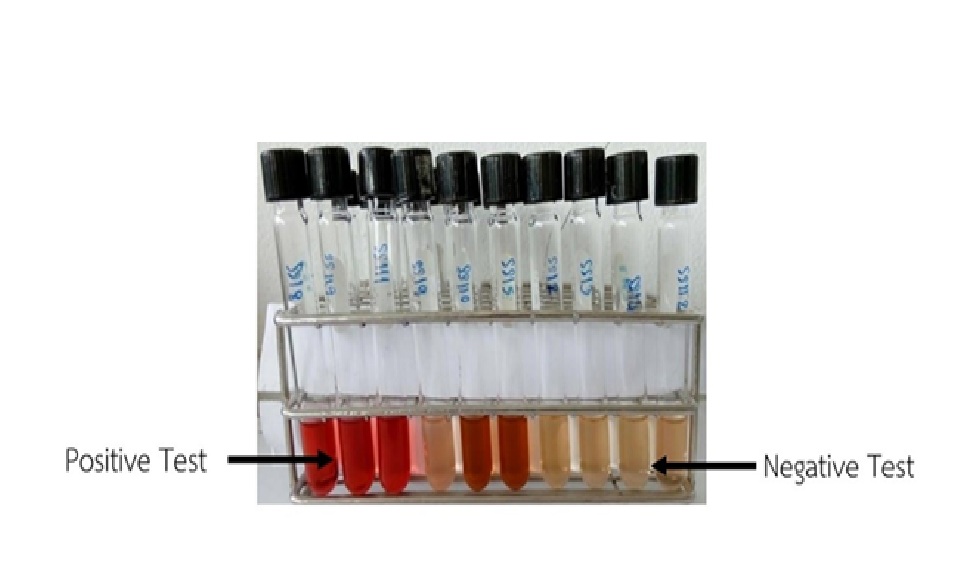
ข้าวสังข์หยดเป็นข้าวพันธุ์พื้นเมืองที่ได้รับความนิยมมากที่สุดของจังหวัดพัทลุง อย่างไรก็ตามมีผลผลิตจากการเพาะปลูกต่ำ เนื่องจากคุณภาพของดินที่เกษตรกรมักใช้ปุ๋ยเคมีเพื่อเพิ่มผลผลิต ส่งผลต่อคุณภาพของดินและการตกค้างของสารเคมี การศึกษานี้มีวัตถุประสงค์เพื่อคัดแยกและประเมินศักยภาพของแบคทีเรียส่งเสริมการเจริญเติบโตของพืชที่คัดแยกได้จากดินบริเวณรอบ ๆ รากข้าวสังข์หยด ผลการศึกษาพบแบคทีเรียที่สามารถผลิตกรดอินโดอะซิติก (Indole Acetic Acid: IAA) ได้จำนวน 18 ไอโซเลต โดยมีปริมาณ IAA อยู่ในช่วง 5.04±0.26 มคก./มล. ถึง 89.8±0.26 มคก./มล. คัดเลือกแบคทีเรีย ที่ผลิต IAA ได้มากกว่า 50 มคก./มล. จำนวน 11 ไอโซเลต มาทดสอบความสามารถในการตรึงไนโตรเจน พบแบคทีเรียจำนวน 4 ไอโซเลต ที่สามารถตรึงไนโตรเจนได้คือ SS10, SS19, SS36 และ SS41 เมื่อนำมาทดสอบความสามารถในการละลายฟอสเฟตบนอาหารแข็ง PVK และความสามารถในการยับยั้งการเจริญของเชื้อรา Alternaria sp. พบว่าทั้ง 4 ไอโซเลตสามารถละลายฟอสเฟตได้ โดย SS10 ให้ค่าดัชนีการละลายฟอสเฟตสูงสุดเท่ากับ 2.46 ในขณะที่ SS10 และ SS36 สามารถยับยั้งการเจริญของเชื้อรา Alternaria sp. ได้ โดยมีผลการยับยั้งเท่ากับ 33.63 และ 36.60% ตามลำดับ คัดเลือกแบคทีเรีย SS10, SS36 และSS41 มาทดสอบความสามารถในการกระตุ้นการงอกของเมล็ดข้าวสังข์หยดพบว่าทุกไอโซเลตให้เปอร์เซ็นต์การงอกไม่แตกต่างกันอย่างมีนัยสำคัญทางสถิติเมื่อเทียบกับชุดควบคุม ในขณะที่ SS36 สามารถกระตุ้นความยาวรากเฉลี่ยได้สูงที่สุด เท่ากับ 13.21±1.34 มม. จากผลการศึกษาแบคทีเรียที่คัดแยกได้มีศักยภาพในการส่งเสริมการเจริญเติบโตของพืช สามารถนำไปพัฒนาเป็นปุ๋ยชีวภาพ เพื่อใช้ส่งเสริมการเจริญของเติบโตของต้นข้าวต่อไป
เอกสารอ้างอิง
Boonnadakul, C., S. Cheunbarn, T. Cheunbarn, S. Klayraung and S. Aumtong. 2019. Selection of free-living nitrogen fixing bacteria to promote on rice growth. Naresuan Phayao 12(2): 32–40. [in Thai]
Bunkhean, A., W. Jangiam and M. Tangwattanachuleeporn. 2023. Application of MALDI-TOF MS to rapid identification of Streptomyces. Rambhai Barni Rajabhat Agricultural Journal 1(1): 1–7. [in Thai]
Chen, P.H., R.Y. Chen and J.Y. Chou. 2018. Screening and evaluation of yeast antagonists for biological control of Botrytis cinerea on strawberry fruits. Mycobiology 46: 33–46.
Christian, L.L., S.S. Michael, B.A. Mark and F. Noah. 2008. The influence of soil properties on the structure of bacterial and fungal communities across land-use types. Soil Biology and Biochemistry 40: 2407–2415.
Division of Rice Product Development. 2021. Rice varieties: Sangyod rice. [Online]. Available https://brpd.ricethailand.go.th/page/4538 (March 27, 2025). [in Thai]
Division of Rice Research and Development. 2004. Instructions for use of chemical fertilizers in paddy fields based on soil analysis. [Online]. Available http://webold.ricethailand.go.th/rkb3/
Eb_014.pdf (March, 30 2025). [in Thai]
Glick, B.R. 2012. Plant growth-promoting bacteria: mechanisms and applications. Scientifica 2012: 1–15. https://doi.org/10.6040/2012/963401.
Huang, R., H.J. Che, J. Zhang, L. Yang, D.H. Jiang, and G.Q. Li. 2012. Evaluation of Sporidiobolus pararoseus strain YCXT3 as biocontrol agent of Botrytis cinereaon post-harvest strawberry fruits. Biological Control 62: 53–63.
Huangmee, K., P. Kanghae, W. Punsak and W. Homhaul. 2019. The ability of potassium-solubilizing bacteria on germinationof seeds Phitsanulok 2 rice under laboratory condition. Thai Journal of Soils and Fertilizers 41(1): 48–58. [in Thai]
Ji, S.H., M.A. Gururani and S.C. Chun. 2014. Isolation and characterization of plant growth promoting endophytic diazotrophic bacteria from Korean rice cultivars. Microbiological Research 169: 83–98.
Jomkhame, S. and C. Atnaseo. 2021. Effectiveness of PGPB from different origins on enhancing germination and seedling growth of Oryza sativa L. cv. KDML105. Khon Kaen Agriculture Journal 49(Suppl.1): 1011–1017. [in Thai]
Kabbua, T. and A. Chaiyara. 2022. Screening and efficiency of phosphate solubilizing bacteria from rice rhizosphere of Si Sa Kat province. PBRU Science Journal 19(1): 72–83.
Kanghae, P., S. Jaikawin, A. Hantanapong, S. Pinmanee and W. Wipa Homhual. 2018. Diversity and efficiency of phosphate solubilizing bacteria from the rhizosphere of rice in the upper northern Thailand. Thai Rice Research Journal 9(1): 46–59. [in Thai]
Khattisa, A., K. Danmek, W. Tera arusiri, T. Hangsoongnern and S. Mahadtanapuk. 2018. Screening of Bacillus in biocontrol and production of bio-fertilizer for use in organic rice farms. Prawarun Agricultural Journal 15(1): 41–50. [in Thai]
Kumar, A., B.R. Maurya and R. Raghuwanshi. 2014. Isolation and characterization of PGPR and their effect on growth, yield and nutrient content in wheat (Triticum aestivum L.). Biocatalysis and Agricultural Biotechnology 3: 121–128.
Magrin, G., C.G. García, D.C. Choque, J.C. Giménez, A.R. Moreno and G.J. Nagy. 2007. Contribution of Working Group II to the Fourth Assessment Report of the Intergovernmental Panel on Climate Change. pp. 581–615. In Parry M.L., O.F. Canziani, J.P. Palutikof, P.J. van der Linden and C.E. Hanson (Eds.). Latin America. Climate Change 2007: Impacts, Adaptation and Vulnerability. Cambridge: Cambridge University Press.
Meunchang, P. 2016. Reduction of rice production cost by biofertilizer. [Online]. Available https://www.dailynews.co.th/agriculture/387802 (April 26, 2024). [in Thai]
Mohanram, S. and P. Kumar. 2019. Rhizosphere microbiome: revisiting the synergy of plant-microbe interactions. Annals of Microbiology 69: 307–320.
Pechwang, J., C. Sungthong, S. Noonet and S. Thitithanakul. 2021 . Isolation of yeast antagonists from surface of vegetables and fruits for control of Alternaria alternata. Khon Kaen Agriculture Journal Suppl.1(2021): 838-843. [in Thai]
Setargie, A., S. Tilahun, S. Alemayehu, T. Dejenie and S. Kiros. 2015. Isolation and phenotypic characterization of phosphate solubilizing bacteria from lentil (Lens culnaris.) rhizosphere soils from Southern parts of Tigray, Ethiopia. International Journal of Microbiological Research 6: 188–194.
Singh, A., V.K. Yadav, R.S. Chundawat, R. Soltane, N.S. Awwad, H.A. Ibrahium, K.K. Yadav and S.I. Vicas. 2023. Enhancing plant growth promoting rhizobacterial activities through consortium exposure: a review. Frontiers in Bioengineering and Biotechnology 11: 1099999. https://doi.org/10.3389/fbioe.2023.1099999
Sutthisa, W. and B. Wapi. 2019. Screening of plant growth promoting bacteria for rice from rhizosphere soil of Gomphrena celosioides Mart. Journal of Science & Technology, Ubon Ratchatani University 21(3): 86–94. [in Thai]
Thancharoen, K., J. PhoolonKaew, K. Sinthurak, K. Leamsamrong, S. Thamduangsri and A. Pimsawan. 2021. Study of soil quality and isolation of phosphate-solubilizing bacteria from organic rice soil area. Khon Kaen Agriculture Journal 49(Suppl.1): 293–298. [in Thai]
Vishan, I., S. Sivaprakasam and A. Kalamdhad. 2017. Isolation and identification of bacteria from rotary drum compost of water hyacinth. International Journal Recycling Organic Waste in Agriculture 6: 245–253.
Wanchai, K. and S. Ruangsang. 2014. Effect of phosphate-soluble bacteria fixated on rice husk ash on the growth of KK47 rice varieties. Journal of Agricultural Sciences. 45(2)(Special): 513–516. [in Thai]
Zhou, D., H. Feng, T. Schuelke, A. De Santiago, Q. Zhang, J. Zhang, C. Luo and L. Wei. 2019. Rhizosphere microbiomes from root knot nematode non-infested plants suppress nematode infection. Microbial Ecology 78: 470–481.
ดาวน์โหลด
เผยแพร่แล้ว
รูปแบบการอ้างอิง
ฉบับ
ประเภทบทความ
สัญญาอนุญาต
ลิขสิทธิ์ (c) 2025 วารสารวิจัยและส่งเสริมวิชาการเกษตร

อนุญาตภายใต้เงื่อนไข Creative Commons Attribution-NonCommercial-NoDerivatives 4.0 International License.
บทความนี้ได้รับการเผยแพร่ภายใต้สัญญาอนุญาต Creative Commons Attribution-NonCommercial-NoDerivatives 4.0 International (CC BY-NC-ND 4.0) ซึ่งอนุญาตให้ผู้อื่นสามารถแชร์บทความได้โดยให้เครดิตผู้เขียนและห้ามนำไปใช้เพื่อการค้าหรือดัดแปลง หากต้องการใช้งานซ้ำในลักษณะอื่น ๆ หรือการเผยแพร่ซ้ำ จำเป็นต้องได้รับอนุญาตจากวารสาร