
Diversity of Tree Species in Conservation Area and Utilization Area at Ban Hadpudai Community Forest, Lampang Province
DOI:
https://doi.org/10.14456/jare-mju.2026.7Keywords:
plant community structure, species diversity, forest resources, community forest managementAbstract
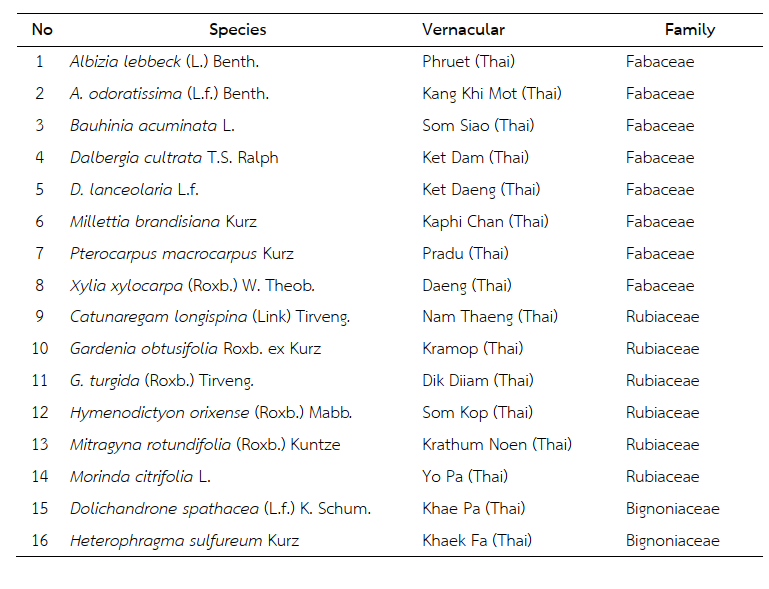
This research aimed to compare the diversity of tree species in conservation and utilization forest areas by specifying 3 sample plots of 20x50 square meters for each area to investigate the number of tree species, which were classified into 3 aged-classes: trees, saplings, and seedlings. The collected tree data were analyzed for the Importance Value Index (IVI) and species diversity index (H') of Shannon-Wiener. The results enumerated 55 species, 45 genera, and 22 families of trees in Ban Hadpudai community forest. The family Fabaceae was the most abundant tree family, followed by Rubiaceae, Bignoniaceae, Combretaceae, and Dipterocarpacceae, respectively. In the conservation forest area 38 species, 32 genera and 16 families were identified. The top 5 tree species with the highest IVI were Shorea siamensis Miq. (38.25%), Xylia xylocarpa (Roxb.) W. Theob. (28.66%), Shorea obtusa Wall. ex Blume (14.07%), Terminalia alata B. Heyne ex Roth (13.50%), and Lannea coromandelica (Houtt.) Merr. (13.37%), respectively. Species diversity indices of trees, saplings, and seedlings age-classes were 1.99 (low), 2.49 (moderate), and 3.06 (high) respectively, whereas 29 species, 22 genera, and 12 families of trees were classified in the utilization forest area. The top 5 tree species with the highest IVI were Shorea siamensis Miq. (62.01%), Shorea obtusa Wall. ex Blume (33.08%), Xylia xylocarpa (Roxb.) W.Theob. (22.61%), Terminalia mucronata Craib & Hutch. (21.00%), and Xantolis cambodiana (Pierre ex Dubard) P. Royen (19.82%), respectively. Species diversity indices of trees, saplings, and seedlings age-classes were 1.45 (very low), 2.55 (moderate), and 2.86 (moderate), respectively.
References
Abson D.J., H. von Wehrden, S. Baumgärtner, J. Fischer, J. Hanspach, W. Härdtle, H. Heinrichs, A.M. Klein, D.J. Lang, P. Martens and D. Walmsley. 2014. Ecosystem services as a boundary object for sustainability. Ecological Economics 103(2014): 29–37. https://doi.org/10.1016/j.ecolecon.2014.04.012
Choopan, T. 2007. Plant diversity and ethnobotany in Khok-Rai forest, Chiang Yuen district, Maha Sarakham province. Journal of Science and Technology Mahasarakham University. 26(2): 150–157. [in Thai]
Department of Environmental Quality Promotion. 2018. Community forest stories: learning and conserving natural resources. Bangkok: Department of Environmental Quality Promotion. 5 p.
Elliott, S., D. Blakesley and K. Hardwick. 2006. Restoring Tropical Forest: A Practical Guide. Kew: Royal Botanic Gardens. 344 p.
Hansoda, A. 2004. Effects of Cattle Grazing on Plant Communities and Soil Properties in Montane Forest, Phu Miang–Phu Thong Wildlife Sanctuary, Phitsanulok Province. Master Thesis. Kasetsart University. 114 p. [in Thai]
Jariyapong, P., T. Promsaka Na Sakolnakorn and K. Sripairoj. 2019. Tree species diversity and structure in Raharn forest, Surin province, Thailand. Agricultural Technology Journal 9(2): 58–68.
Kudin, U. 1999. Fundamental Ecology for Forestry. Bangkok: Department of Forest Biology, Faculty of Forestry, Kasetsart University. 247 p.
Magurran, A.E. 2004. Measuring Biological Diversity. Victoria: Blackwell Publishing. 256 p.
Marod, D. and U. Kutintara. 2009. Forest Ecology. Bangkok: Aksorn Siam Limited. 540 p.
Royal Forest Department. 2021. Community forest management in Ban Hat Pu Dai, Lampang province Retrieved from https://www.forest.go.
Smitinand, T. 2004. Thai Plant Names. Bangkok: Office of the Forest Herbarium, Forest and Plant Conservation Research Office, Department of National Parks, Wildlife and Plant Conservation, Ministry of Natural Resource and Environment. 828 p.
Thammanu, S., J. Chung, H. Han, P. Ketdee and N. Gaewsingha. 2020. Tree species diversity and environmental factors influencing the distribution of deciduous forest plant communities in Ban Mae Chiang Rai Lum community forest, Lampang province. Thai Journal of Urban Forestry and Ecology 4(1): 13–26. [in Thai]
Tripathi, S., P. Srivastava, R. Sanayaima Devi and R. Bhadouria. 2019. Effects of variations in light availability on leaf attributes and seedling growth of four tree species in tropical dry forest. Ecological Processes 9(1): 1–16 https://doi.org/10.1186/s13717-019-0206-4
Wongyai, S. 2021. Forest structure and tree species diversity in Ban Nong Tao community forest, Mae Wang district, Chiang Mai province. Kasetsart Journal of Forest Science 40(1): 56–68. [in Thai]
Downloads
Published
How to Cite
Issue
Section
License
Copyright (c) 2026 Journal of Agricultural Research and Extension

This work is licensed under a Creative Commons Attribution-NonCommercial-NoDerivatives 4.0 International License.
This article is published under a Creative Commons Attribution-NonCommercial-NoDerivatives 4.0 International License (CC BY-NC-ND 4.0), which allows others to share the article with proper attribution to the authors and prohibits commercial use or modification. For any other reuse or republication, permission from the journal and the authors is required.


