
Effects of Female Size and Changes in Water Quality on Egg Abandonment in Ornate Spiny Lobster (Panulirus ornatus), and Influence of Light and Feeding Timing on Phyllosoma Larval
DOI:
https://doi.org/10.14456/jare-mju.2026.16Keywords:
egg abandonment, lobster breeding, ovigerous female lobster, phyllosoma nursingAbstract
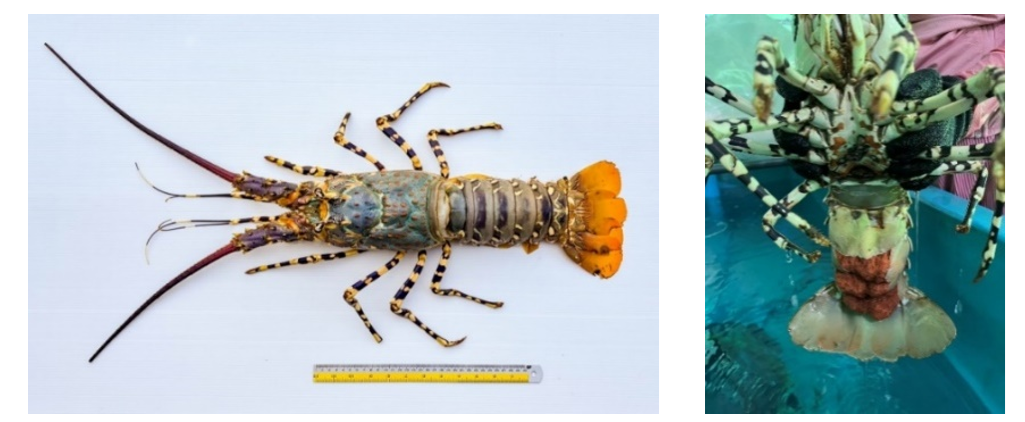
The cultivation of ornate spiny lobster (Panulirus ornatus) faced several challenges, including egg abandonment (EA) by females in hatcheries and unexplained mortality of early-stage larvae, which affect hatchery efficiency. This study aimed to evaluate the effects of female size and water quality changes during rearing that could influence EA behavior in the hatchery, and to examine the influence of light and feeding timing on primary phyllosoma larvae. The experiment was divided into two parts: (1) an initial study to identify trends in the effects of size (carapace length, CL and body weight, BW) and water quality on the daily EA rate of female broodstock (n=5), and (2) a factorial design (2×4 factors) to assess the joint influence of light (two lighting conditions) and live-food feeding intervals (four time periods) on feeding rate and mortality of primary phyllosoma (n=3). Results showed that EA rates varied among females kept at mean salinity of 30.67±1.15 ppt, with CL of 124–148 mm and BW of 1,967–2,740 g (P<0.05). The mean daily EA ranged from 1.89±0.25 to 8.25±4.38 g/day, and brood-size did not correlate with EA rate. Total ammonia changes during rearing were positively associated with EA rate (r=0.90, P=0.032), whereas changes in water quality in terms of physical (temperature) and chemical (dissolved oxygen concentration, pH, nitrite concentration, and alkalinity) properties showed no significant associations. In addition, we found that feeding period affected the eating habits of phyllosoma larva, whereby feeding from 12:00–06.00 p.m. resulted in greater consumption (P<0.05). On the other hand, light condition had no effect on feeding habit and mortality rates of phyllosoma for rearing under natural light and dark conditions (P>0.05). This study indicates that maintaining ammonia levels in water to prevent impacts on EA and aligning feeding times with the phyllosoma’s optimal feeding period can enhance breeding and rearing efficiency of this lobster.
References
American Public Health Association, American Water Works Association and Water Environment Federation (APHA, AWWA and WEF). 2023. Standard Methods for the Examination of Water and Wastewater. 24th ed. Washington D.C.: APHA Press. 1516 p.
Arkronrat, W., R. Konsantad, C. Leearam, P. Deemark, C. Srisupawadee and V. Oniam. 2024. Impacts of stocking densities on bioeconomics and profitability of mud spiny lobster (Panulirus polyphagus Herbst, 1793) cultivation in sea cages. Agriculture and Natural Resources 58(6): 1–10.
Ayra, L., and R. Cruz. 2010. Caribbean lobster reproduction: a review. Revista de Investigaciones Marinas 31(2): 115–123.
Azra, M.N. and M. Ikhwanuddin. 2016. A review of maturation diets for mud crab genus Scylla broodstock: present research, problems and future perspective. Saudi Journal of Biological Sciences 23: 257–267.
Boyd, C.E., L.R. D’Abrama, B.D. Glencross, D.C. Huyben, L.M. Juarez, G.S. Lockwood, A.A. McNevin, A.G.J. Tacon, F. Teletchea, J.R. Tomasso Jr, C.S. Tucker, and W.C. Valenti. 2020. Achieving sustainable aquaculture: historical and current perspectives and future needs and challenges. Journal of the World Aquaculture Society 51: 578–633.
Chamnina, T., P. Chuaduangpui and P. Prapruit. 2021. Challenge of spiny lobster (Panulirus spp.) culture and marketing mechanism of Koh Yao district, Phang Nga province. Khon Kaen Agriculture Journal 50(1): 138–153. [in Thai]
Coleman, M.T., J.S. Porter and M.C. Michael. 2019. Investigating fecundity and egg loss using a non-invasive method during brooding in European lobster (Homarus gammarus). Ices Journal of Marine Science 76(6): 1871–1881.
Francis, D.S., M.L. Salmon, M.J. Kenway and M.R. Hall. 2014. Palinurid lobster aquaculture: nutritional progress and considerations for successful larval rearing. Reviews in Aquaculture 6: 180–203.
Hinkle, D.E., W. Wiersma and S.G. Jurs. 2003. Applied Statistics for the Behavioral Sciences. 5th ed. Boston: Houghton Mifflin. 789 p.
Johnston, C. and P. Jungalwalla. 2000. Aquatic Animal Welfare Guidelines: Guidelines on Welfare of Fish and Crustaceans in Aquaculture and/or in Live Holding Systems for Human Consumption. Canberra: National Aquaculture Council. 46 p.
Kaewmak, P., V. Oniam, W. Arkronrat, C. Rangiaroen, P. Yingsanga and Y. Saeiam. 2020. Hatching management of berried female blue swimming crab (Portunus pelagicus) with dark gray eggs to guidelines for fishery occupation. King Mongkut's Agricultural Journal 38(3): 392–399. [in Thai]
Kittaka, J., K. Ono, J.D. Booth and W.R. Webber. 2005. Development of the red rock lobster, Jasus edwardsii, from egg to juvenile. New Zealand Journal of Marine and Freshwater Research 39(2): 263–277.
Limsuwan C., N. Chuchird, G. Kundee, C. Tipsemongkol, C. Akkarakahasin, P. Poungchor and M. Somboon. 2009. Effects of Light Intensity on Survival Rate and Growth of Rearing Pacific White Shrimp Post-larvae (Litopenaeus vannamei). pp. 149–153.
In Proceedings of 47th Kasetsart University Annual Conference. Bangkok: Kasetsart University. [in Thai]
Mori, M., F. Biagi and S. De Ranieri. 1998. Fecundity and egg loss during incubation in Norway lobster (Nephrops norvegicus) in the North Tyrrhenian Sea. Journal of Natural History 32: 1641–1650.
Nankervis, L. and C. Jones. 2022. Recent advances and future directions in practical diet formulation and adoption in tropical Palinurid lobster aquaculture. Reviews in Aquaculture 14(4): 1–13.
Nelson, M.M., B.J. Crear, P.D. Nichols and D.A. Ritz. 2004. Growth and lipid composition of phyllosomata of the southern rock lobster, Jasus edwardsii, fed enriched Artemia. Aquaculture Nutrition 10(4): 236–246.
Oniam, V., L. Chuchit and W. Arkronrat. 2012. Reproductive performance and larval quality of blue swimming crab (Portunus pelagicus) broodstock, fed with different feeds. Songklanakarin Journal of Science and Technology 34(4): 381–386.
Oniam, V. and W. Arkronrat. 2013. Development of crab farming: the complete cycle of blue swimming crab culture program (CBSC Program) in Thailand. Kasetsart University Fisheries Research Bulletin 37(2): 31–43.
Oniam, V., W. Arkronrat, A. Sookdara and P. Promraksa. 2021. Embryonic development, hatchability and survival of early larval stage of mud spiny lobster Panulirus polyphagus (Herbst, 1793) under hatchery conditions. Journal of Fisheries and Environment 45(3): 42–52.
Petersen, E., E. Susanti, R. Oktaviani, C. Jones and A. Diedrich. 2020. Bio-economics of tropical spiny lobster farming in Indonesia. Aquaculture and Fisheries Studies 2(2): 1–10.
Prue. T. 2020. Ovulation Attachment and Retention of Lobster Eggs. pp. 9–18. In Kuris, A. (ed.). Crustacean Egg Production. London: CRC Press.
Quackenbush, L.S. 1994. Lobster reproduction: a review. Crustaceana 67(1): 82–94.
Radhakrishnan, E.V., J.K. Kizhakudan and B.F. Phillips. 2019. Introduction to Lobsters: Biology, Fisheries and Aquaculture. pp. 1–33. In Radhakrishnan, E.V., B.F. Phillips and G. Achamveetil (eds.). Lobsters: Biology, Fisheries and Aquaculture. Heidelberg: Springer Nature.
Sawaddee, N., C. Rangjaroen, Y. Saeiam, W. Prajongsak, A. Arkronrat and A. Sookdara. 2021. Guidelines to using chemical and drug for hatching efficiency enhancement of the mud spiny lobster (Panulirus polyphagus Herbst, 1793) under hatchery conditions. Journal of Fisheries Technology Research 15(2): 11–21. [in Thai]
Srithong, C., R. Yoonpundh and C. Thaitungchin. 2016. Effect of Light Intensity and Photoperiod to Larvae Nursing of Giant Freshwater Prawn (Macrobrachium rosenbergii de Man). pp. 968–978. In The 54th Kasetsart University Annual Conferrence. Bangkok: Kasetsart University. [in Thai]
Utama, M.I.C., A. Yustiati, Y. Andriani and R. Rostika. 2021. Lobster cultivation in Indonesia and Vietnam: a review. Asian Journal of Fisheries and Aquatic Research 13(1): 12–20.
Downloads
Published
How to Cite
Issue
Section
License
Copyright (c) 2026 Journal of Agricultural Research and Extension

This work is licensed under a Creative Commons Attribution-NonCommercial-NoDerivatives 4.0 International License.
This article is published under a Creative Commons Attribution-NonCommercial-NoDerivatives 4.0 International License (CC BY-NC-ND 4.0), which allows others to share the article with proper attribution to the authors and prohibits commercial use or modification. For any other reuse or republication, permission from the journal and the authors is required.


