Growth, and Phytochemicals of Collard Green (Brassica oleracea var. acephala ‘Morris Heading’) Grown in Growing Media from Transitioned-paddy Soil to Organic Paddy Soil Supplemented with Different Organic Materials
DOI:
https://doi.org/10.14456/jare-mju.2026.4Keywords:
collard green, phytochemical, spent mushroom, azolla, goat manureAbstract
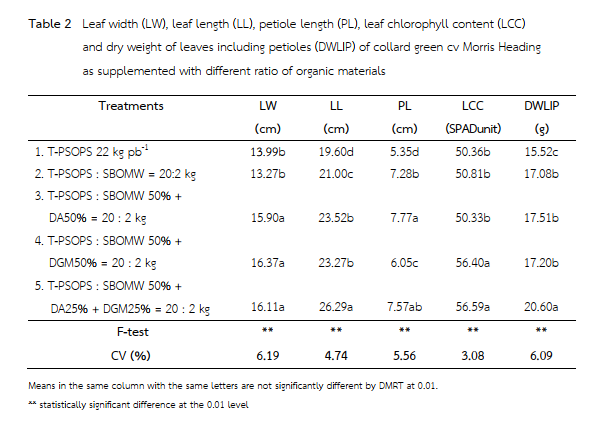
This study aimed to evaluate the effects of supplementing paddy soil, after three years of transition to organic rice farming (T-PSOPS), with composted spent Bhutan oyster mushroom waste (SBOMW) mixed with dried Azolla (DA) and dried goat manure (DGM) on the growth performance and phytochemical properties of collard green ‘Morris Heading’ grown in planting bags. The experiment employed a completely randomized design with five treatments and six replications. The treatments consisted of T-PSOPS (control) (T1); T1 + SBOMW at a ratio of 20:2 kg (T2); T1 + 50% SBOMW co-composted with 50% DA at a ratio of 20:2 kg (T3); T1 + 50% co-composted with 50% DGM at a ratio of 20:2 kg (T4); and T1 + 50% SBOMW co-fermented with 25% DA and 25% DGM at a ratio of 20:2 kg (T5). Results showed that the treatment with 50% SBOMW composted with 25% DA and 25% DGM yielded the highest leaf width (16.11±0.80 cm), leaf length (26.92±1.15 cm), leaf chlorophyll content (56.59±1.35 SPAD units), dry weight of leaves including petioles (20.60±0.90 g), total phenolic content (7.47±0.79 mg GAE g-1 DW), and antioxidant activity (4.72±0.44 mg VitC g-1 DW). Meanwhile, the mixture of 50% SBOMW and 50% DA produced the highest petiole length (7.77±0.39 cm) and total flavonoid content (45.81±2.74 mg QE g-1 DW). Therefore, the specific combinations of organic amendments into T-PSOPS were able to enhance both growth and phytochemical substances in collard green under planting bag conditions.
References
Akanda, K.I., A.K.M. Azad-ud-Doula Prodhan, S. Rahman, M.S. Alam and S. Afrin. 2012. Effect of nitrogen and potassium on morpho-physiological characteristics of fine grain aromatic rice. Journal of Agroforestry and Environment 6(1) : 99–103.
Alhasan, A.S. and D.T. Al-Ameri. 2021. Effects of macronutrient fertilization on plant growth, essential oil content, and chemical composition in medicinal and aromatic plants grown under different environmental conditions: a review. Natural Volatiles and Essential Oils 8(6): 2588–2601.
Amarowicz, R., B. Cwalina-Ambroziak, M.A. Janiak and B. Bogucka. 2020. Effect of N fertilization on the content of phenolic compounds in Jerusalem artichoke (Helianthus tuberosus L.) tubers and their antioxidant capacity. Agronomy 10(8): 1–12. https://doi.org/10.3390/agronomy10081215
Bravo, L. 1998. Polyphenols: chemistry, dietary sources, metabolism, and nutritional significance. Nutrition Reviews 56: 317–333.
Brojovic, B. and J. Stojanovic. 2005. Chlorophyll and carotenoid content in wheat cultivars as a function of mineral nutrition. Archives of Biological Science 57(4): 283–290.
Fritschi, F.B. and J.D. Ray. 2007. Soybean leaf nitrogen, chlorophyll content, and chlorophyll a/b ratio. Photosynthetica 45(1): 92–98.
Gardner, F.P., R.B. Pearce and R.L. Mitchell. 1985. Physiology of Crop Plants. Ames: Iowa State University Press. 327 p.
Hanif, M.A., H. Nawaz, M.A. Ayub, N. Tabassum, N. Kanwal, N. Rashid, M. Saleem and M. Ahmad. 2017. Evaluation of the effect of Zinc on the chemical composition and biological activity of basil essential oil by using Raman spectroscopy. Industrial Crops and Products 96: 91–101.
Hossain, Md. D., M.H. Musa, J. Talib and H. Jol. 2010. Effect of nitrogen, phosphorus and potassium levels on kenaf (Hisbicus cannabinus L.) growth and photosynthesis under nutrient solution. Journal of Agricultural Science 2(2): 49–57.
Idowu, O.O. and M. Kadiri. 2013. Growth and yield response of okra to spent mushroom compost from the cultivation of Pleurotus ostreatus an edible mushroom. Academia Journal of Agricultural Research 1(3): 39–44.
Jamaludin, A.A., N.Z. Mahmood and N. Abdullah. 2012. Waste recycling: feasibility of saw dust based spent mushroom substrate and goat manure in vermicomposting. Sains Malaysiana 4(11): 1445–1450.
Kadiri, M. and Y. Mustapha. 2010. The use of spent mushroom substrate of Lentinus subnudus (Berk) as a soi conditioner for vegetables. Bayero Journal of Pure and Applied Science 3: 16–19.
Kaewnarin, K., H. Niamsup, L. Shank and N. Rakariyatham. 2014. Antioxidant and antiglycation activities of some edible and medicinal plants. Chiang Mai Journal of Science 41(1): 105–116.
Kaewsuralikhit, S. and P. Thongraa. 2014. Study on Proportion of Azolla as Carrier for Phosphate Solubilizing Biofertilizer. 9 p. In Research Report. Bangkok: Department of Agriculture. [in Thai]
Kasote, D.M., S.S. Katyare, M.V. Hegde and H. Bae. 2015. Significance of antioxidant potential of plants and its relevance to therapeutic applications. International Journal of Biological Sciences 11(8): 982–991. https://doi.org/10.7150/ijbs.12096
Khatutshelo, M.V., N. Mpumelelo, N. Wonder and M.N. Fhatuwani. 2016. Effects of foliar spray application of selected micronutrients on the quality of bush tea. HorTScience 51(7): 873–879
Land Development Department. 2022. Series Cni soil series group15hi. Retrieved from https://iddindee.ldd.go.th/SoilSeries/Ch_3/16_Series_(Cni).pdf [in Thai]
Li, M., P.W. Paré, J. Zhang, T. Kang, Z. Zhang, D. Yang, K. Wank and H. Xing. 2018. Antioxidant capacity connection with phenolic and flavonoid content in chinese medicinal herbs. Record of Natural Products 12(3): 239–250.
Maeda, H. and N. Dudareva. 2012. The shikimate pathway and aromatic amino acid biosynthesis in plants. Annual Review of Plant Biology 63: 73–105. https://doi.org/10.1146/annurev-arplant-042811-105439
Mengel, K. and E.A. Kirby. 2001. Principle of Plant Nutrition. 5th Ed. Dordrecht, The Netherlands: Kluwer Academic Publishers. 849 p.
Mohr, H. and P. Schopfer. 1995. Plant Physiology. Berlin: Springer-Verlag. 629 p.
Naguib, A. E-M. M., F.K. El-Baz, Z.A. Salaman, H.A.E.B. Hanaa, H.F. Ali and A.A. Gaafar. 2012. Enhancement of phenolics, flavonoids and glucosinolates of Broccoli (Brassica oleracea var. Italica) as antioxidants in response to organic and bio-organic fertilizers. Journal of the Saudi Society of Agricultural Sciences 11(2): 135–142.
Obidola, S.M., I.I. Iro and Z.A. Rebeca. 2019. Influence of organic manure and inorganic fertilizer on the growth, yield and phytochemical constituents of cabbage (Brassica oleracea). Asian Journal of Agricultural and Horticultural Research 4(1): 1–9.
Office of Science for Land Development. 2024. Average amount of nutrients in different types of dry animal manure. Retrieved from https://worldsoilday.ldd.go.th/Data/3_poster/th/poster_TH4_6364b60bcb6fb.pdf [in Thai]
Osotsapa, Y. 2000. Plant Nutrients. 1st Ed. Bangkok: Kasetsart University Press. 424 p. [in Thai]
Panhwar, Q.A., U.A. Naher, O. Radziah, J. Shamshuddin, I. Mohd Razi, S.S. Dipti and M.T. Karabalei Aghamolki. 2015. Quality and antioxidant activity of rice grown on alluvial soil amended with Zn, Cu and Mo. South African Journal of Botany 98: 77–83.
Sakunasing, P. and K. Kangsadalampai. 2008. Different antimutagenicity against urethane between conventionally and organically grown cruciferous vetgetables (Brassica spp.). Thai Journal of Toxicology 23(2): 126–134.
Saltveit, M.E. 2010. Synthesis and Metabolism of Phenolic Compounds. pp. 89–100. In de la Rosa, L.A., E. Alvarez-Parrilla and G.A. González-Aguilar (eds.). Fruit and Vegetable Phytochemicals: Chemistry, Nutritional Value, and Stability. Ames, Iowa: Wiley-Blackwell.
Stephen, J.M. 1994. Collards-Brassica oleracea L. (Acephala group). Retrieved from https://edis.ifas.ufl.edu/publication/MV053.
Stern, K.R., S. Jansky and J.E. Bidlack. 2003. Introductory Plant Biology. 9th Ed. New York: McGraw-Hill. 624 p.
Tohge, T., M. Watanabe, R. Hoefgen and A.R. Fernie. 2013. Shikimate and phenylalanine biosynthesis in the green lineage. Frontiers in Plant Science 4: 1–13. https://doi.org/10.3389/fpls.2013.00062
Trakoonyingcharoen, P. 2021. Potassium for Plant Growth. Thai Journal of Soils and Fertilizers 43(1): 10–27. [in Thai]
Treutter, D. 2010. Managing phenol contents in crop plants by phytochemical farming and breeding - visions and constraints. International Journal of Molecular Sciences 11(3): 807–857
Vetrano, F., A. Miceli, A. Moncada, G. Mutazza and C. Romando. 2013. Collard green (Brassica oleracea var. acephala) cultivation in Sicily. Acta Hortic 1005: 471–477. https://doi.org/10.17660/AactaHtortic.2013.1005.57
Yingngam, B., M. Monschein and A. Brantner. 2014. Ultrasound-assisted extraction of phenolic compounds from Cratoxylum formosum ssp. formosum leaves using central composite design and evaluation of its protective ability against H¬2O¬¬¬2-incuced cell death. Asian Pacific Journal of Tropical Medicine 7(Suppl. 1): 5497–5505.
Downloads
Published
How to Cite
Issue
Section
License
Copyright (c) 2026 Journal of Agricultural Research and Extension

This work is licensed under a Creative Commons Attribution-NonCommercial-NoDerivatives 4.0 International License.
This article is published under a Creative Commons Attribution-NonCommercial-NoDerivatives 4.0 International License (CC BY-NC-ND 4.0), which allows others to share the article with proper attribution to the authors and prohibits commercial use or modification. For any other reuse or republication, permission from the journal and the authors is required.


