
Hydrolysis-Enhanced Cricket (Acheta domesticus) Proteins with Improved Antioxidant Capacity and Inhibitory Effects on Enzymes Related to Obesity and Type 2 Diabetes
DOI:
https://doi.org/10.14456/jare-mju.2026.18Keywords:
hydrolysis, cricket protein, obesity, type 2 diabetes, antioxidant activityAbstract
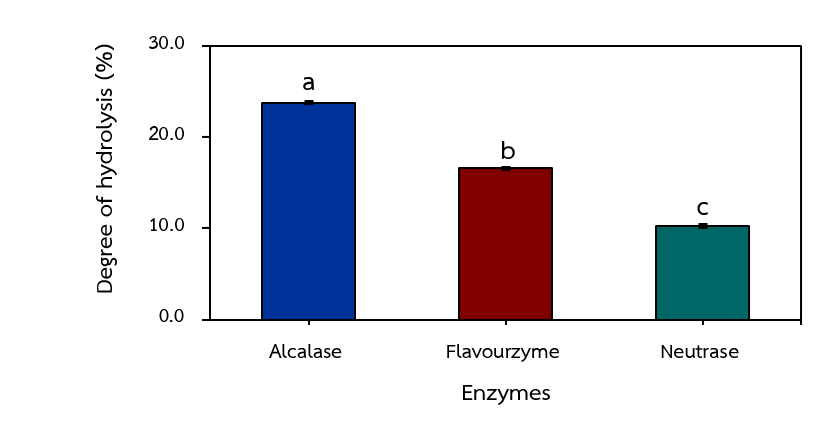
This study aimed to enhance the functional and bioactive properties of house-cricket (Acheta domesticus) proteins via enzymatic hydrolysis. Three enzymes, Alcalase, Flavourzyme, and Neutrase, were evaluated and compared based on their antioxidant activity and their ability to inhibit carbohydrate-metabolizing enzymes (DPP-IV, alpha-amylase, alpha-glucosidase). Hydrolysates produced with Alcalase exhibited the highest degree of hydrolysis (DH=22.36%) and the greatest proportion of low–molecular-weight peptides (<3 kDa), resulting in superior activities, i.e., lower EC50 values in antioxidant assays and lower IC50 values against the target enzymes, relative to Flavourzyme- and Neutrase-derived hydrolysates. These findings indicate a positive association between DH/low-MW peptide proportion and the bioactivity of cricket protein hydrolysates under the present conditions. Collectively, the results identified Alcalase as the most promising protease for upgrading the nutritional value and enhancing the biofunctional efficacy of cricket proteins, supporting their application as ingredients in functional foods or nutraceutical formulations.
References
Antony, P. and R. Vijayan. 2021. Bioactive peptides as potential nutraceuticals for diabetes therapy: a comprehensive review. International Journal of Molecular Sciences 22(16): 9059.
Anyasi, T.A., P. Acharya and C.C. Udenigwe. 2025. Edible insects as an alternative protein source: nutritional composition and global consumption patterns. Future Foods 12: 100699.
Chanadang, S., S. Mingyai, P. Charoenthaikij, K. Sathapornprasath, Y. Supan, D. Wayupap and T. Itthisoponkul. 2024. Topic: physicochemical, functional and antioxidant properties of cricket protein powders produced by microwave-assisted spouted bed drying. Future Foods 10: 100480.
Czelej, M., K. Garbacz, T. Czernecki, J. Wawrzykowski and A. Wasko 2022. Protein hydrolysates derived from animals and plants-a review of production methods and antioxidant activity. Foods 11(13): 1953.
Hamad, A. and A. Tayel. 2025. Food 2050 concept: trends that shape the future of food. Journal of Future Foods 6(6): 1053–1066.
Ma, Z., M. Mondor, F.G. Valencia and Hernández- A.J. Alvarez. 2023. Current state of insect proteins: extraction technologies, bioactive peptides and allergenicity of edible insect proteins. Food & Function 14(18): 8129–8156.
Mishyna, M., J.K. Keppler and J. Chen. 2021. Techno-functional properties of edible insect proteins and effects of processing. Current Opinion in Colloid & Interface Science 56: 101508.
Patil, P., S. Mandal, S.K. Tomar and S. Anand. 2015. Food protein-derived bioactive peptides in management of type 2 diabetes. European Journal of Nutrition 54(6): 863–880.
Sangsawad, P., S. Katemala, D. Pao, S. Suwanangul, R. Jeencham and M. Sutheerawattananonda. 2022. Integrated evaluation of dual-functional DPP-IV and ACE inhibitory effects of peptides derived from sericin hydrolysis and their stabilities during in vitro-simulated gastrointestinal and plasmin digestions. Foods 11(23): 3931.
Suwanangul, S., M.A. Alashi, R.E. Aluko, W. Tochampa and K. Ruttarattanamongkol, 2021. Inhibition of α-amylase, α-glucosidase and pancreatic lipase activities in vitro by sacha inchi (Plukenetia volubilis L.) protein hydrolysates and their fractionated peptides. Maejo International Journal of Science and Technology 15(1): 13–26.
Suwanangul, S., P. Sangsawad, M.A. Alashi, R.E. Aluko, W. Tochampa, S. Chittrakorn, and K. Ruttarattanamongkol. 2021. Antioxidant activities of sacha inchi (Plukenetia volubilis L.) protein isolate and its hydrolysates produced with different proteases. Maejo International Journal of Science and Technology 15(1): 48–60.
Suwanangul, S. and K. Ruttarattanamongkol. 2022. Antioxidant and biochemical properties of protein hydrolysates prepared from Sacha Inchi meal. Journal of Agricultural Research and Extension 39(2): 55–67. [in Thai]
Suwanangul, S., P. Jaichakan, N. Narkprasom, S. Kraithong, K. Narkprasom and P. Sangsawad. 2023. Innovative insights for establishing a synbiotic relationship with Bacillus coagulans: viability, bioactivity, and In Vitro-simulated gastrointestinal digestion. Foods 12(19): 3692.
Suwanangul, S., K. Arkanit, S. Kraithong, W. Sorndech, S. Tastub, N. Rungraeng and P. Sangsawad. 2025. Impact of an innovative two-step temperature-controlled accelerated germination process on phytochemical enhancement, digestibility, and morphological changes in colored rice. Food Chemistry 478: 143558.
Suwanangul, S., N. Rungraeng, S. Phongthai, R. Chen, H. Corke, Y. Ai and P. Sangsawad. 2025. Effects of pressure-cooking and freeze-drying on the quality and functionality of instant black rice: starch crystallinity, bioactive properties, and digestibility. International Journal of Biological Macromolecules 318(1): 144754.
Downloads
Published
How to Cite
Issue
Section
License
Copyright (c) 2026 Journal of Agricultural Research and Extension

This work is licensed under a Creative Commons Attribution-NonCommercial-NoDerivatives 4.0 International License.
This article is published under a Creative Commons Attribution-NonCommercial-NoDerivatives 4.0 International License (CC BY-NC-ND 4.0), which allows others to share the article with proper attribution to the authors and prohibits commercial use or modification. For any other reuse or republication, permission from the journal and the authors is required.


