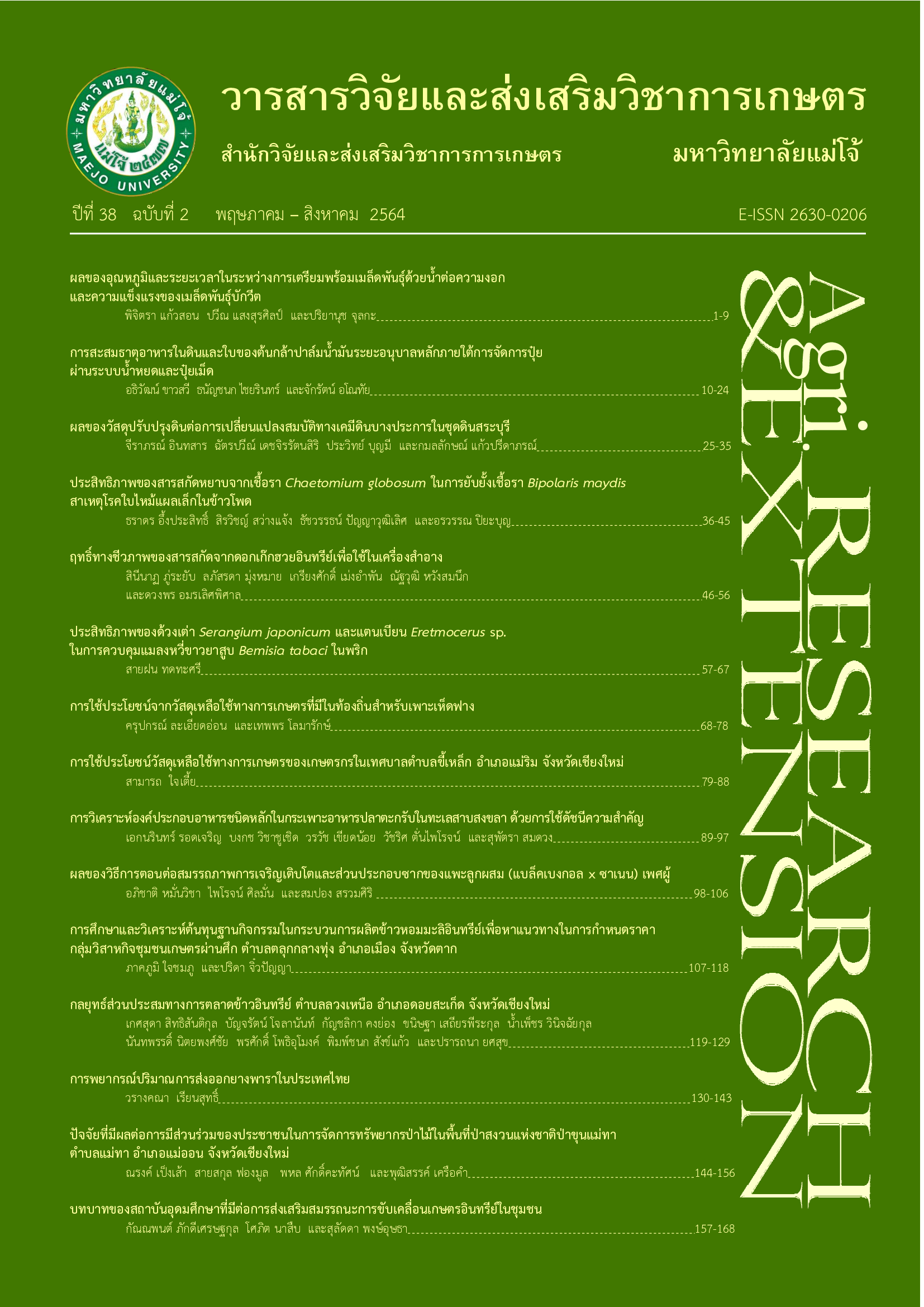
ฤทธิ์ทางชีวภาพของสารสกัดจากดอกเก๊กฮวยอินทรีย์เพื่อใช้ในเครื่องสำอาง
คำสำคัญ:
เก๊กฮวย, สารชีวภาพ, สารต้านอนุมูลอิสระ, สารประกอบในเครื่องสำอางบทคัดย่อ
ดอกเก๊กฮวยมีสารออกฤทธิ์ทางชีวภาพจึงได้รับความนิยมนำมาผลิตเป็นเครื่องดื่มสมุนไพรในแถบเอเชีย ส่วนการนำดอกเก๊กฮวยมาเพิ่มมูลค่าเป็นผลิตภัณฑ์เครื่องสำอางยังพบอยู่น้อยมาก ดังนั้นงานวิจัยนี้จึงมีวัตถุประสงค์เพื่อประเมินสารชีวภาพและฤทธิ์ทางชีวภาพของดอกเก๊กฮวยอินทรีย์ที่มีประโยชน์ต่อการชะลอวัย โดยทำการสกัดดอกเก๊กฮวยอินทรีย์แห้งด้วยน้ำและตรวจหาสารสำคัญ จากนั้นนำไปทดสอบฤทธิ์ชะลอวัย ได้แก่ ฤทธิ์ขจัดอนุมูลอิสระ ฤทธิ์ยับยั้งเอนไซม์คอลลาจิเนส และไทโรซิเนส ผลการทดลองพบว่า สารสกัดดอกเก๊กฮวยอินทรีย์มีองค์ประกอบสำคัญของสารประกอบฟีนอลิก ฟลาโวนอยด์ และเคอร์ซิติน เท่ากับ 72.28 mgGAE, 16.54 mgQE และ 402.47 mg/kg ตามลำดับ นอกจากนี้ยังมีประสิทธิภาพในการขจัดอนุมูลอิสระเอบีทีเอส ดีพีพีเอช และซุปเปอร์ออกไซด์ โดยมีค่าการยับยั้งอนุมูลดังกล่าวได้ 50% (IC50) เท่ากับ 0.22, 0.32 และ 9.39 mg/ml ตามลำดับ รวมทั้งยังสามารถยับยั้งเอนไซม์คอลลาจิเนสและไทโรซิเนสได้ มีค่า IC50 เท่ากับ 2.33 และ 102.11 mg/ml ตามลำดับ
ผลการศึกษาครั้งนี้แสดงให้เห็นว่าสารสกัดด้วยน้ำจากดอกเก๊กฮวยอินทรีย์เป็นสารออกฤทธิ์ทางชีวภาพช่วยต้านอนุมูลอิสระและช่วยป้องกันการเสื่อมสภาพของผิวหนังได้ โดยการเพิ่มมูลค่าให้กับดอกเก๊กฮวยอินทรีย์เป็นสารประกอบเชิงหน้าที่หรือใช้เป็นสารผสมในผลิตภัณฑ์เครื่องสำอางจะช่วยเพิ่มทางเลือกและรายได้ให้แก่เกษตรกรผู้เพาะปลูก รวมทั้งผู้ประกอบการด้านเครื่องสำอางอีกทางหนึ่ง
เอกสารอ้างอิง
Anitha, T. 2012. Medicinal plants used in skin protection. Asian J Pharm Clin Res. 5(2): 35-38.
Cheng, W., J. Li, T. You and C. Hu. 2005. Anti-inflammatory and immunomodulatory activities of the extracts from the inflorescence of Chrysanthemum indicum Linné. J Ethnopharmacol 101(1-3): 334-337.
Choi, M.H. and H.J. Shin. 2015. Anti-melanogenesis effect of quercetin. Cosmetics 3(2): 18.
Choi, K.T., J.H. Kim, H.T. Cho, S.S. Lim, S.S. Kwak and Y.J. Kim. 2016. Dermatologic evaluation of cosmetic formulations containing Chrysanthemum indicum extract. J Cosmet Dermatol. 15(2): 162-168.
Costa, R. and L. Santos. 2017. Delivery systems for cosmetics−from manufacturing to the skin of natural antioxidants. Powder Technol 322: 402-416.
D’Orazio, J., S. Jarrett, A. Amaro-Ortiz and T. Scott. 2013. UV radiation and the skin. Int J Mol Sci 14: 12222-12248.
Hammerschmidt, P.A. and D.E. Pratt. 1978. Phenolic antioxidants of dried soybeans. J Food Sci 43(2): 556-559.
Kanlayavattanakul, M. 2016. Herbs for Cosmetics: Anti-Wrinkle. Bangkok: Protexts Press. 118 p. [in Thai]
Kim, Y.J. 2012. Hyperin and quercetin modulate oxidative stress−induced melanogenesis. Biol Pharm Bull. 35(11): 2023-2027.
Kim, Y.J.. 2016. Extracts of Chrysanthemum indicum Linne mediated regulation of MMP1 via JNK−AP1 pathway. Asian J Beauty Cosmetol 14(4): 399-405.
Leelapornpisid, P., S. Chansakaow, S. Na-Boonlong and P. Jantrawut. 2014. Development of cream containing nanostructured lipid carriers loaded marigold (Tagetes erecta Linn) flowers extract for anti-wrinkles application. Int J Pharm Pharm Sci 6(5): 309-313.
Limtrakul, P., S. Yodkeeree, P. Thippraphan, W. Punfa and J. Srisomboon. 2016. Anti-aging and tyrosinase inhibition effects of Cassia fistula flower butanolic extract. BMC Complement Altern Med. 16: 497.
Malinowska, P. 2013. Effect of flavonoids content on antioxidant activity of commercial cosmetic plant extracts. Herba Pol. 59(3): 63-75.
Masuda, T., D. Yamashita, Y. Takeda and S. Yonemori. 2005. Screening for tyrosinase inhibitors among extracts of seashore plants and identification of potent inhibitors from Garcinia subelliptica. Biosci Biotechnol Biochem. 69(1): 197-201.
Mensor, L.L., F.S. Menezes, G.G. Leitão, A.S. Reis, T.C.D. Santos, C.S. Coube and S.G. Leitão. 2001. Screening of Brazilian plant extracts for antioxidant activity by the use of DPPH free radical method. Phytother Res 15(2): 127-130.
Nishikimi, M., N.A. Rao, K. Yagi. 1972. The occurrence of superoxide anion in the reaction of reduced phenazine methosulfate and molecular oxygen. Biochem Biophy. Res Commun 46(2): 849-854.
Peñarrieta, J.M., J.A. Alvarado, B. Akesson and B. Bergenståhl. 2007. Separation of phenolic compounds from foods by reversed-phase high performance liquid chromatography. Revista Boliviana de Química 24(1): 1-4.
Rawdkhao, T. 2017. Production promotion of organic Chrysanthemum indicum L. 7 p. In Research Report. Chiang Mai: Maejo University. [in Thai]
Re, R., N. Pellegrini, A. Proteggente, A. Pannala, M. Yang and C. Rice-Evans. 1999. Antioxidant activity applying an improved ABTS radical cation decolorization assay. Free Radic Biol Med 26(9-10): 1231-1237.
Ribeiro, A.S., M. Estanqueiro, M.B. Oliveira and J.M.S. Lobo. 2015. Main benefits and applicability of plant extracts in skin care products. Cosmetics 2(2): 48-65.
Sasikumar, V. and P. Kalaisezhiyen. 2014. Evaluation of free radical scavenging activity of various leaf extracts from Kedrostis foetidissima (Jacq.) Cogn. Biochem Anal Biochem 3(2): 7.
Soto, M., E. Falqué and H. Domínguez. 2015. Relevance of natural phenolics from grape and derivative products in the formulation of cosmetics. Cosmetics 2(3): 259-276.
Stanković, M.S. 2011. Total phenolic content, flavonoid concentration and antioxidant activity of Marrubium peregrinum L. extracts. Kragujevac J. Sci 33: 63-72.
Tungmunnithum, D., A. Thongboonyou, A. Pholboon and A. Yangsabai. 2018. Flavonoids and other phenolic compounds from medicinal plants for pharmaceutical and medical aspects: an overview. Medicines 5(3): 93.
Whangsomnuek, N., L. Mungmai,K. Mengamphan and D. Amornlerdpison. 2019. Efficiency of skin whitening cream containing Etlingera elatior flower and leaf extracts in volunteers. Cosmetics 6(3): 39.
Zakiah, K., E. Anwar and T. Nurhayat. 2018. In-vitro evaluation of antioxidant activity and anti-collagenase activity of Thalassia hempricii as a potent ingredients for anti-wrinkle cosmetics. Pharmacogn J 10(4): 778-782.
Zolghadri, S., A. Bahrami, M.T.H. Khan, J. Munoz-Munoz, F. Garcia-Molina, F. Garcia-Canovas and A.A. Saboury. 2019. A comprehesive review on tyrosinase inhibitors. Enzyme Inhib Med. Chem 34(1): 279-309.
ดาวน์โหลด
เผยแพร่แล้ว
รูปแบบการอ้างอิง
ฉบับ
ประเภทบทความ
สัญญาอนุญาต
บทความนี้ได้รับการเผยแพร่ภายใต้สัญญาอนุญาต Creative Commons Attribution-NonCommercial-NoDerivatives 4.0 International (CC BY-NC-ND 4.0) ซึ่งอนุญาตให้ผู้อื่นสามารถแชร์บทความได้โดยให้เครดิตผู้เขียนและห้ามนำไปใช้เพื่อการค้าหรือดัดแปลง หากต้องการใช้งานซ้ำในลักษณะอื่น ๆ หรือการเผยแพร่ซ้ำ จำเป็นต้องได้รับอนุญาตจากวารสาร