
ผลของการใช้เชื้อรา Beauveria bassiana ท้องถิ่นต่อการควบคุมเพลี้ยไก่แจ้ Allocaridala maleyensis (Crawford) ในพื้นที่ปลูกทุเรียนภาคตะวันออก
Article Sidebar
Main Article Content
บทคัดย่อ
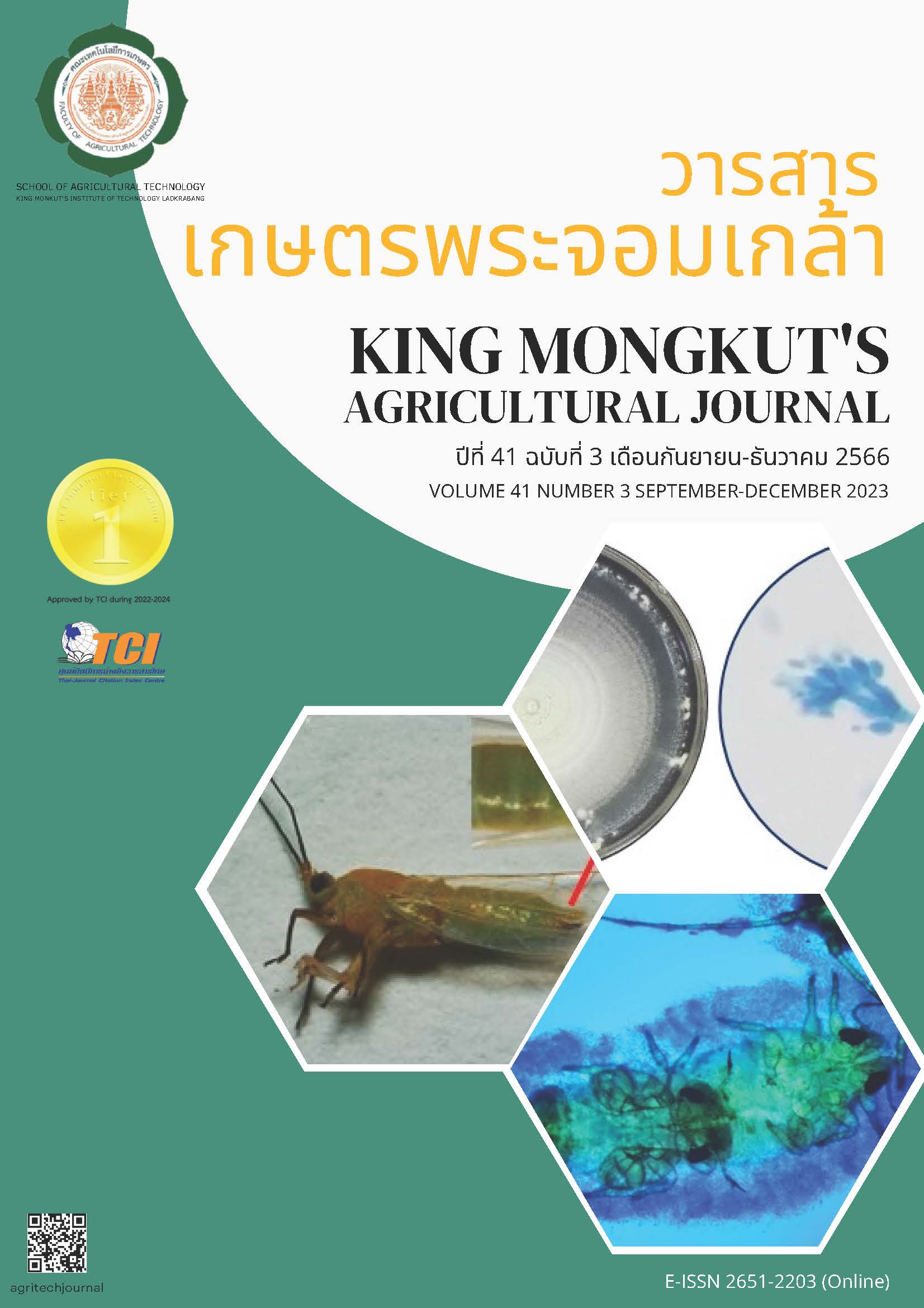
ปัญหาการแพร่ระบาดของเพลี้ยไก่แจ้ในแปลงปลูกทุเรียนสร้างผลกระทบอย่างมากต่อเกษตรกรผู้ปลูกทุเรียน เพราะเพลี้ยไก่แจ้สามารถเข้าทำลายทุเรียนได้แทบทุกระยะตั้งแต่เริ่มสร้างใบอ่อนจนกระทั่งเก็บผลผลิต จึงเป็นสิ่งจำเป็นที่จะต้องมีการคัดเลือกเชื้อรากินแมลงท้องถิ่นที่มีศักยภาพในการช่วยควบคุมเพลี้ยไก่แจ้ในแปลงปลูกทุเรียน ของเกษตรกร โดยงานวิจัยนี้มีวัตถุประสงค์เพื่อทดสอบประสิทธิภาพของเชื้อรา Beauveria bassiana ท้องถิ่น ต่อการควบคุมเพลี้ยไก่แจ้ในพื้นที่ปลูกทุเรียนภาคตะวันออก เริ่มจากการเก็บตัวอย่างแมลงศัตรูพืชในสวนทุเรียน จำนวน 3 จังหวัด คือ จันทบุรี ตราด และ ระยอง จากนั้นนำแมลงศัตรูพืชที่เก็บได้มาแยกเชื้อรากินแมลงและจัดจำแนกทางสัณฐานวิทยาของเชื้อรา พบว่าเกิดจากเชื้อรา B. bassiana จึงนำเชื้อราที่แยกได้มาทดสอบประสิทธิภาพในการควบคุมเพลี้ยไก่แจ้ โดยประเมินจาก เปอร์เซ็นต์การตายของเพลี้ยไก่แจ้ ซึ่งแบ่งการทดสอบออกเป็น 2 ส่วน คือ ระยะตัวอ่อนทดสอบกับใบ และระยะตัวเต็มวัย ทดสอบกับยอดอ่อนของทุเรียน ผลการทดลองพบว่า เชื้อรา B. bassiana ทั้ง 3 ระดับความเข้มข้น 104, 106 และ 108 สปอร์ต่อมิลลิลิตร สามารถยับยั้งการเจริญของเพลี้ยไก่แจ้ได้ทั้งหมด โดยระดับความเข้มข้น 108 สปอร์ต่อมิลลิลิตร มีเปอร์เซ็นต์การตายของเพลี้ยไก่แจ้ระยะตัวอ่อนและตัวเต็มวัยสูงที่สุด มีค่าเท่ากับ 100 และ 88 เปอร์เซ็นต์ตามลำดับ โดยสรุปจากการใช้เชื้อรา B. bassiana ท้องถิ่นควรต้องฉีดพ่นกับเพลี้ยไก่แจ้ในระยะตัวอ่อนดีกว่าฉีดพ่นในระยะตัวเต็มวัย เพราะยังอ่อนแอต่อการเข้าทำลายของเชื้อรากินแมลง
Article Details

อนุญาตภายใต้เงื่อนไข Creative Commons Attribution-NonCommercial-NoDerivatives 4.0 International License.
วารสารเกษตรพระจอมเกล้า
เอกสารอ้างอิง
Anutrakunchai, S., Tongla, T. & Thongkamngam, T. (2019). A Survey of Shot-Hole Borer (Xyleborus fornicates Eichoff) Scolytidae: Coleoptera-an Insect pest on durian in chanthaburi province. In Proceedings of 3rd International Symposium on Agricultural Technology and 17th International Symposium on Biocontrol and Biotechnology. (pp. 118-123). Bangkok: King Mongkut's Institute of Technology Ladkrabang.
Boston, W., Leemon, D. & Cunningham, J. P. (2020). Virulence screen of Beauveria bassiana isolates for Australian Carpophilus (Coleoptera: Nitidulidae) beetle biocontrol. Agronomy. 10, 1207.
Bukhari, T., Takken, W. & Koenraadt, C. J. M. (2011). Development of Metarhizium anisopliae and Beauveria bassiana formulations for control of malaria mosquito larvae. Parasites & Vectors. 4(1), 23-37.
Burckhardt, D., Ouvrard, D., Queiroz, D. & Percy, D. (2014). Psyllid host-plants (Hemiptera: Psylloidea): Resolving a semantic problem. Florida Entomologist. 97(1), 242-246.
Butler, C. D. & Trumble, J. T. (2012). The potato psyllid, Bactericera cockerelli (Sulc) (Hemiptera: Triozidae): Life history, relationship to plant diseases, and management strategies. Terrestrial Arthropod Reviews. 5(2), 87-111.
Dowd, P. E. & Vega, F. E. (2003). Autodissemination of Beauveria bassiana by Sap Beetle (Coleopterra: Nitidulidae) to overwintering sites. Biocontrol Science and Technology. 13, 65-75.
Erler, F. & Ates, A. O. (2015). Potential of two entomopathogenic fungi, Beauveria bassiana and Metarhizium anisopliae (Coleoptera: Scarabaeidae), as biological control agents against the June beetle. Journal of Insect science. 15(1), 44-62.
Fabrice, D. H., Elie, D. A., Kobi, D. O., Valerien, Z. A., Thomas, H. A., Joelle, T., Maurille, E. I. A. T., Denis, O. B. & Manuele, T. (2020). Toward the efficient use of Beauveria bassiana in integrated cotton insect pest management. Journal of Cotton Research. 3, 24-45.
Hodkinson, I. D. & Bird, J. M. (2006). Facultative parthenogenesis in Cacopsylla myrtilli (Wagner) (Hemiptera: Psylloidea) in northern Sweden. Entomologisk Tidskrift. 127, 157-160.
Hodkinson, I. D. (2009). Life cycle variation and adaptation in jumping plant lice (Insecta:Hemiptera: Psylloidea): a global synthesis. Journal of Natural History. 43(1-2), 65-179.
Humber, R. (1997). Fungi: identification. In Lacey, L. A., Manual of Technique in Insect pathology. (pp. 153-163). San Diego: Academic Press.
Lee, T. J., Zobayed, S., Firmani, F. & Park, E. (2019). A novel automated transplanting system for plant tissue culture. Biosystems Engineering. 181, 63-72.
Mascarin, G. M. & Jaronski, S. T. (2016). The production and uses of Beauveria bassiana as a microbial insecticide. World Journal of Microbiology and Biotechnology. 32, 177-203.
Mascarin, G. M., Lopes, R. B., Delalibera, I. D., Fernandes, E. K. K, Luz, C. & Faria, M. (2019). Current status and perspectives of fungal entomopathogens used for microbial control of arthropod pests in Brazil. Journal of Invertebrate Pathology. 165, 46-53.
Muerrle, T. M., Neumann, P., Dames, J. F., Hepburn, H. P. & Hill, H. P. (2006). Susceptibility of adult Aethina tumida (Coleoptera: Nitidulidae) to entomopathogenic fungi. Journal of Economic Entomology. 99, 1-6.
Samson, R., Evans, H. & Latge, J. P. (1988). Atlas of Entomopathologenic fungi. Berlin: Springer Verlag.
Ullah, M. I., Arshad, M., Abdullah, A., Khalid, S., Iftikhar, Y. & Zahid, A. M. (2018). Use of the entomopathogenic fungi Beauveria bassiana (Hyphomycetes: Moniliales) and Isaria fumosorosea (Hypocreales: Cordycipitaceae) to control Diaphorina citri Kuwayama (Hemiptera: Liviidae) under laboratory and semi-field conditions. Egyptian Journal of Biological Pest Control. 28, 75-80.
Zapata, Q. I., Gonzalez, F. M. S., Santillana, L. E. J., Gonzalez, N. A. & Pacheco, G. F. L. (2020). Late effects of Beauveria bassiana on larval stages of Aedes aegypti Linneo, 1762 (Diptera: Culicidae). Brazilian Journal of Biology. 82, 1-8.
