
The Online Marketing Communication Model of Organic Agricultural Products for Community Enterprises
Article Sidebar
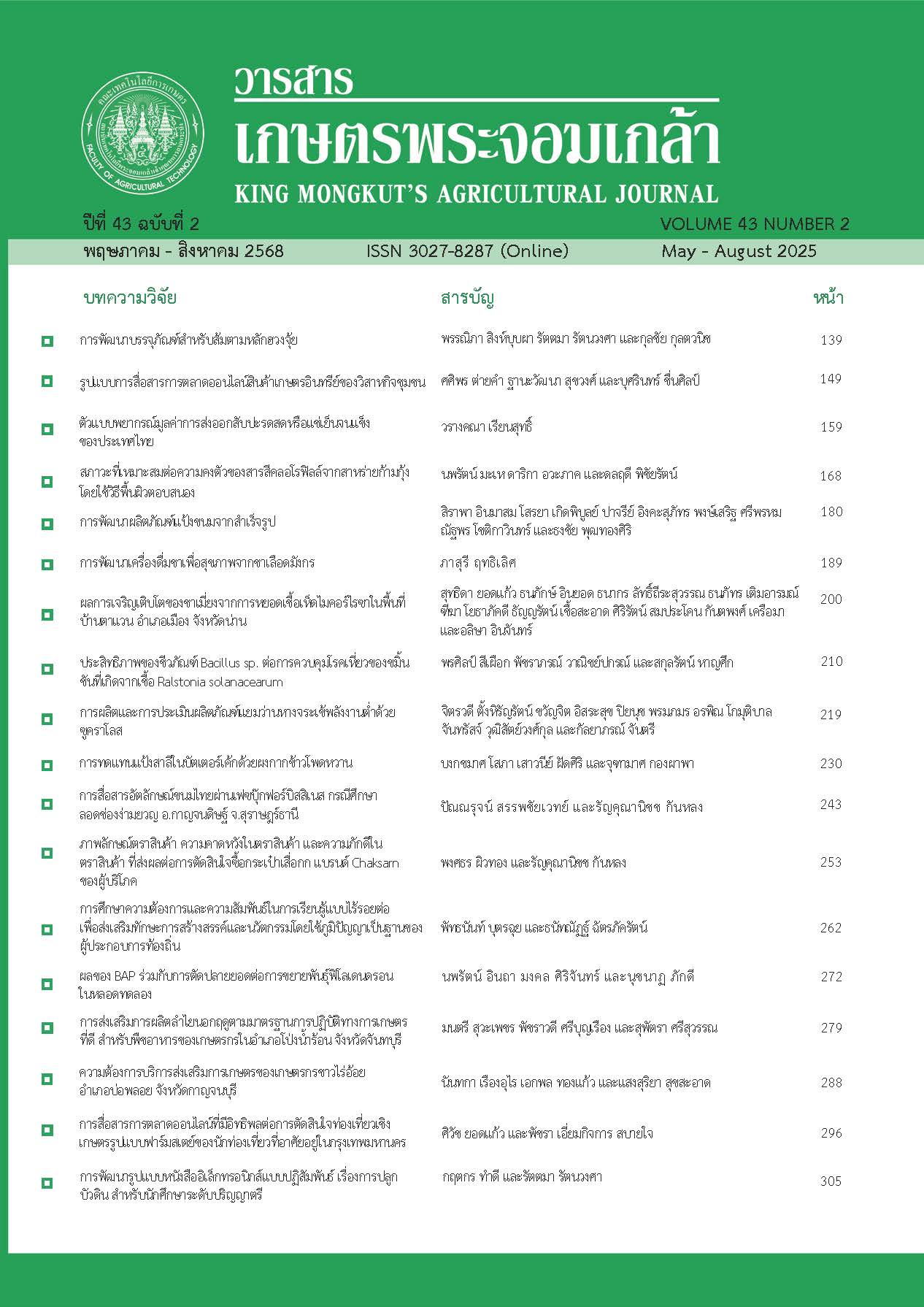
Main Article Content
Abstract
Selling products online is popular nowadays, but most agricultural community enterprises rarely sell products online. Therefore, it is necessary to study the causes and develop an online marketing communication model through research and development. The objectives are to: (1) study basic information for the development of an online marketing communication model of organic agricultural products for community enterprises by conducting in-depth interviews with 20 key informants and surveying the trust of 343 consumers, (2) develop an online marketing communication model of organic agricultural products for community enterprises, and (3) experiment with and improve the online marketing communication model of organic agricultural products for community enterprises. The basic data study found that some community enterprises lack knowledge of online marketing communications. Consumers attach great importance to online marketing communication factors (mean = 4.20, SD = 0.70). The results of simple linear regression analysis found that the content factor (𝛃 = 0.53, t =4.70, p-value =.00) and the communication channel factor (𝛃 0.3, t = 3.87, p-value =.00) have a statistically significant effect on consumers' trust in online marketing communication at .05. The data were then used to develop the online marketing communication model of organic agricultural products for community enterprises, which consists of (1) farmers who have knowledge of online marketing communications, have content creation skills, produce products that meet organic standards, are honest, and form groups to sell online; (2) content related to products and consumers, which should be useful, relevant to consumers' interests, on point, trustworthy, attractive with storytelling and regularly updated content; (3) online communication channels, which are easy to use, convenient, fast, and low-cost; (4) the electronic commerce process that is complete in every step; (5) consumers who are aware and knowledgeable about food safety, organic agricultural standards; and (6) feedback. The model was evaluated by experts as appropriate and practical. The experimental group was satisfied with the model.
Article Details

This work is licensed under a Creative Commons Attribution-NonCommercial-NoDerivatives 4.0 International License.
King Mongkut's Agricultural Journal
References
Chatzoglou, P., & Chatzoudes, D. (2016). Factors affecting e-business adoption in SMEs: an empirical research. Journal of Enterprise Information Management, 29(3), 327-358.
Community Enterprise Promotion Division. (2023). Summary of the Number of Community Enterprises and Community Enterprise Networks Approved for Registration. Community Enterprise Promotion Division. (in Thai).
Gallego, M. D., Bueno, S., & López-Jiménez, D. (2016). Impact of B2C e-commerce codes of conduct on sales volume: lessons from the Spanish perspective. Journal of Business & Industrial Marketing, 31(3), 381–392.
Hanna, N. K. (2016). E-commerce as a techno-managerial innovation ecosystem: Policy implications. Journal of Innovation Management, 4(1), 4-10.
Jambulingamis, M., Sumathi, C., & Rajagopal, G. (2015). Barriers of Venturing into Facebook Commerce among SMEs. Journal of Internet Banking and Commerce, 21(Suppl.2), 1-9.
Kanchanopast, S. (2011). The Factors Influencing Successful Implementation of E Commerce to Create Competitive Advantage, within SME Businesses. Suan Sunandha Rajabhat University. (in Thai).
Kasikorn Research Center. (2018). Organic Market: Thai SME Money Generating Business. Kasikorn Research Center. (in Thai).
Kull, K. (2007). The Model of Internet-Based Marketing Communication, Mattimar. Retrieved from: https://www.semanticscholar.org/paper/THE-MODEL-OF-INTERNET-BASED-MARKETING-COMMUNICATION-Kull/3e92ebe4a76db2af27b345137867e1e6c286e325.
Ministry of Agriculture and Cooperatives. (2022). Agriculture and Cooperatives Action Plan 2023-2027. Retrieved from: https://www.opsmoac.go.th/phichit-dwl-files-442991791932. (in Thai).
Nastasi, B. K., & Schensul, S. L. (2005). Contributions of qualitative research to the validity of intervention research. Journal of School Psychology, 43(3), 177-195.
National Statistical Office. (2016). Report of the Labor Force Survey Whole Kingdom. Retrieved from: http://service.nso.go.th/nso/nsopublish/themes/files/lfs59/reportJun.pdf. (in Thai).
Office of the National Economic and Social Development Council. (2022). The thirteenth national economic and social development plan (2023-2027). Thai Government Gazette, 139(258), 6-9. (in Thai).
Panyakul, W. (2016). Overview of Thai Organic Agriculture 2015: Sai Jai Phaendin Foundation. Retrieved from: http://www.greennet.or.th/sites/default/files/Thai%20OA%2015.pdf. (in Thai).
Ramayah, T., Ling, N. S., Taghizadeh, S. K., & Rahman, A. (2016). Factors influencing SMEs website continuance intention in Malaysia. Telematics and Informatics, 33(1), 150–164.
Theeranithiwat, K. (2016). Online Vs Offline marketing. Retrieved from: http://www.ifarm.in.th/index.php?option=com_content&view=article&id=736:online-vs-offline-marketing. (in Thai).
Vongsraluang, N., & Bhatiasevi, V. (2016). The Determinants of Social Commerce System Success for SMEs in Thailand. Mahidol University International College. (in Thai).
Wanga, W. T., Wanga Y. S., & Liuc, E. R. (2016). The stickiness intention of group-buying websites: The integration of the commitment–trust theory and e-commerce success model. Information & Management, 53(5), 625-642.
Yang, T. A., Kim, D. J., Dhalwani, V., & Vu, T. K. (2008). The 8C framwork as a reference model for collaborative value webs in the context of web 2.0. In Proceedings of the 41st Hawaii International Conference on System Sciences – 2008, pp. 1-10. University of Hawaii at Manoa.
Yenyodwichai, P. (2015). Social Media and Agricultural Product Marketing Channel, Technology Chao Ban. Retrieved from: http://www.technologychaoban.com/news_detail.php?tnid=1746. (in Thai).
Young, L. (2011). The Marketer’s Handbook: Reassessing Marketing Techniques for Modern Business. John Wiley & Sons.
