
ประสิทธิภาพของจุลินทรีย์ปฏิปักษ์ต่อการเจริญเติบโต คุณภาพผลผลิต และการจำแนกเชื้อสาเหตุโรคเมล่อนสายพันธุ์โมเมจิที่ปลูกในโรงเรือน
DOI:
https://doi.org/10.14456/jare-mju.2026.28คำสำคัญ:
เมล่อน, การควบคุมโรคพืชโดยชีววิธี , การกระตุ้นการเจริญ, Trichoderma Asperellum, Bacillus subtilisบทคัดย่อ
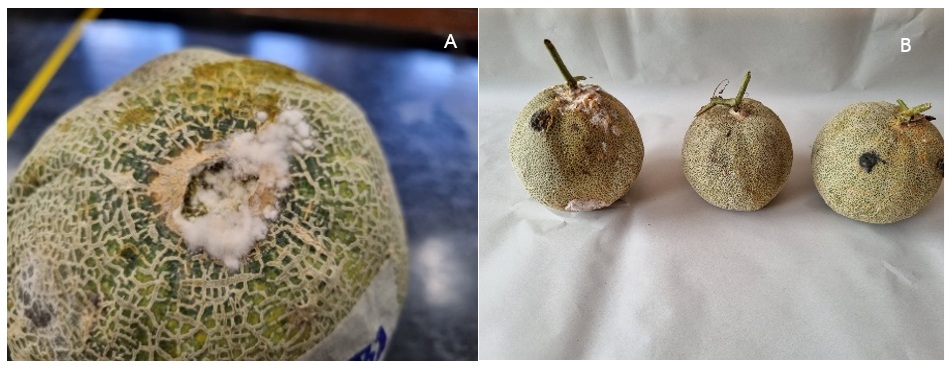
การทดสอบประสิทธิภาพของจุลินทรีย์ปฏิปักษ์ต่อการเจริญเติบโตและคุณภาพผลผลิตของเมล่อน สายพันธุ์โมเมจิ ทำการทดลองในโรงเรือนเมล่อน ณ ศูนย์บริการและพัฒนาลุ่มน้ำปายตามพระราชดำริ (ท่าโป่งแดง) อำเภอเมืองแม่ฮ่องสอน จังหวัดแม่ฮ่องสอน ในช่วงเดือนมีนาคมถึงเดือนสิงหาคม พ.ศ. 2566 วางแผน การทดลองแบบสุ่มสมบูรณ์ (Completely Randomized Design: CRD) แบ่งเป็น 5 กรรมวิธี กรรมวิธีละ 25 ต้น ประกอบด้วย กรรมวิธีที่ 1 ควบคุม (ไม่มีการใช้สาร) กรรมวิธีที่ 2 แช่เมล็ดและพ่นต้นเมล่อนด้วยเมทาแลกซิล กรรมวิธีที่ 3 แช่เมล็ดและพ่นต้นเมล่อนด้วยคาร์เบนดาซิม กรรมวิธีที่ 4 แช่เมล็ดและพ่นต้นเมล่อนด้วย B. subtilis และกรรมวิธีที่ 5 แช่เมล็ดและพ่นต้นเมล่อนด้วย T. asperellum ผลการทดลองพบว่า การใช้จุลินทรีย์ปฏิปักษ์ แบคทีเรีย B. subtilis และเชื้อรา T. asperellum โดยวิธีการแช่เมล็ดและพ่นต้นเมล่อนสายพันธุ์โมเมจิ พบว่าต้นเมล่อนสายพันธุ์โมเมจิ มีการเจริญเติบโตด้านความสูงมากที่สุด คือ 196.75 และ 197.25 เซนติเมตร ตามลำดับ ผลการศึกษาด้านคุณภาพผลผลิตเมล่อน กรรมวิธีที่ใช้เชื้อรา T. asperellum ผลเมล่อนมีปริมาณของแข็งที่ละลายน้ำได้ (ความหวาน) เพิ่มขึ้น มีค่า 11.72 °Brix และมีค่าความแน่นเนื้อสูง 1.68 นิวตัน และกรรมวิธีที่ใช้แบคทีเรีย B. subtilis ผลเมล่อนมีปริมาณไนเตรทสะสมในผลน้อยที่สุด คือ 152.5 มิลลิกรัมต่อกิโลกรัม เมื่อเปรียบเทียบกับกรรมวิธีควบคุม ผลการสำรวจการเกิดโรคผลเน่าของเมล่อน พบอาการของโรคผลเน่า บริเวณรอบ ๆ ขั้วหรือก้านผล และบริเวณก้นผลที่มีรอยแตก พบเส้นใยเชื้อราสีขาวขึ้นฟูบริเวณแผล เมื่อนำเส้นใยมาส่องใต้กล้องจุลทรรศน์พบลักษณะสปอร์ของเชื้อรา Fusarium sp. และผลเมล่อนที่พบเส้นใยสีเทาเข้มขึ้นคลุมทั่วทั้งผลที่เน่า เมื่อแผลขยายจะปรากฏเป็นจุดสีดำเล็ก ๆ (fruiting body) เมื่อนำเส้นใยมาส่องใต้กล้องจุลทรรศน์พบลักษณะสปอร์ของเชื้อรา Lasiodiplodai sp. เมื่อวิเคราะห์ลักษณะทางชีวโมเลกุลโดยการวิเคราะห์สายสัมพันธ์วิวัฒนาการของเชื้อรา สามารถจำแนกสกุลของเชื้อราสาเหตุโรคผลเน่าของเมล่อนได้ 2 สกุล ได้แก่ Fusarium sp. และ Lasiodiplodia sp. เมื่อเปรียบเทียบลำดับ นิวคลีโอไทด์ของตัวอย่างเชื้อราที่ได้กับฐานข้อมูลจาก GenBank โดยจัดเรียงแนวความสัมพันธ์ความใกล้เคียงกัน พบว่าเชื้อราสาเหตุโรคผลเน่าของเมล่อนจำแนกได้เป็นเชื้อรา F. equiseti และเชื้อรา L. theobromae โดยมีค่าความเชื่อมั่น 99%
เอกสารอ้างอิง
Amthong, S., C. Sritontip, K. Pensri and M. Nakdee. 2025. Effect of Antagonistic Microorganisms on the Growth and Yield of Melons cv. Konami Grown in Mae Hong Son Province. Journal of Agricultural Science and Management 8(1): 70–77. [in Thai]
Boonsrinukul, S., S. Wongchaochant, P. Chulaka and T. Sreewongchai. 2016. Evaluation of pickling melon and commercial melon cultivars for resistance to Fusarium oxysporum f. sp. melonis Race 1. Agricultural Science Journal 47(2): 163–173. [in Thai]
Chamswarng, C. 2020. Trichoderma Antagonistic Fungus for Plant Disease Control. Nakhon Pathom: Department of Plant Pathology, Faculty of Agriculture, Kasetsart University, Kamphang Saen Campus. 556 p. [in Thai]
Chaiyawan, N., R. Morakote and J. Roddee. 2019. Seasonal fluctuations of melon insect pests. Khon Kaen Agriculture Journal 47(Suppl. 1): 937–946. [in Thai]
Information System for Agriculture Production. 2019. Report on the situation of Japanese melon in 2019. Retrieved from http://www.agriinfo.doae.go.th/year63/plant/rortor/veget/japanesemelon.pdf [in Thai]
Junda, V., K. Tungkannanuruk and A. Amnuaykanjanasin. 2022. Biological control agent as alternative of chemical insecticides in melon greenhouse. Khon Kaen Agriculture Journal 50(6): 1683–1700. [in Thai]
Naziya. B., M. Murali. and K.N. Amruthesh. 2019. Plant Growth-Promoting Fungi (PGPF) instigate plant growth and induce disease resistance in Capsicum annuum L. upon infection with Colletotrichum capsici (Syd.) Butler & Bisby. Biomolecules 10(1)41: 1–18 https://doi.org/10.3390/biom10010041
Niraphai, K. and E. Chukeatirote. 2009. Biology of Lasiodiplodia spp. Srinakharinwirot Science Journal 25(2): 119–137. [in Thai]
Nuangmek, W., P. Papong and M. Titayavan. 2014. Effect of Trichoderma sp. on growth and disease control of cantaloupe (Cucumis melo) in the field. Khon Kaen Agriculture Journal 42(3): 680–685. [in Thai]
O'Donnell, K., H.C. Kistler, B.K. Tacke, H.H. Casper. 2000. Gene genealogies reveal global phylogeographic structure and reproductive isolation among lineages of Fusarium graminearum, the fungus causing wheat scab. Proc Natl Acad Sci 97(14): 7905–7910. https://doi.org/10.1073/pnas.130193297
Rahman, M.Z, K. Ahmad, Y. Siddiqui, N. Saad, T.G. Hun, E.M. Hata, O. Rashed and M.I. Hossin. 2021. First report of Fusarium equiseti, causing fruit rot disease of watermelon in Malaysia. Plant Disease 106(1): 1–7 https://doi.org/10.1094/PDIS-05-21-1027-PDN
Somrith, A., Y. Chiamchaisri, T. Bhasabutra and S. Seemadua. 2010. Surveying, Collecting and Identification of Plant Pathogenic Fusarium. 20 p. Annual Report. Bangkok: Plant Protection Research and Development Office. [in Thai]
Somtrakoon, K. and W. Chouychai. 2023. Roles of plant promoting bacteria on plant growth under drought stress. Journal of Agricultural Research and Extension 40(2): 24–36. [in Thai]
Thianchai, P. 2020. Control of Fusarium Wilt in Melon by Endophytic Fungi in Combination with Soil Conditioner. Master Thesis. Phayao University. 114 p. [in Thai]
Wonglom, P. and A. Sunpapao. 2020. Fusarium incarnatum is associated with postharvest fruit rot of muskmelon (Cucumis melo). Journal of Phytopathology 168(1): 204–210. https://doi.org/10.1111/jph.12882
Wonglom, P., W. Daengsuwan and A. Sunpapao. 2020. Occurrence and disease incidence of muskmelon disease cultivated in polyhouse system in southern Thailand. Khon Kaen Agriculture Journal 48(Suppl. 1): 1165–1172. [in Thai]
Yenjit, P., T. Deathoup and W. Intana. 2018. The combination application of Trichoderma sp. and Bacillus sp. powders to dirty panicle disease caused by Bipolaris oryzae in rice. Agricultural Science Journal 49(1): 15–26. [in Thai]
ดาวน์โหลด
เผยแพร่แล้ว
รูปแบบการอ้างอิง
ฉบับ
ประเภทบทความ
สัญญาอนุญาต
ลิขสิทธิ์ (c) 2026 วารสารวิจัยและส่งเสริมวิชาการเกษตร

อนุญาตภายใต้เงื่อนไข Creative Commons Attribution-NonCommercial-NoDerivatives 4.0 International License.
บทความนี้ได้รับการเผยแพร่ภายใต้สัญญาอนุญาต Creative Commons Attribution-NonCommercial-NoDerivatives 4.0 International (CC BY-NC-ND 4.0) ซึ่งอนุญาตให้ผู้อื่นสามารถแชร์บทความได้โดยให้เครดิตผู้เขียนและห้ามนำไปใช้เพื่อการค้าหรือดัดแปลง หากต้องการใช้งานซ้ำในลักษณะอื่น ๆ หรือการเผยแพร่ซ้ำ จำเป็นต้องได้รับอนุญาตจากวารสาร