
Impact of Antagonistic Microorganisms on the Growth, Fruit Quality and Identification of Fungal Diseases in Greenhouse-Grown Melons cv. Momeji
DOI:
https://doi.org/10.14456/jare-mju.2026.28Keywords:
melon, biological control, growth promotion, Trichoderma asperellum, Bacillus subtilisAbstract
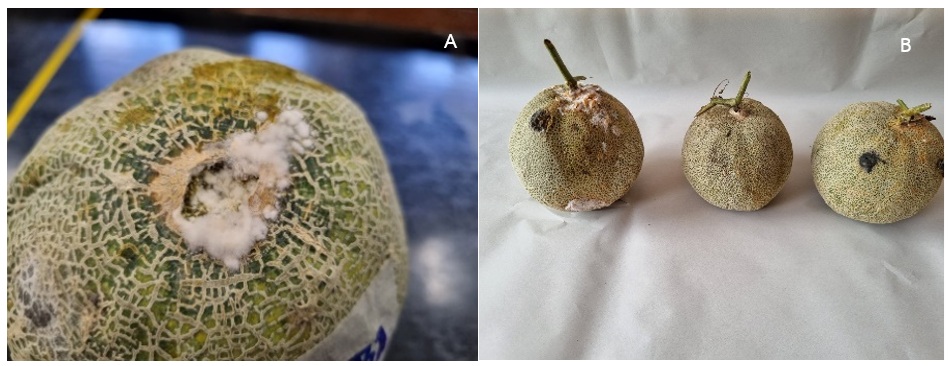
This study assessed the impact of antagonistic microorganisms on the growth and yield of melon cv. Momeji in a greenhouse located at the Watershed Royal Service and Development Center, Tha Pong Daeng, Mueang Mae Hong Son district, Mae Hong Son province, from March to August 2023. The experiment was arranged in a Completely Randomized Design (CRD) with five treatments, each consisting of 25 plants as follows: Treatment 1: control (no treatment); Treatment 2: soaking seeds and spraying melon plants with metalaxyl; Treatment 3: soaking seeds and spraying melon plants with carbendazim; Treatment4: soaking seeds and spraying melon plants with Bacillus subtilis; and Treatment 5: soaking seeds and spraying melon plants with Trichoderma asperellum. The results showed that treatments with antagonistic microorganisms, B. subtilis and T. asperellum, resulted in the greatest plant heights of 196.75 and 197.25 cm, respectively. In terms of yield, T. asperellum treatment significantly increased total soluble solids (sweetness) to 11.72 °Brix and improved flesh firmness to 1.68 N. Additionally, the B. subtilis treatment reduced nitrate accumulation in the fruit to the lowest level of 152.5 mg kg-1 compared to the control treatment. Melon fruit rot disease was observed, with symptoms appearing around the stem, calyx, and bottom of the fruit as cracks. White fungal mycelium was found covering the wounds, and microscopic examination revealed spore characteristics typical of Fusarium sp. Additionally, in severely affected melons, gray fungal mycelium was observed covering the decayed fruit, with small black fruiting bodies appearing as the lesions expanded. Microscopic analysis confirmed the presence of spore characteristics of Lasiodiplodia sp. Molecular identification using phylogenetic analysis of the fungal isolates revealed 2 pathogens associated with melon fruit rot: Fusarium sp. and Lasiodiplodia sp. Sequence alignment with the GenBank database further identified these pathogens as Fusarium equiseti and Lasiodiplodia theobromae with 99% confidence.
References
Amthong, S., C. Sritontip, K. Pensri and M. Nakdee. 2025. Effect of Antagonistic Microorganisms on the Growth and Yield of Melons cv. Konami Grown in Mae Hong Son Province. Journal of Agricultural Science and Management 8(1): 70–77. [in Thai]
Boonsrinukul, S., S. Wongchaochant, P. Chulaka and T. Sreewongchai. 2016. Evaluation of pickling melon and commercial melon cultivars for resistance to Fusarium oxysporum f. sp. melonis Race 1. Agricultural Science Journal 47(2): 163–173. [in Thai]
Chamswarng, C. 2020. Trichoderma Antagonistic Fungus for Plant Disease Control. Nakhon Pathom: Department of Plant Pathology, Faculty of Agriculture, Kasetsart University, Kamphang Saen Campus. 556 p. [in Thai]
Chaiyawan, N., R. Morakote and J. Roddee. 2019. Seasonal fluctuations of melon insect pests. Khon Kaen Agriculture Journal 47(Suppl. 1): 937–946. [in Thai]
Information System for Agriculture Production. 2019. Report on the situation of Japanese melon in 2019. Retrieved from http://www.agriinfo.doae.go.th/year63/plant/rortor/veget/japanesemelon.pdf [in Thai]
Junda, V., K. Tungkannanuruk and A. Amnuaykanjanasin. 2022. Biological control agent as alternative of chemical insecticides in melon greenhouse. Khon Kaen Agriculture Journal 50(6): 1683–1700. [in Thai]
Naziya. B., M. Murali. and K.N. Amruthesh. 2019. Plant Growth-Promoting Fungi (PGPF) instigate plant growth and induce disease resistance in Capsicum annuum L. upon infection with Colletotrichum capsici (Syd.) Butler & Bisby. Biomolecules 10(1)41: 1–18 https://doi.org/10.3390/biom10010041
Niraphai, K. and E. Chukeatirote. 2009. Biology of Lasiodiplodia spp. Srinakharinwirot Science Journal 25(2): 119–137. [in Thai]
Nuangmek, W., P. Papong and M. Titayavan. 2014. Effect of Trichoderma sp. on growth and disease control of cantaloupe (Cucumis melo) in the field. Khon Kaen Agriculture Journal 42(3): 680–685. [in Thai]
O'Donnell, K., H.C. Kistler, B.K. Tacke, H.H. Casper. 2000. Gene genealogies reveal global phylogeographic structure and reproductive isolation among lineages of Fusarium graminearum, the fungus causing wheat scab. Proc Natl Acad Sci 97(14): 7905–7910. https://doi.org/10.1073/pnas.130193297
Rahman, M.Z, K. Ahmad, Y. Siddiqui, N. Saad, T.G. Hun, E.M. Hata, O. Rashed and M.I. Hossin. 2021. First report of Fusarium equiseti, causing fruit rot disease of watermelon in Malaysia. Plant Disease 106(1): 1–7 https://doi.org/10.1094/PDIS-05-21-1027-PDN
Somrith, A., Y. Chiamchaisri, T. Bhasabutra and S. Seemadua. 2010. Surveying, Collecting and Identification of Plant Pathogenic Fusarium. 20 p. Annual Report. Bangkok: Plant Protection Research and Development Office. [in Thai]
Somtrakoon, K. and W. Chouychai. 2023. Roles of plant promoting bacteria on plant growth under drought stress. Journal of Agricultural Research and Extension 40(2): 24–36. [in Thai]
Thianchai, P. 2020. Control of Fusarium Wilt in Melon by Endophytic Fungi in Combination with Soil Conditioner. Master Thesis. Phayao University. 114 p. [in Thai]
Wonglom, P. and A. Sunpapao. 2020. Fusarium incarnatum is associated with postharvest fruit rot of muskmelon (Cucumis melo). Journal of Phytopathology 168(1): 204–210. https://doi.org/10.1111/jph.12882
Wonglom, P., W. Daengsuwan and A. Sunpapao. 2020. Occurrence and disease incidence of muskmelon disease cultivated in polyhouse system in southern Thailand. Khon Kaen Agriculture Journal 48(Suppl. 1): 1165–1172. [in Thai]
Yenjit, P., T. Deathoup and W. Intana. 2018. The combination application of Trichoderma sp. and Bacillus sp. powders to dirty panicle disease caused by Bipolaris oryzae in rice. Agricultural Science Journal 49(1): 15–26. [in Thai]
Downloads
Published
How to Cite
Issue
Section
License
Copyright (c) 2026 Journal of Agricultural Research and Extension

This work is licensed under a Creative Commons Attribution-NonCommercial-NoDerivatives 4.0 International License.
This article is published under a Creative Commons Attribution-NonCommercial-NoDerivatives 4.0 International License (CC BY-NC-ND 4.0), which allows others to share the article with proper attribution to the authors and prohibits commercial use or modification. For any other reuse or republication, permission from the journal and the authors is required.


