ความท้าทายและโอกาสของการพัฒนาผู้ให้บริการโดรนกำจัดแมลงศัตรูมะพร้าว ในจังหวัดสมุทรสงคราม
DOI:
https://doi.org/10.14456/jare-mju.2026.39คำสำคัญ:
โดรนเกษตร, ผู้ให้บริการโดรน, ศัตรูมะพร้าวบทคัดย่อ
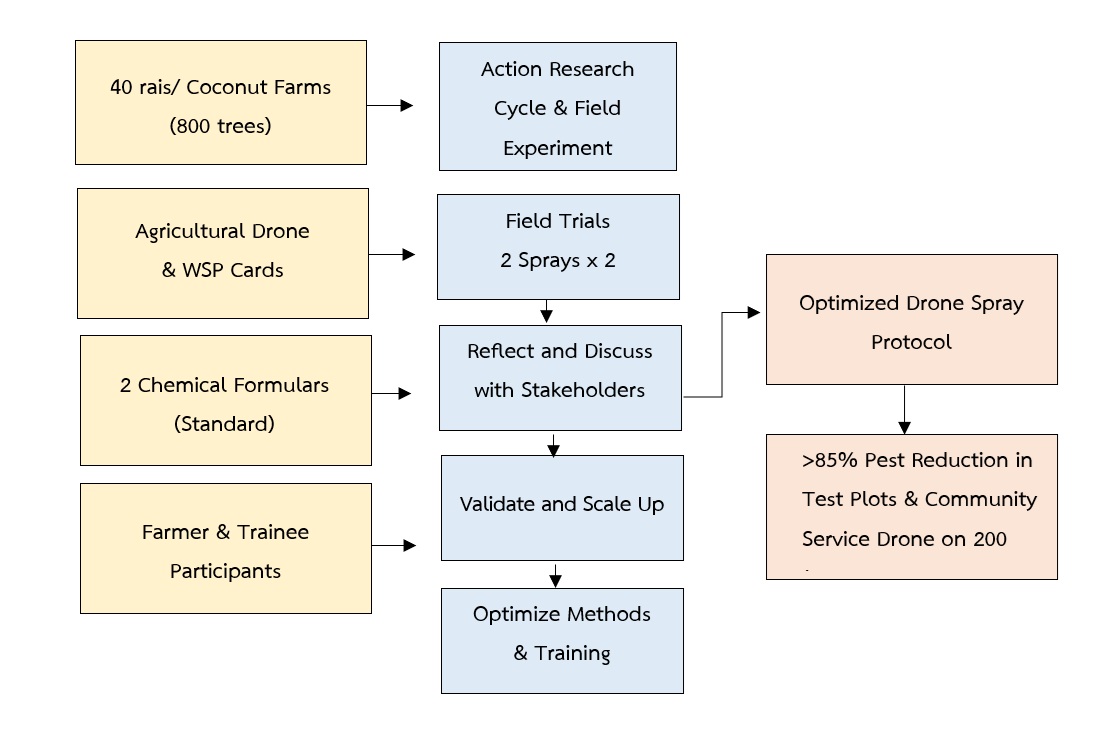
การวิจัยนี้มีวัตถุประสงค์เพื่อศึกษาการประยุกต์ใช้สารเคมีกำจัดแมลงศัตรูมะพร้าวที่เหมาะสมกับการใช้โดรนเกษตรในสภาพพื้นที่จริง และถ่ายทอดองค์ความรู้เพื่อพัฒนาศักยภาพสถาบันการศึกษาและเกษตรกรไปสู่การเป็นผู้ให้บริการโดรนกำจัดแมลงศัตรูมะพร้าวในจังหวัดสมุทรสงคราม งานวิจัยนี้ใช้แนวทาง การวิจัยเชิงปฏิบัติการในพื้นที่ เพื่อทดสอบการใช้โดรนการเกษตรสำหรับการฉีดพ่นสารเคมี เปรียบเทียบกับการฉีดพ่นแบบใช้แรงงานคนตามวิธีการดั้งเดิม ในสวนมะพร้าวจำนวน 2 แปลง ครอบคลุมพื้นที่รวม 40 ไร่ (ประมาณ 800 ต้น) ใช้โดรนเกษตรแบบพ่นละอองฝอยควบคุมความสูงเฉลี่ย 2 เมตร และเวลาพ่น 8 วินาทีต่อต้น ทดสอบสารเคมี 2 สูตร ได้แก่ สูตรลูเฟนนูรอน (Lufenuron) ร่วมกับสารจับใบ และสูตรฟลูเบนไดอไมด์ (Flubendiamide) ร่วมกับสารจับใบ โดยฉีดพ่น 2 ครั้ง ห่างกัน 7 วัน และติดตามผลที่ 15, 30 และ 60 วัน หลังจากฉีดพ่นครั้งแรก
ผลการวิจัยพบว่าสารเคมีทั้งสองสูตรเมื่อใช้ร่วมกับโดรนสามารถลดการระบาดของหนอนหัวดำได้มากกว่าร้อยละ 85 ภายใน 60 วัน พร้อมทั้งทำให้ต้นมะพร้าวฟื้นตัวชัดเจนจากการแตกยอดใหม่และการเพิ่มความเขียวของใบ การประเมินการกระจายละอองด้วยกระดาษไวต่อน้ำ ยืนยันว่าการพ่นสามารถครอบคลุม เรือนยอดได้ทุกระดับ สนับสนุนความน่าเชื่อถือของผล เชิงชีวภาพ ด้านการขยายผลโครงการได้จัดกิจกรรมถ่ายทอดองค์ความรู้ด้านการใช้สารเคมีอย่างปลอดภัยและการบินโดรน ส่งผลให้เกิดบุคลากรต้นแบบและความพร้อมในการพัฒนาผู้ให้บริการโดรนเกษตร อย่างไรก็ตาม ยังพบอุปสรรคด้านต้นทุนเริ่มต้น ต้นทุนแฝงการซ่อมบำรุง และระบบบริการหลังการขายในพื้นที่ จึงเสนอให้จัดทำต้นทุนมาตรฐานและเสริมระบบสนับสนุนเพื่อเพิ่มความยั่งยืนของการให้บริการโดรนระดับชุมชน
เอกสารอ้างอิง
Agricultural Research Development Agency (Public Organization). 2022. Role of new-generation farmers in building national economic security. Retrieved from https://www.arda.or.th/detail/6179 [in Thai]
Amporn, W. 2014. Integrated pest management of important insect pests of coconut. Coconut Research & Development Journal 30(2): 18–36.
Anderson, K. and K.J. Gaston. 2013. Lightweight unmanned aerial vehicles will revolutionize spatial ecology. Frontiers in Ecology and the Environment 11(3): 138–146. https://doi.org/10.1890/120150
Charoenwikkai, P. 2023. Factors for Acceptance of Drone Technology for Spraying Herbicides in Sugarcane Fields, Lan Krabue District, Kamphaeng Phet Province. Master Thesis. Naresuan University. 57 p. [in Thai]
Daoden, K., T. Sornnen, T. Pankasemsuk, P. Phaphuangwittayakal, S. Sringam, and S. Nicrotha. 2021. Development of agricultural spraying drones prototype for coconut beetle weevil control. Natural Volatiles & Essential Oils 8(5): 8322–8322.
Ministry of Agriculture and Cooperatives. 2025. Report on coconut black-headed caterpillar outbreak monitoring in Samut Songkhram province. Retrieved from https://www.moac.go.th/moaceng-news-preview-471891792209
Pandiselvam, R., Daliyamol, S. Syed Imran, V. Hegde, M. Sujithra, P.S Prathibha, V.H. Prathibha and K.B. Hebbar. 2024. Evaluation of unmanned aerial vehicle for effective spraying application in coconut plantations. Heliyon 10(19): 1–10. https://doi.org/10.1016/j.heliyon.2024.e38569
Plant Protection Research and Development Office, Department of Agriculture. 2017. Technical Document: Management of Coconut Pests. Bangkok: 91 p. In Research Report. Bangkok. Plant Protection Research and Development Office, Department of Agriculture, Ministry of Agriculture and Cooperatives. [in Thai]
Secretariat of the House of Representatives. 2022. Analytical report on the application of drones in Thai agriculture. Retrieved from https://library.parliament.go.th/th/radioscript/rr2565-mar4?utm_source =chatgpt.com
Setthamani, T. 2022. Factors Influencing the Adoptation of Drones for Rice Farming among Large-scale Rice Farmers in Pathum Thani Province. Master Thesis. Thammasat University. 112 p. [in Thai]
Yallappa, D., R. Kavitha, A. Surendrakumar, B. Suthakar, A.P. Mohan Kumar, M.K. Kalarani and B. Kannan. 2023. Effect of downwash airflow distribution of multi-rotor unmanned aerial vehicle on spray droplet deposition characteristics in rice crop. ResearchGate 125(2): 172–182. https://doi.org/10.18520/cs/v125/i2/172-182
ดาวน์โหลด
เผยแพร่แล้ว
รูปแบบการอ้างอิง
ฉบับ
ประเภทบทความ
สัญญาอนุญาต
ลิขสิทธิ์ (c) 2026 วารสารวิจัยและส่งเสริมวิชาการเกษตร

อนุญาตภายใต้เงื่อนไข Creative Commons Attribution-NonCommercial-NoDerivatives 4.0 International License.
บทความนี้ได้รับการเผยแพร่ภายใต้สัญญาอนุญาต Creative Commons Attribution-NonCommercial-NoDerivatives 4.0 International (CC BY-NC-ND 4.0) ซึ่งอนุญาตให้ผู้อื่นสามารถแชร์บทความได้โดยให้เครดิตผู้เขียนและห้ามนำไปใช้เพื่อการค้าหรือดัดแปลง หากต้องการใช้งานซ้ำในลักษณะอื่น ๆ หรือการเผยแพร่ซ้ำ จำเป็นต้องได้รับอนุญาตจากวารสาร