Challenges and Opportunities in Developing Drone-Based Pest Control Service Providers for Coconut Plantations in Samut Songkhram Province
DOI:
https://doi.org/10.14456/jare-mju.2026.39Keywords:
agricultural drones, drone service providers, coconut pestsAbstract
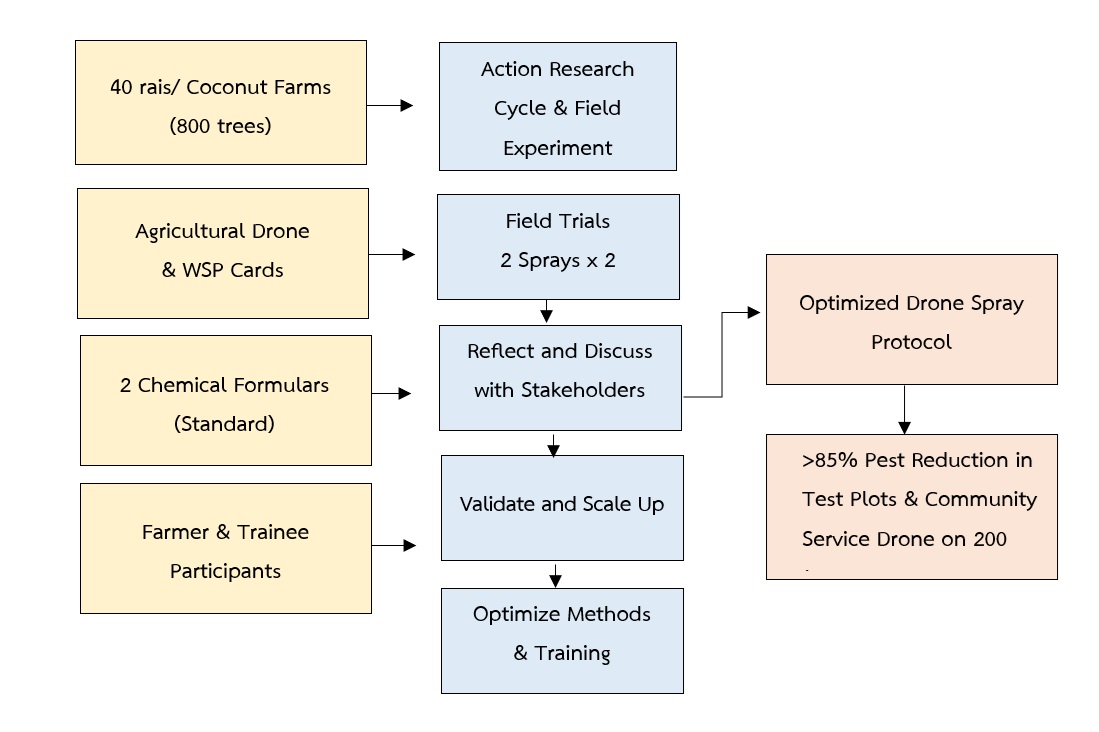
This study investigated the application of chemical formulations suitable for agricultural drones to control coconut pests under real field conditions and to transfer knowledge for developing drone-based pest control service providers in Samut Songkhram Province. An area-based action research approach was conducted to pilot the use of agricultural drones for chemical spraying, compared with conventional manual spraying, in two coconut plantations covering 40 rai (approximately 800 trees). A mist-spraying agricultural drone was operated at a height of 2 meters with a spraying duration of 8 seconds per tree. Two chemical formulations, lufenuron and flubendiamide (each with an adjuvant), were applied twice at 7-day intervals, with monitoring at 15, 30, and 60 days after first application.
The results showed that both formulations reduced black-headed caterpillar infestation by more than 85% within 60 days and promoted clear tree recovery, including new shoot emergence and increased leaf greenness. Water-sensitive paper analysis confirmed effective spray coverage across all canopy levels. Knowledge transfer activities on safe chemical use and drone operation supported the development of model operators and readiness for drone service providers. However, challenges related to high initial investment, hidden maintenance costs, and limited local after-sales services remain. The study recommends establishing standardized cost frameworks and strengthening support systems to ensure the long-term sustainability of community-based agricultural drone services.
References
Agricultural Research Development Agency (Public Organization). 2022. Role of new-generation farmers in building national economic security. Retrieved from https://www.arda.or.th/detail/6179 [in Thai]
Amporn, W. 2014. Integrated pest management of important insect pests of coconut. Coconut Research & Development Journal 30(2): 18–36.
Anderson, K. and K.J. Gaston. 2013. Lightweight unmanned aerial vehicles will revolutionize spatial ecology. Frontiers in Ecology and the Environment 11(3): 138–146. https://doi.org/10.1890/120150
Charoenwikkai, P. 2023. Factors for Acceptance of Drone Technology for Spraying Herbicides in Sugarcane Fields, Lan Krabue District, Kamphaeng Phet Province. Master Thesis. Naresuan University. 57 p. [in Thai]
Daoden, K., T. Sornnen, T. Pankasemsuk, P. Phaphuangwittayakal, S. Sringam, and S. Nicrotha. 2021. Development of agricultural spraying drones prototype for coconut beetle weevil control. Natural Volatiles & Essential Oils 8(5): 8322–8322.
Ministry of Agriculture and Cooperatives. 2025. Report on coconut black-headed caterpillar outbreak monitoring in Samut Songkhram province. Retrieved from https://www.moac.go.th/moaceng-news-preview-471891792209
Pandiselvam, R., Daliyamol, S. Syed Imran, V. Hegde, M. Sujithra, P.S Prathibha, V.H. Prathibha and K.B. Hebbar. 2024. Evaluation of unmanned aerial vehicle for effective spraying application in coconut plantations. Heliyon 10(19): 1–10. https://doi.org/10.1016/j.heliyon.2024.e38569
Plant Protection Research and Development Office, Department of Agriculture. 2017. Technical Document: Management of Coconut Pests. Bangkok: 91 p. In Research Report. Bangkok. Plant Protection Research and Development Office, Department of Agriculture, Ministry of Agriculture and Cooperatives. [in Thai]
Secretariat of the House of Representatives. 2022. Analytical report on the application of drones in Thai agriculture. Retrieved from https://library.parliament.go.th/th/radioscript/rr2565-mar4?utm_source =chatgpt.com
Setthamani, T. 2022. Factors Influencing the Adoptation of Drones for Rice Farming among Large-scale Rice Farmers in Pathum Thani Province. Master Thesis. Thammasat University. 112 p. [in Thai]
Yallappa, D., R. Kavitha, A. Surendrakumar, B. Suthakar, A.P. Mohan Kumar, M.K. Kalarani and B. Kannan. 2023. Effect of downwash airflow distribution of multi-rotor unmanned aerial vehicle on spray droplet deposition characteristics in rice crop. ResearchGate 125(2): 172–182. https://doi.org/10.18520/cs/v125/i2/172-182
Downloads
Published
How to Cite
Issue
Section
License
Copyright (c) 2026 Journal of Agricultural Research and Extension

This work is licensed under a Creative Commons Attribution-NonCommercial-NoDerivatives 4.0 International License.
This article is published under a Creative Commons Attribution-NonCommercial-NoDerivatives 4.0 International License (CC BY-NC-ND 4.0), which allows others to share the article with proper attribution to the authors and prohibits commercial use or modification. For any other reuse or republication, permission from the journal and the authors is required.


